
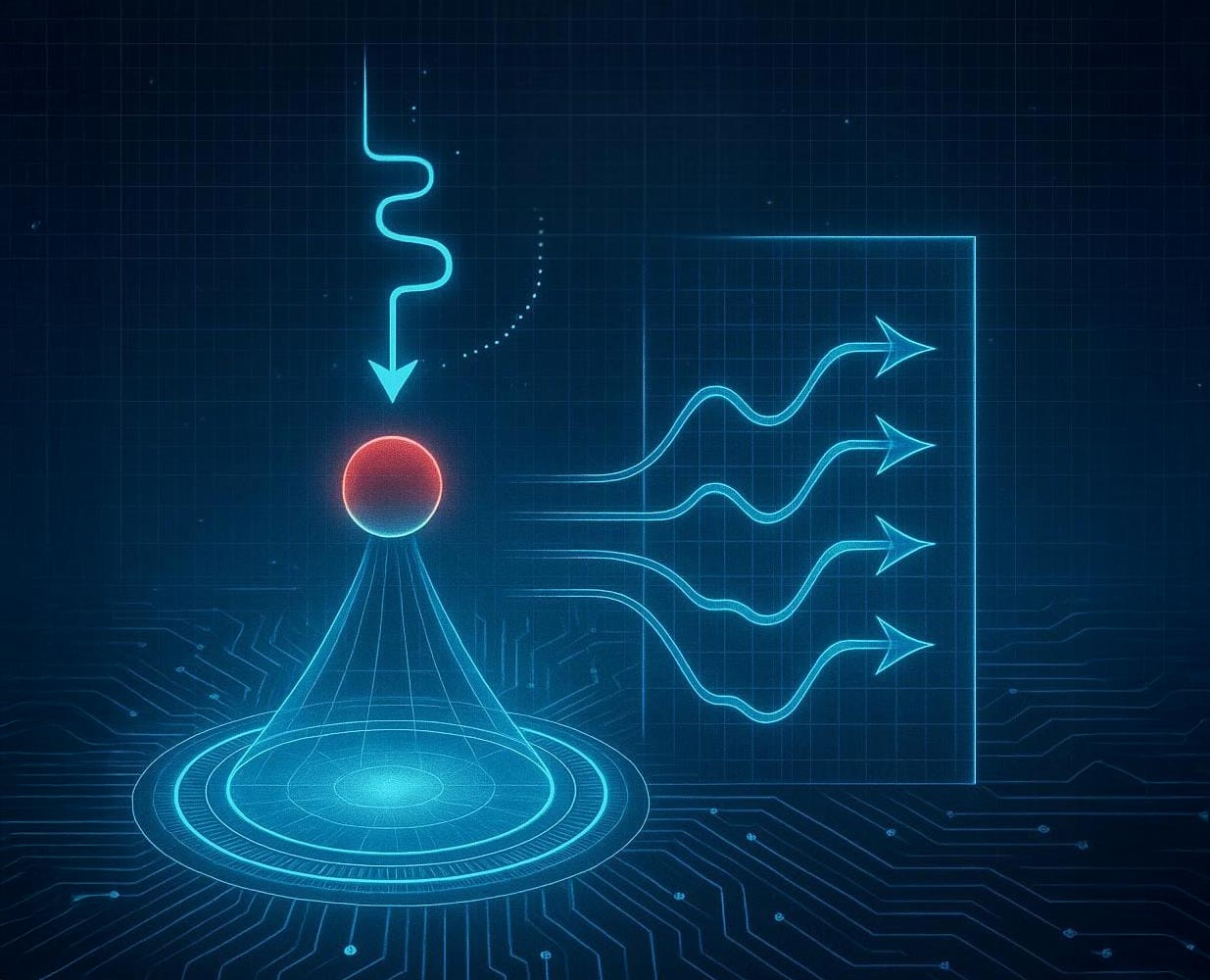
Scientists have discovered a clever new way to control the light emitted by quantum dots — tiny crystals that can release individual photons.
The advance could lead to faster, cheaper, and more practical quantum technologies, from ultra-secure communication systems to experiments that explore the strange foundations of quantum physics.
The Challenge of Single-Photon Sources
Quantum dots are tiny semiconductor structures capable of releasing single photons on demand, making them strong candidates for future photonic quantum computers. The difficulty is that no two quantum dots are exactly the same, and each can emit light at slightly different colors. This variation prevents researchers from combining multiple dots to create multi-photon states.
To work around this, scientists typically rely on a single quantum dot and then split its light into different spatial and temporal modes with the help of a fast electro-optic modulator. The drawback is that these modulators are costly, often require highly customized designs, and can be inefficient, leading to energy losses within the system.
An Elegant Optical Solution Emerges
A research collaboration led by Vikas Remesh of the Photonics Group at the Department of Experimental Physics, University of Innsbruck, together with partners from the University of Cambridge, Johannes Kepler University Linz, and other institutions, has now demonstrated a way to bypass these challenges. Their method relies on a fully optical process known as stimulated two-photon excitation. This technique allows quantum dots to emit streams of photons in distinct polarization states without the need for electronic switching hardware.
In tests, the researchers successfully produced high-quality two-photon states while maintaining excellent single-photon characteristics.
How the Technique Works in Practice
“The method works by first exciting the quantum dot with precisely timed laser pulses to create a biexciton state, followed by polarization-controlled stimulation pulses that deterministically trigger photon emission in the desired polarization,” explain Yusuf Karli and Iker Avila Arenas, the study’s first authors.
“It was a fantastic experience for me to work in the photonics group for my master’s thesis, remembers Iker Avila Arenas, who was part of 2022-2024 cohort of the Erasmus Mundus Joint Master’s program in Photonics for Security Reliability and Safety and spent 6 months in Innsbruck.
Moving Complexity to the Optical Stage
“What makes this approach particularly elegant is that we have moved the complexity from expensive, loss-inducing electronic components after the single photon emission to the optical excitation stage, and it is a significant step forward in making quantum dot sources more practical for real-world applications,” notes Vikas Remesh, the study’s lead researcher.
Looking ahead, the researchers envision extending the technique to generate photons with arbitrary linear polarization states using specially engineered quantum dots.
Real-World Quantum Applications
“The study has immediate applications in secure quantum key distribution protocols, where multiple independent photon streams can enable simultaneous secure communication with different parties, and in multi-photon interference experiments which are very important to test even the fundamental principles of quantum mechanics,” explains Gregor Weihs, head of the photonics research group in Innsbruck.
The research, published in npj Quantum Information, represents a collaborative effort involving expertise in quantum optics, semiconductor physics, and photonic engineering.
Reference: “Passive demultiplexed two-photon state generation from a quantum dot” by Yusuf Karli, Iker Avila Arenas, Christian Schimpf, Ailton Jose Garcia Junior, Santanu Manna, Florian Kappe, René Schwarz, Gabriel Undeutsch, Maximilian Aigner, Melina Peter, Saimon F. Covre da Silva, Armando Rastelli, Gregor Weihs and Vikas Remesh, 11 August 2025, npj Quantum Information.
DOI: 10.1038/s41534-025-01083-0
The work was supported by the Austrian Science Fund (FWF), the Austrian Research Promotion Agency (FFG), and the European Union’s research programs.
Never miss a breakthrough: Join the SciTechDaily newsletter.
Follow us on Google and Google News.
3 Comments
This new generation RS capitalize
2,000 billion data console/second
Aha! I didn’t read the article. But it’s connected to what I said about introducing more states! 😁 that can be measured. 😁😁🙂↔️🙂↔️👍
ionq and regetti shares.
I’m thinking could sky rocket if this pay off in quantum computer