

Researchers have pioneered the design and manipulation of photonic orbitals through specific material arrangements, leading to potential advancements in optical technologies and quantum computing.
In their recent paper, scientists from the University of Twente in the Netherlands have gained important insights into the elementary particles that make up light. These particles, photons, ‘behave’ in an amazingly greater variety than electrons surrounding atoms, while also being much easier to control. These new insights have broad applications from smart LED lighting to new photonic bits of information controlled with quantum circuits, to sensitive nano-sensors.
Understanding Electron and Photon Orbitals
In atoms, minuscule elementary particles called electrons occupy regions around the nucleus in shapes called orbitals. These orbitals give the probability of finding an electron in a particular region of space. Quantum mechanics determines the shape and energy of these orbitals. Similarly to electrons, researchers describe the region of space where a photon is most likely found with orbitals too.
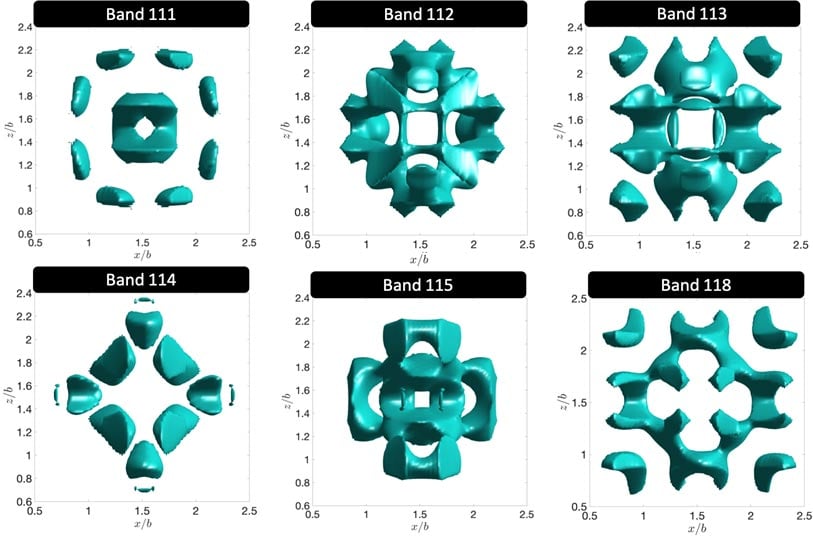
‘Whatever Wild Shape You Design’
Researchers at the University of Twente studied these photonic orbitals and discovered with careful design of specific materials, they can create and control these orbitals with a great variety of shapes and symmetries. These results have potential applications in advanced optical technologies and quantum computing.
First author Kozon explains: “In textbook chemistry, the electrons always orbit around the tiny atomic core at the center of the orbital. So an electron orbital’s shape cannot deviate much from a perfect sphere. With photons, the orbitals can have whatever wild shape you design by combining different optical materials in designed spatial arrangements.”
Photonic Orbital Design Through Computational Studies
The researchers conducted a computational study to understand how photons behave when they are confined in a specific 3D nanostructure consisting of tiny pores (a photonic crystal). These cavities are intentionally designed to have defects, creating a superstructure that isolates the photonic states from the surrounding environment.
Physicists Vos and Lagendijk enthuse: “Given the rich toolbox in nanotechnology, it is much easier to design nifty nanostructures with novel photonic orbitals than it is to modify atoms to realize novel electronic orbitals and chemistry.”
The Impact of Nanostructure Design in Photonics
Photonic orbitals are important for developing advanced optical technologies, such as efficient lighting, quantum computing, and sensitive photonic sensors.
The researchers also studied how these nanostructures enhance the local density of optical states, which is important for applications in cavity quantum electrodynamics. They found that structures with smaller defects reveal greater enhancement than those with larger defects. This makes them more suitable for integrating quantum dots and creating networks of single photons.
Reference: “Symmetries and wave functions of photons confined in three-dimensional photonic band gap superlattices” by Marek Kozoň, Ad Lagendijk, Matthias Schlottbom, Jaap J. W. van der Vegt and Willem L. Vos, 20 June 2024, Physical Review B.
DOI: 10.1103/PhysRevB.109.235141
The research was done by Marek Kozoň, Ad Lagendijk, Matthias Schlottbom, Jaap van der Vegt and Willem Vos from the University of Twente. Marek is a theoretical physicist who recently graduated from the COPS and MACS chairs (now with Pixel Photonics GmbH, a single photon detector company in Germany), Matthias and Jaap are professors of MACS, and Ad and Willem are professors of COPS.
The work is supported by the NWO-CSER program, project “Understanding the absorption of interfering light for improved solar cell efficiency” under the Project No. 680.93.14CSER035; the NWO-JCER program, project “Accurate and Efficient Computation of the Optical Properties of Nanostructures for Improved Photovoltaics” under the Project No. 680-91-084; the NWO-GROOT program, project “Self-Assembled Icosahedral Photonic Quasicrystals with a Band Gap for Visible Light” under the Project No. OCENW.GROOT.2019.071; the NWO-TTW Perspectief program P15-36 “Free-Form Scattering Optics” (FFSO); and the MESA+ Institute for Nanotechnology, section Applied Nanophotonics (ANP).
Never miss a breakthrough: Join the SciTechDaily newsletter.
Follow us on Google and Google News.
1 Comment
Transforming Light: How Novel Photonic Shapes Advance Optical Technologies
VERY GOOD!
Please ask researchers to think deeply:
1. What is the natural essence of photons?
2. What is the spatiotemporal background formed by photons?
Scientific research guided by correct theories can help humanity avoid detours, failures, and pomposity. Please witness the exemplary collaboration between theoretical physicists and experimentalists (https://scitechdaily.com/microscope-spacecrafts-most-precise-test-of-key-component-of-the-theory-of-general-relativity/#comment-854286). Some people in contemporary physics has always lived in a self righteous children’s story world. Whose values have been overturned by such a comical and ridiculous reality?
From Physical Review Letters (PRL), to Nature, and Science, even the Proceedings of the National Academy of Sciences (PNAS), the so-called academic journals firmly believe that two high-dimensional spacetime objects (such as two sets of cobalt-60) rotating in opposite directions can be transformed into two objects that mirror each other, and that the asymmetry between the amount of created matter and antimatter led to the matter-dominated Universe as we know it today.
Does the facts tell the so-called academic journals that two sets of cobalt-60 rotating in opposite directions can be transformed into two objects that mirror each other? Does mathematics tell the so-called academic journals that matter and antimatter are asymmetric?
When physics no longer believes in facts and mathematics, it is no different from theology.
Space has physical properties of zero viscosity and absolute incompressibility. Zero viscosity and absolute incompressibility are physical characteristics of ideal fluids. The space with ideal fluid physical characteristics forms vortices via topological phase transitions, which is not difficult to understand mathematically. Once the topological vortex is formed, it occupies space and maintains its presence in time. This is the transition from chaos to order via two bidirectional coupled continuous chaotic systems.
Symmetry of topological vortex can be used to explore particle behavior under spatial, temporal, and quantum reversals, involving quantum gravity, discrete and continuous changes. It underpins the consistency of natural laws and experiment reproducibility.
The so-called academic publications (such as Physical Review Letters, Nature, Science, the Proceedings of the National Academy of Sciences, etc.) blatantly humiliate public wisdom, and have degenerated into malignant tumors that hinder scientific development and progress. Isn’t this a shame in today’s academic community?
If the researcher is interested, you can browse https://scitechdaily.com/microscope-spacecrafts-most-precise-test-of-key-component-of-the-theory-of-general-relativity/#comment-775504.
Science must understand natural laws via mathematical rules. Author hope researchers are not fooled by the pseudoscientific theories of the Physical Review Letters (PRL), and hope more people dare to stand up and fight against rampant pseudoscience.