
Researchers have discovered that superconducting nanowire photon detectors (SNSPDs), originally designed for detecting photons, can also accurately detect high-energy protons.
This unexpected finding could transform nuclear physics, enabling ultra-sensitive measurements in extreme environments.
A Groundbreaking Breakthrough at Fermilab
Particle detectors are essential tools for studying the fundamental components of the universe. They help scientists analyze the behavior and properties of particles created in high-energy collisions. In these experiments, particles are accelerated to nearly the speed of light and then smashed into targets or other particles. Detectors capture and measure the results, revealing valuable insights. However, traditional detectors often lack the sensitivity and precision needed for certain types of research.
Recently, researchers at the U.S. Department of Energy’s (DOE) Argonne National Laboratory achieved a major breakthrough in high-energy particle detection. Their experiments, conducted at the Test Beam Facility at DOE’s Fermi National Accelerator Laboratory (Fermilab), have opened new possibilities for more precise and effective particle detection.
“This was a first-of-its-kind use of the technology. This step was critical to demonstrate that the technology works the way we want it to because it is typically geared toward photons. It was a key demonstration for future high-impact applications.” — Whitney Armstrong, Argonne physicist
Revolutionizing Photon Sensors for Particle Detection
They have found a new use for the superconducting nanowire photon detectors (SNSPDs) already employed for detecting photons, the fundamental particles of light. These incredibly sensitive and precise detectors work by absorbing individual photons. The absorption generates small electrical changes in the superconducting nanowires at very low temperatures, allowing for the detection and measurement of photons. Specialized devices able to detect individual photons are crucial for quantum cryptography (the science of keeping information secret and secure), advanced optical sensing (precision measurement using light), and quantum computing.
From Photons to Protons: A Surprising Discovery
In this study, the research team discovered that these photon sensors could potentially also function as highly accurate particle detectors, specifically for high-energy protons used as projectiles in particle accelerators. Found in the atomic nucleus of every element, the proton is a particle with a positive electrical charge.
The team’s breakthrough opens up exciting opportunities in the field of nuclear and particle physics.
“This was a first-of-its-kind use of the technology,” said Argonne physicist Whitney Armstrong. “This step was critical to demonstrate that the technology works the way we want it to because it is typically geared toward photons. It was a key demonstration for future high-impact applications.”
Testing the Limits: High-Energy Protons at Fermilab
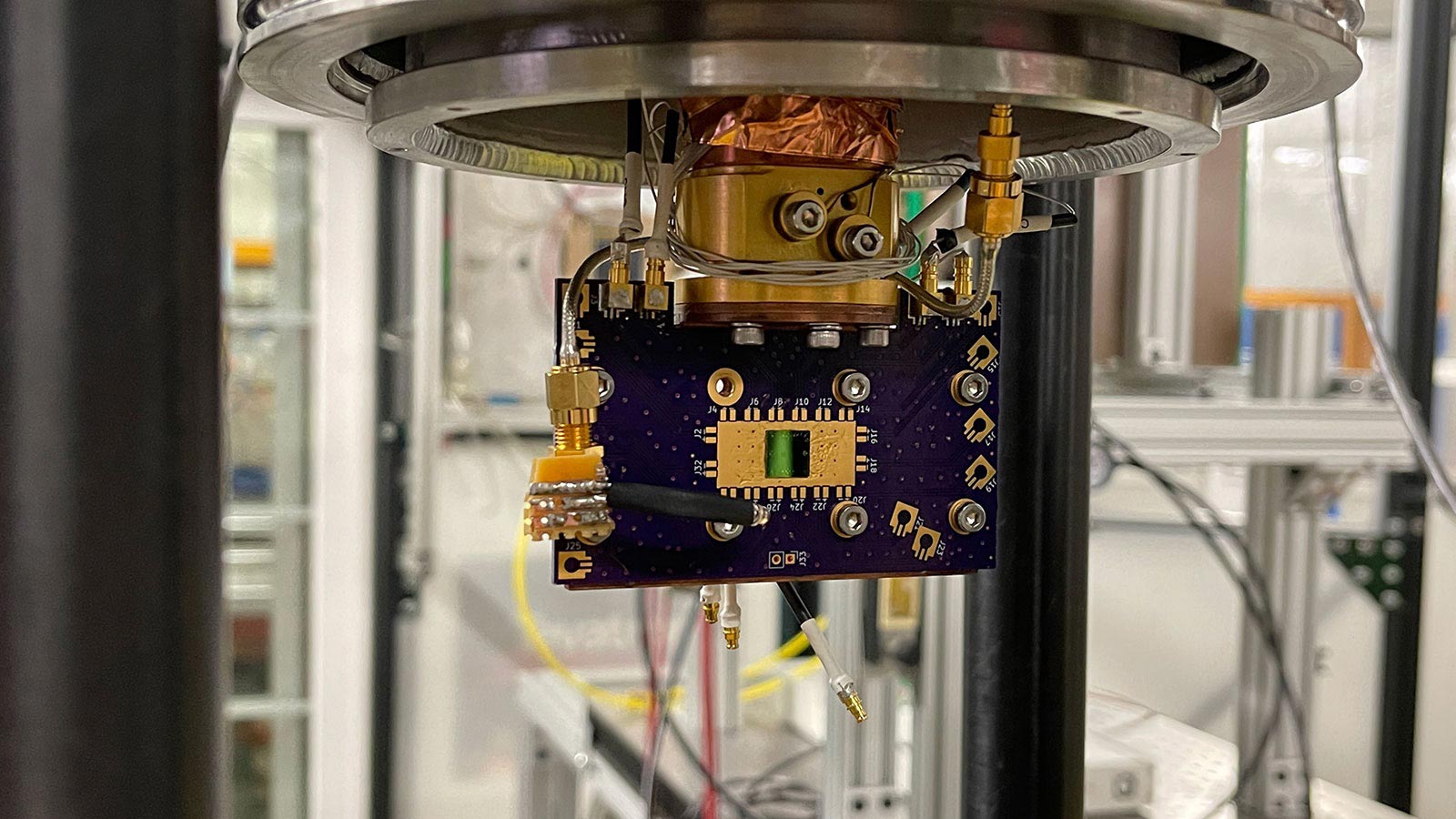
The team made SNSPDs with different wire sizes and tested them with a beam of 120 GeV protons at Fermilab, which was the nearest facility equipped to carry out this experiment. These high-energy protons are important because they allow researchers to simulate and study the conditions under which SNSPDs might operate in high-energy physics experiments, providing valuable insights into their capabilities and limitations.
They found that wire widths smaller than 400 nanometers — the width of a human hair is approximately 100,000 nanometers — demonstrated the high detection efficiency needed for high-energy proton sensing. Further, the study also revealed an optimal wire size of approximately 250 nanometers for this application.
Expanding the Possibilities for Particle Accelerators
In addition to their sensitivity and precision, SNSPDs also operate well under high magnetic fields, making them suitable for use in the superconducting magnets used in accelerators to boost particle velocity. The ability to detect high-energy protons with SNSPDs has never been reported before, and this breakthrough widens the scope of particle detection applications.
“This was a successful technology transfer between quantum sciences, for photon detection, into experimental nuclear physics,” said Argonne physicist Tomas Polakovic. “We took the photon-sensing device and made slight changes to make it work better in magnetic fields and for particles. And behold, we saw the particles exactly as we expected.”
Shaping the Future of the Electron-Ion Collider
This work also demonstrates the feasibility of the technology for use in the Electron-Ion Collider (EIC), a cutting-edge particle accelerator facility being built at DOE’s Brookhaven National Laboratory. The EIC will collide electrons with protons and atomic nuclei (ions) to get a better look at the internal structure of those particles, including the quarks and gluons that make up the protons and neutrons of nuclei.
The EIC requires sensitive and precise detectors, and SNSPDs will be valuable tools for capturing and analyzing the resulting particles produced in collisions within the EIC. “The proton energy range that we tested at Fermilab is right in the middle of the span of the ion’s energy range that we will detect at EIC, so these tests were well-suited,” said Sangbaek Lee, a physics postdoctoral appointee at Argonne.
Reference: “Beam tests of SNSPDs with 120 GeV protons” by Sangbaek Lee, Tomas Polakovic, Whitney Armstrong, Alan Dibos, Timothy Draher, Nathaniel Pastika, Zein-Eddine Meziani and Valentine Novosad, 9 October 2024, Nuclear Instruments and Methods in Physics Research Section A: Accelerators, Spectrometers, Detectors and Associated Equipment.
DOI: 10.1016/j.nima.2024.169956
The research team made use of the Reactive Ion Etching tool at the Center for Nanoscale Materials, a DOE Office of Science user facility at Argonne.
Other contributors to this work include Alan Dibos, Timothy Draher, Nathaniel Pastika, Zein-Eddine Meziani, and Valentine Novosad.
The results of this research were published in Nuclear Instruments and Methods in Physics Research Section A. The study was funded by the DOE Office of Science, Office of Nuclear Physics.
Never miss a breakthrough: Join the SciTechDaily newsletter.
Follow us on Google and Google News.
4 Comments
Accidental Breakthrough As Supercooled Wires Detect Near-Light-Speed Protons. This work also demonstrates the feasibility of the technology for use in the Electron-Ion Collider (EIC).
GOOD.
Ask the researchers:
1. What is the spacetime background of the speed of light?
2. What is the spacetime background of protons?
3. Can only collisions fully understand the spacetime structure of particles?
4. Is’ The Blind and the Elephant ‘just a fable?
Scientific research guided by correct theories can enable researchers to think more.
A topological vortex is a concept in physics that describes the natural gravitational field or the fluid-body coupled system. A topological vortex is formed by the interaction and balance of vortex and anti-vortex field pairs, which can be set into resonance by the body motion and interaction. A topological vortex is the foundation of the evolution of spacetime material motion.
According to the Topological Vortex Theory (TVT), spins create everything, spins shape the world. There are substantial distinctions between Topological Vortex Theory (TVT) and traditional physical theories. Grounded in the inviscid, incompressible, and isotropic spaces, TVT introduces the concept of topological phase transitions and employs topological principles to elucidate the formation and evolution of matter in the universe, as well as the impact of interactions between topological vortices and anti-vortices on spacetime dynamics and thermodynamics.
Within TVT, low-dimensional spacetime matter serves as the foundation for high-dimensional spacetime matter, and the hierarchical structure of matter and its interaction mechanisms challenge conventional macroscopic and microscopic interpretations. The conflict between Quantum Physics and Classical Physics can be attributed to their differing focuses: Quantum Physics emphasizes low-dimensional spacetime matter, whereas Classical Physics centers on high-dimensional spacetime matter.
Subatomic particles in the quantum world often defy the familiar rules of the physical world. The fact repeatedly suggests that the familiar rules of the physical world are pseudoscience. In the familiar rules of the physical world, two sets of cobalt-60 can form the mirror image of each other by rotating in opposite directions, and should receive the Nobel Prize for physics.
Please witness the grand performance of some so-called peer review publications (including PRL, PNAS, Nature, Science, etc.). https://scitechdaily.com/microscope-spacecrafts-most-precise-test-of-key-component-of-the-theory-of-general-relativity/#comment-854286. Some so-called academic publications (including PRL, PNAS, Nature, Science, etc.) are addicted to their own small circles and have deviated from science for a long time.
As the background of various material interactions and movements, space exhibits inviscid, absolutely incompressible and isotropic physical characteristics. It may form various forms of spacetime vortices through topological phase transitions. Hence, vortex phenomena are ubiquitous in cosmic space, from vortices of quantum particles and living cells to tornados and black holes. Stars and radioactive elements are one of the most active topological nodes in spacetime. Utilizing them is more valuable and meaningful than simulating them. Small or micro power topology intelligent batteries may be the direction of future energy research and development for human society.
Under the topological vortex architecture, science and pseudoscience are clear at a glance. Topological Vortex Theory (TVT) can play a crucial role in elucidating the foundations of physics, establishing its principles, and combating pseudoscience. Therefore, TVT has been strongly opposed and boycotted by traditional so-called peer review publications (such as PRL, PNAS, Nature, Science, etc.).
These so-called peer review publications (including PRL, PNAS, Nature, Science, etc.) mislead the direction of science and are known for their various absurdities and wonders. They collude together, reference each other, and use so-called Impact Factor (IF) or the Nobel Prize to deceive people around.
Ask the so-called peer review publications (including PRL, PNAS, Nature, Science, etc.):
1. What are your criteria for distinguishing science from pseudoscience?
2. Is your Impact Factor (IF) the standard for distinguishing science from pseudoscience?
3. Is the Nobel Prize the standard for distinguishing science from pseudoscience?
4. What is the most important aspect of academic publications?
5. Is the most important aspect of academic publications being flashy and impractical articles?
Pseudo academic publications (including PRL, PNAS, Nature, Science, etc.) are neither inclusivity nor openness, nor transparency and fairness, and have already had a serious negative impact on the progress of science and technology. Some so-called peer review publications (including PRL, PNAS, Nature, Science, etc.) are addicted to their own small circle and no longer know what science is. They hardly know what is dirty and ugly.
Publications that mislead the public under the guise of scholarship are more reprehensible than ordinary publications. The field of physics faces an ongoing challenge in maintaining scientific rigor and integrity in the face of pervasive pseudoscientific claims. Fighting against rampant pseudoscience, physics still has a long way to go.
While my comments may be lengthy, they are necessary to combat the proliferation of rampant pseudoscience and to promote the advancement of science and technology, and also is all I can do.
Appreciate the SciTechDaily for its inclusivity, openness, transparency, and fairness. If the researchers are truly interested in cosmic matter, please read: A Brief History of the Evolution of Cosmic Matter (https://scitechdaily.com/microscope-spacecrafts-most-precise-test-of-key-component-of-the-theory-of-general-relativity/#comment-873523).
When distinguishing science from pseudoscience, the impact factor (IF) and Nobel Prize are neither primary nor necessary conditions. However, some so-called peer review publications (including PRL, PNAS, Nature, Science, etc.) have hyped it up. As a result, many researchers have given up their original intention and pursued fame and fortune. Their behavior seriously hinders the progress and development of science and technology.
“”””ACCIDENTAL””””
Just everyday Argonne built-in self single-tricolor baryon 170 GeV measurements. They can excuse 300 Quatrllion Virtual Senior Scratch Monkeys who no longer have to finger 3k nanowires in high vacuum around proton beamlines and fire the DOGE inquisition now.