
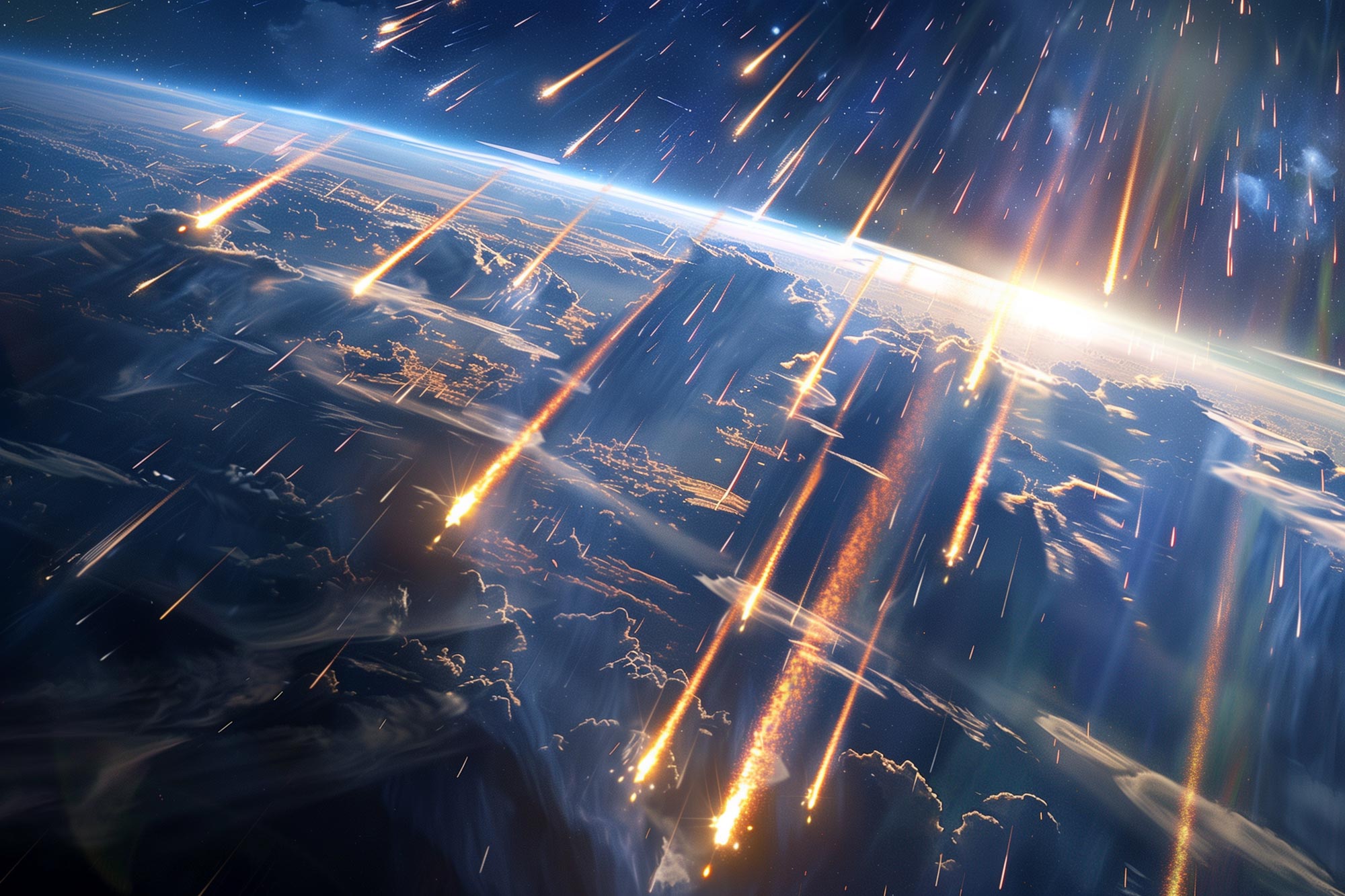
Researchers are uncovering the origins of cosmic rays, linking them to mysterious cosmic accelerators called PeVatrons.
New research from astrophysicists at Michigan State University may bring scientists closer to solving a mystery that has puzzled them for more than a century: where do galactic cosmic rays come from?
Cosmic rays are high-energy particles that travel at nearly the speed of light. They originate from locations both within the Milky Way and beyond, yet their exact sources have remained unknown since their discovery in 1912.
Shuo Zhang, an assistant professor of physics and astronomy at MSU, and her research team led two recent studies offering new insights into where these particles may have formed. The findings were presented at the 246th meeting of the American Astronomical Society in Anchorage, Alaska.
These energetic particles are believed to come from some of the universe’s most extreme environments, including black holes, supernova remnants, and regions where stars are born. Such astrophysical events also generate neutrinos, which are tiny, nearly massless particles found throughout the cosmos and even here on Earth.
“Cosmic rays are a lot more relevant to life on Earth than you might think,” Zhang said. “About 100 trillion cosmic neutrinos from far, far away sources like black holes pass through your body every second. Don’t you want to know where they came from?”
The Universe’s Ultimate Accelerators
The sources of cosmic rays are so powerful that they can accelerate protons and electrons to energy levels far exceeding what is possible with even the most advanced human-made particle accelerators. Zhang’s group focuses on these natural cosmic accelerators, known as PeVatrons, to understand where they exist, what they are made of, and how they propel particles to such extreme energies.
Gaining a deeper understanding of these mechanisms could help answer fundamental questions about galaxy evolution and the mysterious nature of dark matter.
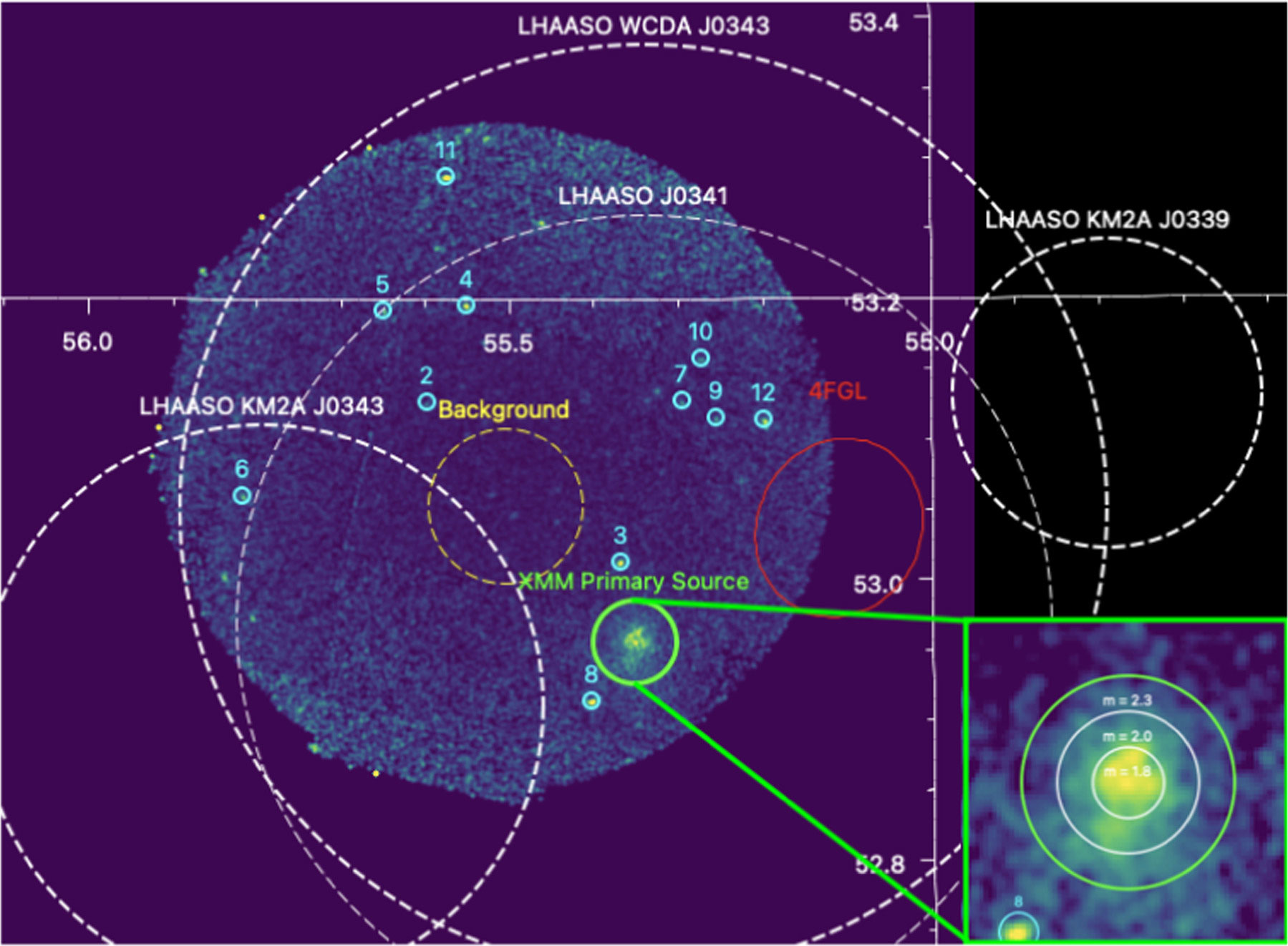
Her group’s latest papers explore multi-wavelength studies of PeVatron candidates whose sources remained unknown. In the first paper, Stephen DiKerby, a postdoctoral student in Zhang’s group, investigated a mysterious PeVatron candidate discovered by the Large High Altitude Air Shower Observatory (LHAASO), but the nature of the source was still unknown. Using X-ray data from the XMM-Newton space telescope, DiKerby found a pulsar wind nebula – an expanding bubble with relativistic electrons and positions with energy injection from a pulsar. This finding established this PeVatron as a pulsar wind nebula type of cosmic ray source and is one of a few cases where scientists can identify the nature of PeVatrons.
Students Lead the Next Wave
In the second paper, three MSU undergraduate students in Zhang’s group – Ella Were, Amiri Walker, and Shaan Karim – used NASA’s Swift X-ray telescope to observe X-ray emissions from little-explored LHAASO cosmic ray sources. The team calculated the upper limits for the X-ray emission, and their work could serve as a pathfinder for future studies.
“Through identifying and classifying cosmic ray sources, our effort can hopefully provide a comprehensive catalogue of cosmic ray sources with classification,” Zhang said. “That could serve as a legacy for future neutrino observatory and traditional telescopes to perform more in-depth study in particle acceleration mechanisms.”
Next, Zhang’s team plans to tackle another study on cosmic ray sources by combining data it collects from the IceCube Neutrino Observatory with those from X-ray and gamma-ray telescopes. They want to explore why some cosmic ray sources emit neutrinos but not others, as well as where and how the neutrinos are produced.
“This work will call for collaboration between particle physicists and astronomers,” Zhang said. “It’s an ideal project for the MSU high-energy physics group.”
References:
“Discovery of a Pulsar Wind Nebula Candidate Associated with the Galactic PeVatron 1LHAASO J0343+5254u” by Stephen DiKerby, Shuo Zhang, Tülün Ergin, Naomi Tsuji, Kaya Mori, Fabio Acero, Samar Safi-Harb, Shunya Takekawa and Jooyun Woo, 2 April 2025, The Astrophysical Journal.
DOI: 10.3847/1538-4357/adb7e0
“Swift-XRT Observations and Upper Limits at Five LHAASO Galactic Sources” by Amiri Walker, Ella Werre, Shaan Karim and Stephen DiKerby, 17 April 2025, Research Notes of the AAS.
DOI: 10.3847/2515-5172/adccb9
This work is supported by multiple NASA observation grants and the National Science Foundation IceCube analysis grant.
Never miss a breakthrough: Join the SciTechDaily newsletter.
Follow us on Google and Google News.
1 Comment
B note 2511_141722,150127_Source1.Storytelling【
Source 1.
https://scitechdaily.com/after-over-100-years-scientists-are-finally-closing-in-on-the-origins-of-cosmic-rays/
1.
_After more than 100 years of research, scientists have finally discovered the origin of the spacecraft.
_Cosmic rays are high-energy particles composed mainly of protons and atomic nuclei, traveling through space at almost the speed of light and constantly pouring into Earth from faraway space.
_It was discovered more than 100 years ago, but its origins are largely unknown. Through new research, scientists are one step closer to figuring out where these powerful particles are generated and how they get such extreme energy.
[I can’t sleep well when I think about the universe! I have so many questions… The universe may not collapse into a suqer anytime soon…] Uh-huh.
>>>> In my cosmology, most elementary particles appear infinitely in qqcell.nqvix.eqpms.dark_energy. Hmm.
>>>> By the way, aren’t the cern kids putting out only 17 standard physics models (msbase4.sum/2)? There are so many msbase.n…
This is qqcll.tssp particle generation and martial arts..so ignorant unbalanced..haha.
】
1-1.
_Researchers are identifying the origin of the spacecraft and linking it to a mysterious space accelerator called PeVatron.
_A new study by astrophysicists at Michigan State University takes scientists one step closer to finding an answer to a mystery that hasn’t been solved for more than a century: where galaxy spacecraft come from.
_Cosmic rays are high-energy particles that travel at almost the speed of light. They occur inside and beyond the Milky Way, but their exact origins have not been determined since their discovery in 1912.
[cosmic_ray hits the Earth’s atmosphere with unknown particles. Most of them are rays of little-known qqcell.nqvix.eqpms.dark_energy. Hmm.
】
_Shuo Zhang, an assistant professor of physics and astronomy at Michigan State University (MSU), and her team of researchers recently provided new insights into where these particles are formed through two studies. The findings were presented at the 246th American Astronomical Society conference in Anchorage, Alaska.
_These high-energy particles are thought to occur in the most extreme environments of the universe, such as black holes, supernova remnants, and star-forming regions. These astrophysical phenomena produce neutrinos, which are very small and almost massless particles found throughout the universe as well as on Earth.
1-2.
_”Spaceships are much more closely related to life on Earth than you might think,” Zhang said.
[The cosmic ray is a qqcell like a ciphertext. Can you open a door if any giant number is a ciphertext key?
So cosmicray is like a suqer.qcell.tsp point, so almost a becomes a possible b through suqer.free.entangle.5thpower. huh. even dust can turn into space. no kidding.
[_”About 100 trillion cosmic neutrinos from a distance like a black hole pass through our bodies every second. Aren’t you curious where they came from?”]
>>>>> I’m not curious!!!!
】
1-2. The ultimate accelerator of the universe
_The source of cosmic rays is so powerful that they can accelerate protons and electrons to energy levels far beyond what is possible even with the most advanced artificial particle accelerator. Professor Chang’s research team focuses on these natural space accelerators, known as PeVatrons, and wants to understand their existence, composition, and how they accelerate particles to such extreme energy.
_Getting a deeper understanding of these mechanisms may help answer fundamental questions about the evolution of galaxies and the mysterious nature of dark matter.
1-3.
Recent papers from her team explore multi-wavelength studies of PeVatron candidates of unknown origin. In the first paper, Stephen DiKerby, a postdoctoral investigator on Zhang’s team, investigated the mysterious PeVatron candidate found at the Large High Altitude Atmospheric Shower Observatory (LHAASO), but the nature of its source is still unknown. Using X-ray data from the XMM-Newton Space Telescope, DiKerby discovered the Pearl West Wind Nebula (an expanding bubble with relativistic electrons and positions from pulsar to energy injection). This discovery established this PeVatron as a pulsar wind nebula-type cosmic source, and is one of the few cases in which scientists can identify the nature of PeVatron.