
Close Menu
    Facebook X (Twitter) Instagram
    SciTechDaily
    • Biology
    • Chemistry
    • Earth
    • Health
    • Physics
    • Science
    • Space
    • Technology
    Facebook X (Twitter) Pinterest YouTube RSS
    SciTechDaily
    Home»Technology»AI Helped Design a Clear Window Coating That Can Cool Buildings Without Using Energy
    Technology

    AI Helped Design a Clear Window Coating That Can Cool Buildings Without Using Energy

    By American Chemical SocietyNovember 2, 20223 Comments3 Mins Read
    Facebook Twitter Pinterest Telegram LinkedIn WhatsApp Email Reddit
    Share
    Facebook Twitter LinkedIn Pinterest Telegram Email Reddit
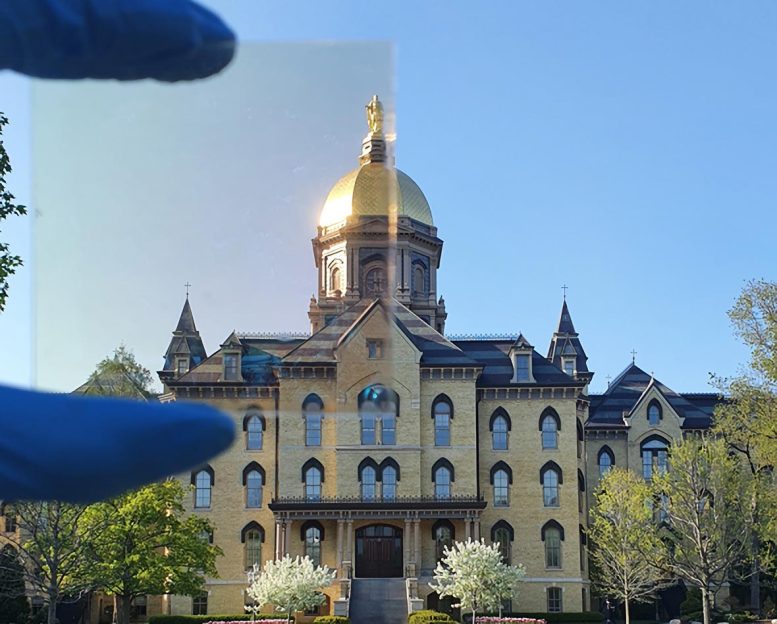
    Clear Window Coating Could Cool Buildings Without Using Energy
    This window film (held in fingers at top left) keeps rooms bright and cool by allowing visible light to pass in while reflecting invisible infrared and ultraviolet sunlight and radiating heat into outer space. Credit: Adapted from ACS Energy Letters 2022, DOI: 10.1021/acsenergylett.2c01969

    Researchers designed an energy-free cooling window coating using quantum computing, reducing energy use by up to 31%.

    Demand is growing for effective new technologies to cool buildings, as climate change intensifies summer heat. Now, scientists have just designed a transparent window coating that could lower the temperature inside buildings, without expending a single watt of energy. They did this with the help of advanced computing technology and artificial intelligence. The researchers report the details today (November 2) in the journal ACS Energy Letters.

    Cooling accounts for about 15% of global energy consumption, according to estimates from previous research studies. That demand could be lowered with a window coating that could block the sun’s ultraviolet and near-infrared light. These are parts of the solar spectrum that are not visible to humans, but they typically pass through glass to heat an enclosed room.

    Energy use could be even further reduced if the coating radiates heat from the window’s surface at a wavelength that passes through the atmosphere into outer space. However, it’s difficult to design materials that can meet these criteria simultaneously and at the same time can also transmit visible light, This is required so they don’t interfere with the view. Eungkyu Lee, Tengfei Luo, and colleagues set out to design a “transparent radiative cooler” (TRC) that could do just that.

    The team constructed computer models of TRCs consisting of alternating thin layers of common materials like silicon dioxide, silicon nitride, aluminum oxide or titanium dioxide on a glass base, topped with a film of polydimethylsiloxane. They optimized the type, order, and combination of layers using an iterative approach guided by machine learning and quantum computing, which stores data using subatomic particles. This computing method carries out optimization faster and better than conventional computers because it can efficiently test all possible combinations in a fraction of a second. This produced a coating design that, when fabricated, beat the performance of conventionally designed TRCs in addition to one of the best commercial heat-reduction glasses on the market.

    In hot, dry cities, the researchers say, the optimized TRC could potentially reduce cooling energy consumption by 31% compared with conventional windows. They note their findings could be applied to other applications, since TRCs could also be used on car and truck windows. In addition, the group’s quantum computing-enabled optimization technique could be used to design other types of composite materials.

    Reference: “High-Performance Transparent Radiative Cooler Designed by Quantum Computing” by Seongmin Kim, Wenjie Shang, Seunghyun Moon, Trevor Pastega, Eungkyu Lee and Tengfei Luo, 2 November 2022, ACS Energy Letters.
    DOI: 10.1021/acsenergylett.2c01969

    The authors acknowledge support from the National Research Foundation of Korea and the Notre Dame Center for Research Computing.

    Never miss a breakthrough: Join the SciTechDaily newsletter.
    Follow us on Google and Google News.

    American Chemical Society Energy
    Share. Facebook Twitter Pinterest LinkedIn Email Reddit

    Related Articles

    Your Car Is Wasting Energy and Scientists Just Found a Fix

    Elastic Horizons: The Science Behind 5000% Stretchable Lithium-Ion Batteries

    New Improved Lithium-Ion Batteries That Last Longer in Extreme Cold

    MXene Nanomaterial Offers Flexible and Stretchable High-Capacity Energy Storage

    Ultralow-Temperature Supercapacitors Using Porous Carbon Aerogel – Could Power Mars & Polar Missions

    Backpack Makes Loads Feel Lighter and Powers Electronics by Harvesting Energy From Walking

    Anode-Free Zinc Battery Could Someday Provide Large Scale Storage of Renewable Energy

    ‘Flapping Wings’ Powered by the Sun – Could Be Used for Solar Energy Harvesting

    Swarms of Microrobots Quickly Clean Up Radioactive Waste [Video]

    3 Comments

    1. Luke on November 2, 2022 8:17 am

      Could they not just design a coating for buildings to reflect the uv and infrared back into space? Then you wouldn’t have to see through it.

      Reply
    2. Peggy King on November 3, 2022 10:24 am

      But will reflecting change ozone or be bad for space and create more problems back to earth

      Reply
    3. Halina Biernack on November 7, 2022 3:26 pm

      I have applied a similar reflective film to all my windows and it really helps reduce the radiation, thus, cooling the room that has large w=indows. The product is sold by HOME Depot.

      Reply
    Leave A Reply Cancel Reply

    • Facebook
    • Twitter
    • Pinterest
    • YouTube

    Don't Miss a Discovery

    Subscribe for the Latest in Science & Tech!

    Trending News

    The Strange “Spacetime Crystal” That Can Suddenly Turn Into a Black Hole

    The Surprising Way Asteroids May Have Helped Life Begin on Earth

    Vast Hidden Structure Discovered Under Miles of Ice in East Antarctica

    A Surprising Discovery Suggests Autism Is Not One Condition

    New Alzheimer’s Discovery Could Change How Scientists Fight the Disease

    Yale Discovery Overturns Long-Held “Evolutionary Dead End” Theory

    UCLA Scientists Uncover a “Hidden Weakness” in Some of the World’s Deadliest Cancers

    Humpback Whale Stuns Scientists With 15,000 Kilometer Journey Across Oceans

    Follow SciTechDaily
    • Facebook
    • Twitter
    • YouTube
    • Pinterest
    • Newsletter
    • RSS
    SciTech News
    • Biology News
    • Chemistry News
    • Earth News
    • Health News
    • Physics News
    • Science News
    • Space News
    • Technology News
    Recent Posts
    • Food Waste Becomes a Powerful Carbon Trap in Climate Breakthrough
    • Battery-Free Artificial Photosynthesis Turns Sunlight, Water, and CO2 Into Fuel
    • How Ancient People Moved a 6-Ton Stone 700 Kilometers to Stonehenge
    • Scientists Finally See How Antibodies Really Attack Viruses
    • The Unexpected Gut Health Risk of Cutting Out Sugar
    Copyright © 1998 - 2026 SciTechDaily. All Rights Reserved.
    • Science News
    • About
    • Contact
    • Editorial Board
    • Privacy Policy
    • Terms of Use

    Type above and press Enter to search. Press Esc to cancel.