
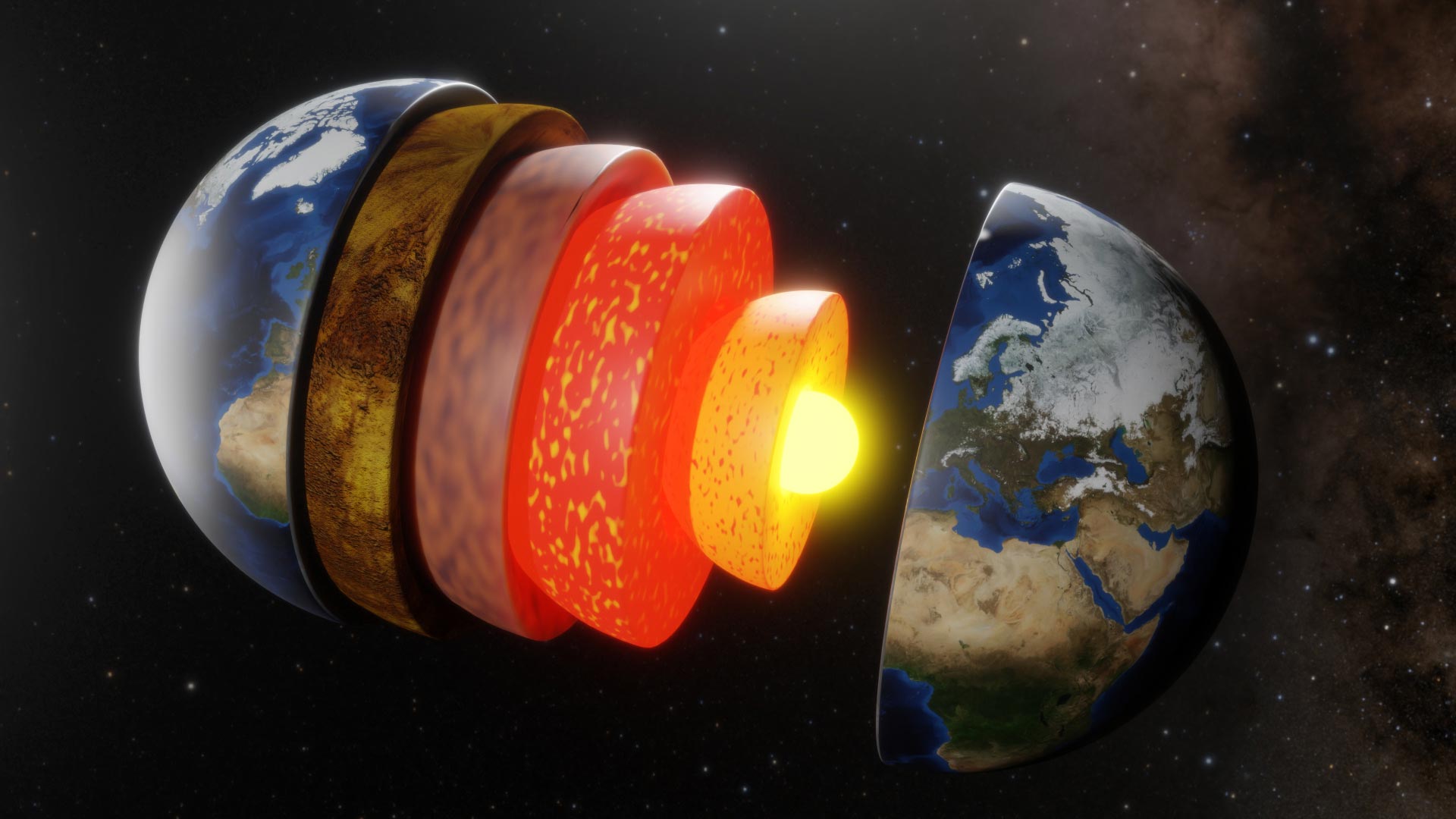
New simulation methods reveal insights into the Earth’s core and promise advances in neuromorphic computing for artificial intelligence.
How Does Earth Generate Its Magnetic Field? While scientists understand the basic process behind Earth’s magnetic field, many details remain unclear. A team of researchers from the Center for Advanced Systems Understanding (CASUS) at Helmholtz-Zentrum Dresden-Rossendorf (HZDR), Sandia National Laboratories in the USA, and the French Alternative Energies and Atomic Energy Commission (CEA) has developed a groundbreaking simulation method to explore the Earth’s core more accurately.
This method models not only atomic behavior but also the magnetic properties of materials under extreme conditions. Their approach could significantly advance geophysics research while paving the way for technological innovations like neuromorphic computing — a cutting-edge field aimed at creating more energy-efficient AI systems.
The team’s findings were published on December 12 in the journal PNAS.
Earth’s Magnetic Shield: How It Works and What We Still Don’t Know
Earth’s magnetic field is vital for life, protecting the planet from harmful cosmic radiation and solar winds. This shield is powered by the geodynamo effect, driven by the motion of molten iron within Earth’s core.
“We know that the Earth’s core is primarily composed of iron,” explains Attila Cangi, Head of the Machine Learning for Materials Design department at CASUS. “As you get closer to the Earth’s core, both temperature and pressure increase. The increase in temperature causes materials to melt, while the increase in pressure keeps them solid. Because of the specific temperature and pressure conditions inside the Earth, the outer core is in a molten state, while the inner core remains solid.”
As electrically charged, liquid iron flows around the inner core due to Earth’s rotation and convection currents, it generates electric currents, creating the magnetic field that envelops the planet.
Despite this basic understanding, many details remain unresolved. Scientists are still investigating the exact structure of Earth’s core and the role of elements besides iron, which could impact the geodynamo effect. Seismic experiments provide clues: researchers send shockwaves through Earth and measure the echoes with sensitive sensors.
“These experiments suggest that the core contains more than just iron,” says Svetoslav Nikolov from Sandia National Laboratories, lead author of the study. “The measurements do not agree with computer simulations that assume a pure iron core.”
Simulating Shock Waves on the Computer
The research team now achieved significant progress by developing and testing a new simulation method. The key innovation of the method called molecular-spin dynamics lies in the integration of two previously separate simulation approaches: molecular dynamics, which models atomic motion, and spin dynamics, which accounts for magnetic properties.
“By combining these two methods, we were able to investigate the influence of magnetism under high-pressure and high-temperature conditions on length and time scales that were previously unattainable,” emphasizes CEA physicist Julien Tranchida.
Specifically, the team simulated the behavior of two million iron atoms and their spins to analyze the dynamic interplay between mechanical and magnetic properties. The researchers also employed artificial intelligence (AI), using machine learning to determine force fields — interactions between atoms — with high precision. Developing and training these models required high-performance computing resources.
Once the models were ready, the researchers performed the actual simulations: the digital model of two million iron atoms, representative of the Earth’s core, was subjected to the temperature and pressure conditions found in the Earth’s interior. This was done by propagating pressure waves through the iron atoms, simulating their heating and compression. When the speed of these shock waves was lower, the iron remained solid and adopted different crystal structures. When the shock waves were faster, the iron became mostly liquid. In particular, the researchers found that magnetic effects significantly affect the material’s properties.
“Our simulations agree well with the experimental data,” says Mitchell Wood, a materials scientist at Sandia National Laboratories, “and they suggest that under certain temperature and pressure conditions, a particular phase of iron could stabilize and potentially affect the geodynamo.”
This phase, known as the bcc phase, has not been experimentally observed in iron under these conditions, only hypothesized. If confirmed, the results of the molecular-spin dynamics method could help resolve several questions about the geodynamo effect.
Driving Energy-Efficient AI
Beyond uncovering new details about the Earth’s interior, the method also has the potential to drive technological innovations in materials science. Both in his department and through external collaboration, Cangi plans to use the technique to model neuromorphic computing devices. This is a new type of hardware inspired by the way the human brain works, which could one day process AI algorithms faster and more energy-efficiently. By digitally replicating spin-based neuromorphic systems, the new simulation method could support the development of innovative, efficient hardware solutions for machine learning.
Data storage offers a second compelling avenue for further research: Magnetic domains along tiny nanowires could serve as storage media that are faster and more energy-efficient than conventional technologies. “There are currently no accurate simulation methods for either application,” says Cangi. “But I am confident that our new approach can model the required physical processes in such a realistic way, that we can significantly accelerate the technological development of these IT innovations.”
Reference: “Probing iron in Earth’s core with molecular-spin dynamics” by Svetoslav Nikolov, Kushal Ramakrishna, Andrew Rohskopf, Mani Lokamani, Julien Tranchida, John Carpenter, Attila Cangi and Mitchell A. Wood, 12 December 2024, Proceedings of the National Academy of Sciences.
DOI: 10.1073/pnas.2408897121
Never miss a breakthrough: Join the SciTechDaily newsletter.
Follow us on Google and Google News.
1 Comment
I read this page completely. It provides useful information about the Earth’s core. You should consider one thing about the influence of the moon on the core and surface of the earth. The moon is a large planet with a dense metallic core. The moon’s gravity has a direct effect on the earth’s crust, which causes the continents to move, and the moon constantly plows the earth’s crust