
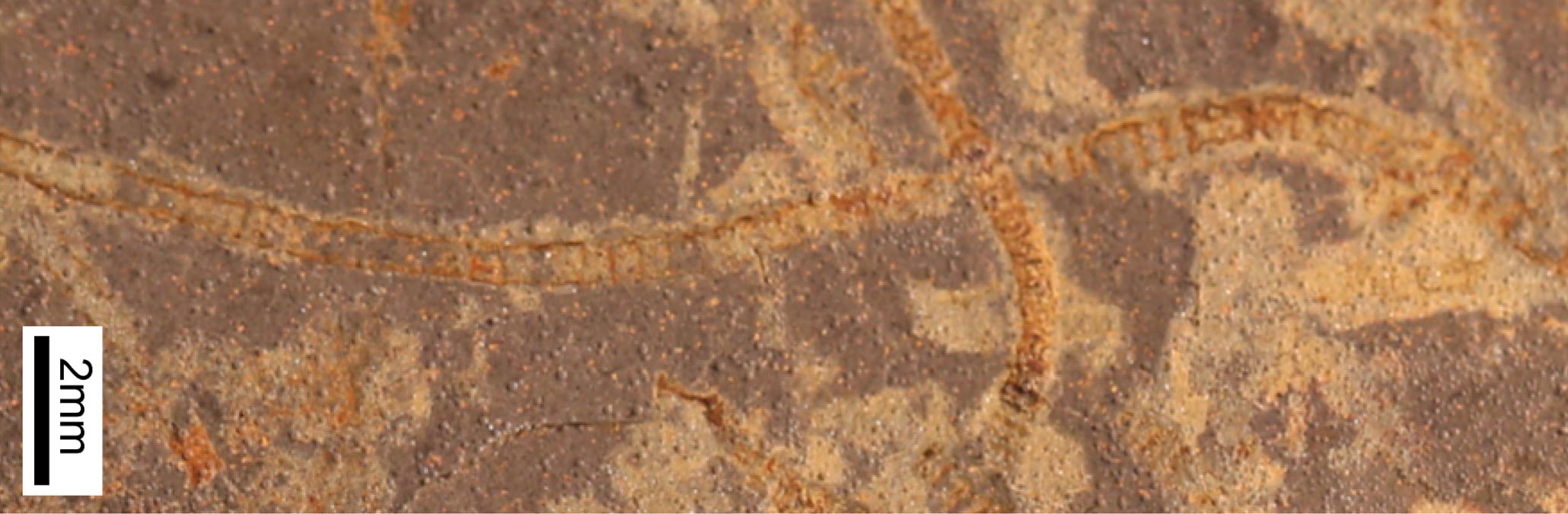
Scientists used advanced chemical analysis and machine learning to detect hidden molecular traces of life in rocks over 3.3 billion years old.
The AI identified biological signatures with more than 90% accuracy and revealed early signs of photosynthesis far earlier than previously known.
Discovery of Ancient Chemical Traces of Life
A new investigation has identified chemical signals of ancient life in rocks that formed more than 3.3 billion years ago. The findings also include molecular evidence indicating that oxygen-producing photosynthesis began nearly a billion years earlier than scientists previously believed.
Researchers from around the world, led by the Carnegie Institution for Science, combined advanced chemical techniques with artificial intelligence to detect faint chemical “whispers” of past biology preserved in long-altered rocks. By applying machine learning, the team trained computer models to recognize delicate molecular patterns left by living organisms, even when the original biomolecules had broken down.
AI Unlocks Invisible Biological Signatures in Ancient Rocks
One of the study’s contributors, Katie Maloney of Michigan State University’s Department of Earth and Environmental Sciences, investigates how early complex life developed and influenced ancient environments. She provided the team with remarkably well-preserved one-billion-year-old seaweed fossils collected in Yukon Territory, Canada. These fossils are among the earliest known seaweeds in the geological record, dating to a time when most life forms were still microscopic.
The study, released today (November 17) in the Proceedings of the National Academy of Sciences, offers new insights into Earth’s earliest biosphere and also holds promise for the search for life beyond our planet. The same analytical methods could examine samples from Mars or other worlds to determine whether they once supported living organisms.
Revealing Hidden Clues in Earth’s Earliest Biosphere
“Ancient rocks are full of interesting puzzles that tell us the story of life on Earth, but a few of the pieces are always missing,” Maloney said. “Pairing chemical analysis and machine learning has revealed biological clues about ancient life that were previously invisible.”
The earliest life on Earth left behind only limited molecular evidence. Fragile materials, including primitive cells and microbial mats, were buried, compressed, heated, and fractured as Earth’s crust shifted over time, then later exposed again at the surface. These intense geological processes destroyed most original biosignatures, erasing many clues about how life began and evolved during the planet’s earliest chapters.
Faint Chemical Whispers That Survived Deep Time
The new work suggests that the distribution of biomolecular fragments found in old rocks still preserves diagnostic information about the biosphere, even if no original biomolecules remain.
Indeed, this new research shows that life left behind more than anyone ever realized – faint chemical “whispers” locked deep inside ancient rocks.
The team used high-resolution chemical analysis to break down organic and inorganic materials into molecular fragments, then trained an artificial intelligence system to recognize the chemical “fingerprints” left behind by life. Scientists examined more than 400 samples from plants and animals to billion-year-old fossils and meteorites. The AI model distinguished biological from non-biological materials with over 90% accuracy and detected signs of photosynthesis in rocks at least 2.5 billion years old.
Extending the Timeline of Detectable Ancient Life
Until now, molecular traces that reliably indicated life had only been found in rocks younger than 1.7 billion years. This new method roughly doubles the window of time scientists can study using chemical biosignatures.
“Ancient life leaves more than fossils; it leaves chemical echoes,” said Dr. Robert Hazen, senior staff scientist at Carnegie and a co-lead author. “Using machine learning, we can now reliably interpret these echoes for the first time.”
Rewriting the Story of Early Photosynthesis and Planetary Life
For Maloney, whose research focuses on how early photosynthetic life transformed the planet, the implications are profound.
“This innovative technique helps us to read the deep time fossil record in a new way,” she said. “This could help guide the search for life on other planets.”
Reference: “Organic geochemical evidence for life in Archean rocks identified by pyrolysis–GC–MS and supervised machine learning” by Michael L. Wong, Anirudh Prabhu, Conel O’D. Alexander, H. James Cleaves, George D. Cody, Grethe Hystad, Marko Bermanec, Wouter Bleeker, C. Kevin Boyce, Andrea Corpolongo, Andrew D. Czaja, Souvik Das, Robert R. Gaines, Daniel D. Gregory, John A. Jaszczak, Emmanuelle J. Javaux, Jaganmoy Jodder, Andrew H. Knoll, Martin Van Kranendonk, Katie M. Maloney, Nora Noffke, Robert Rainbird, Emersyn Slaughter, Eva E. Stüeken, Roger E. Summons, Frances Westall, Jasmina Wiemann, Shuhai Xiao and Robert M. Hazen, 17 November 2025, Proceedings of the National Academy of Sciences.
DOI: 10.1073/pnas.2514534122
Never miss a breakthrough: Join the SciTechDaily newsletter.
Follow us on Google and Google News.