

Fluorescent cave minerals are helping scientists explore how life could survive in harsh places like Europa.
Far beneath Earth’s surface, rock and mineral formations conceal a hidden brilliance. When illuminated with black light, the fossilized chemicals within them glow in vivid shades of pink, blue, and green. Scientists are studying these fluorescent features to better understand cave formation and the conditions that support life in extreme environments, research that could offer insights into how life might survive on distant worlds, such as Jupiter’s icy moon Europa.
These findings were recently presented at the American Chemical Society (ACS), which took place from March 23 to 27, 2025. The event will feature around 12,000 presentations covering a wide range of scientific topics.
South Dakota’s Wind Cave has proven to be a valuable site for this research. Its chemistry appears similar to that of potential extraterrestrial environments like Europa, but it is much more accessible. This has led astrobiologist Joshua Sebree, a professor at the University of Northern Iowa, to venture deep underground to study the minerals and lifeforms thriving in the cave’s cold, dark conditions.
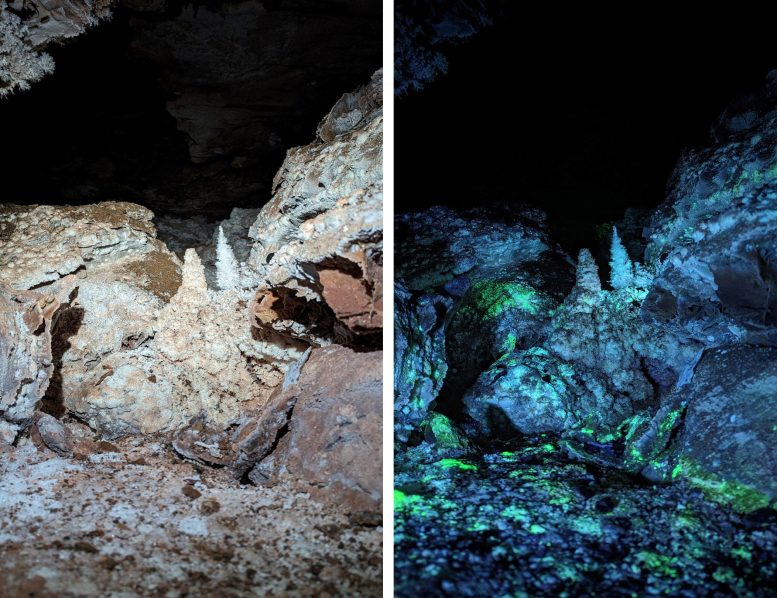
“The purpose of this project as a whole is to try to better understand the chemistry taking place underground that’s telling us about how life can be supported,” he explains.
UV lights expose chemical fossils in cave walls
As Sebree and his students began to venture into new areas of Wind Cave and other caves across the U.S., they mapped the rock formations, passages, streams, and organisms they found. As they explored, they brought along their black lights (UV lights), too, to look at the minerals in the rocks.
Under the black light, certain areas of the caves seemed to transform into something otherworldly as portions of the surrounding rocks shone in different hues. Thanks to impurities lodged within the Earth millions of years ago — chemistry fossils, almost — the hues corresponded with different concentrations and types of organic or inorganic compounds. These shining stones often indicated where water once carried minerals down from the surface.
Credit: American Chemical Society
“The walls just looked completely blank and devoid of anything interesting,” says Sebree. “But then, when we turned on the black lights, what used to be just a plain brown wall turned into a bright layer of fluorescent mineral that indicated where a pool of water used to be 10,000 or 20,000 years ago.”
Non-invasive analysis protects delicate cave environments
Typically, to understand the chemical makeup of a cave feature, a rock sample is removed and taken back to the lab. But Sebree and his team collect the fluorescence spectra — which is like a fingerprint of the chemical makeup — of different surfaces using a portable spectrometer while on their expeditions. That way, they can take the information with them but leave the cave behind and intact.
Anna Van Der Weide, an undergraduate student at the university, has accompanied Sebree on some of these explorations. Using the information collected during that fieldwork, she is building a publicly accessible inventory of fluorescence fingerprints to help provide an additional layer of information to the traditional cave map and paint a more complete picture of its history and formation.
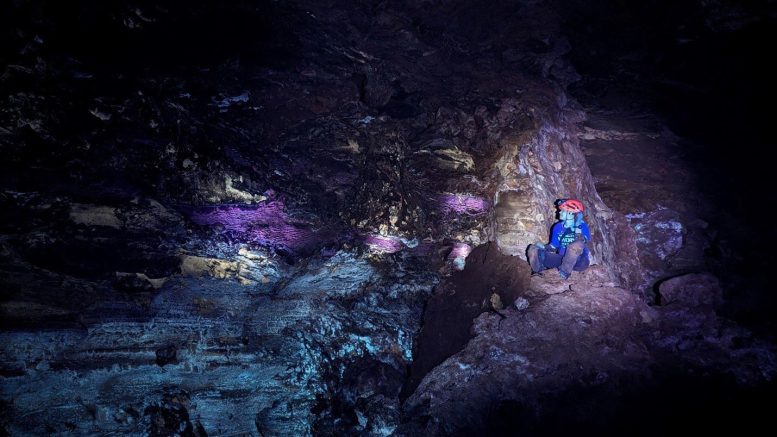
Additional undergraduate students have contributed to the study. Jacqueline Heggen is further exploring these caves as a simulated environment for astrobiological extremophiles; Jordan Holloway is developing an autonomous spectrometer to make measurement easier and even possible for future extraterrestrial missions; and Celia Langemo is studying biometrics to keep explorers of extreme environments safe. These three students are also presenting their findings at ACS Spring 2025.
Fieldwork challenges push the boundaries of cave science
Doing science in a cave is not without its challenges. For example, in the 48-degree Fahrenheit (9 degrees Celsius) temperature of Minnesota’s Mystery Cave, the team had to bury the spectrometer’s batteries in hand warmers to keep them from dying. Other times, to reach an area of interest, the scientists had to squeeze through spaces less than a foot (30 centimeters) wide for hundreds of feet, sometimes losing a shoe (or pants) in the process. Or, they’d have to stand knee-deep in freezing cave water to take a measurement, and hope that their instruments didn’t go for an accidental swim.
But despite these hurdles, the caves have revealed a wealth of information already. In Wind Cave, the team found that manganese-rich waters had carved out the cave and produced the striped zebra calcites within, which glowed pink under black light. The calcites grew underground, fed by the manganese-rich water. Sebree believes that when these rocks shattered, since calcite is weaker than the limestone also comprising the cave, the calcite worked to expand the cave too. “It’s a very different cave-forming mechanism than has previously been looked at before,” he says.
And the unique research conditions have provided a memorable experience to Van Der Weide. “It was really cool to see how you can apply science out in the field and to learn how you function in those environments,” she concludes.
In the future, Sebree hopes to further confirm the accuracy of the fluorescence technique by comparing it to traditional, destructive techniques. He also wants to investigate the cave water that also fluoresces to understand how life on Earth’s surface has affected life deep underground and, reconnecting to his astrobiological roots, understand how similar, mineral-rich water may support life in the far reaches of our solar system.
Meeting: ACS Spring 2025
The research was funded by NASA and the Iowa Space Grant Consortium.
Never miss a breakthrough: Join the SciTechDaily newsletter.
Follow us on Google and Google News.