
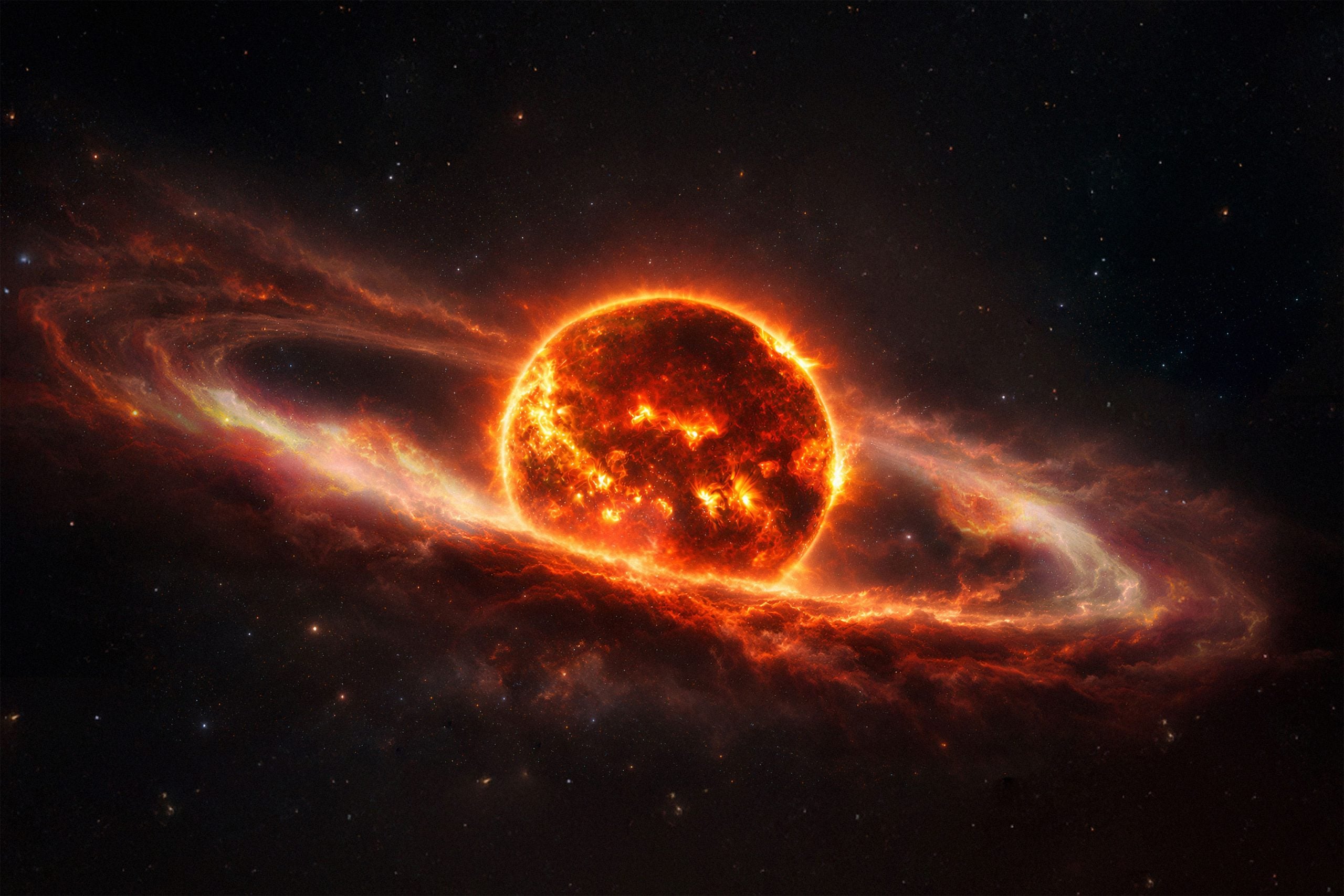
Scientists have identified an unexpected way to study the hidden space weather of distant stars by observing strange, repeating dimming patterns in young M dwarfs.
How much can a star shape the planets that form around it, and what might that mean for whether faraway worlds could ever be livable? Carnegie’s Luke Bouma is tackling this question with an unusual approach: he is studying naturally occurring space weather stations found around at least 10 percent of M dwarf stars early in their lifetimes. He is presenting this work at the American Astronomical Society meeting this week.
Astronomers already know that most M dwarf stars (which are smaller, cooler, and dimmer than our own Sun) host at least one Earth-sized rocky planet. Many of these planets are likely hostile, either too hot to keep liquid water or stable atmospheres, or repeatedly battered by powerful flares and high levels of radiation. Even so, these systems may still serve as valuable testbeds for learning how stars reshape the environments their planets must endure.
The Challenge of Studying Stellar Space Weather
“Stars influence their planets. That’s obvious. They do so both through light, which we’re great at observing, and through particles—or space weather—like solar winds and magnetic storms, which are more challenging to study at great distances,” Bouma explained. “And that’s very frustrating, because we know in our own Solar System that particles can sometimes be more important for what happens to planets.”
But astronomers can’t set up a space weather station around a distant star.
Or can they?
In collaboration with Moira Jardine of the University of St. Andrews, Bouma focused on an strange kind of M dwarf known as a complex periodic variable. These are young stars that spin quickly and show repeated dips in brightness. Until recently, researchers could not tell whether the fading came from starspots on the surface or from material circling the star.
“For a long time, no one knew quite what to make of these oddball little blips of dimming,” Bouma said. “But we were able to demonstrate that they can tell us something about the environment right above the star’s surface.”
Revealing Plasma Tori Around Young Stars
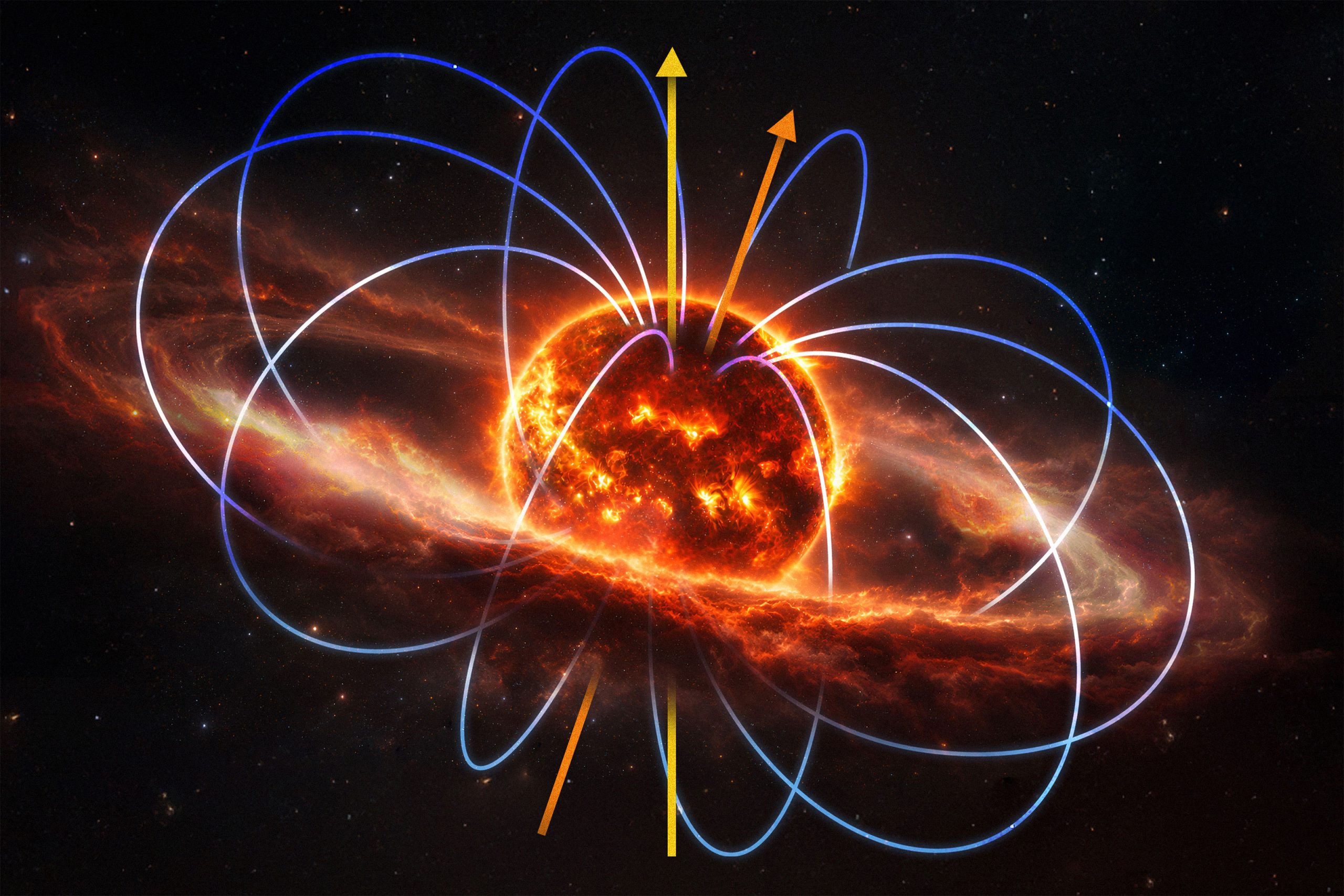
To pin down the cause, Bouma and Jardine built what they call “spectroscopic movies” of one complex periodic variable star. Their results indicate the dimming is linked to large concentrations of cool plasma trapped in the star’s magnetosphere. The star’s magnetic field holds this material and carries it along as the star rotates, gathering it into a doughnut shape called a torus.
“Once we understood this, the blips in dimming stopped being weird little mysteries and became a space weather station,” Bouma exclaimed. “The plasma torus gives us a way to know what’s happening to the material near these stars, including where it’s concentrated, how it’s moving, and how strongly it is influenced by the star’s magnetic field.”
Bouma and Jardine estimate that at least 10 percent of M dwarfs could have plasma features like this early in their lives. So, these space weather stations could help astronomers learn a great deal about particles from stars contribute to planetary conditions.
Next, Bouma hopes to reveal where the material in the torus comes from—the star itself or an external source.
“This is a great example of a serendipitous discovery, something we didn’t expect to find but that will give us a new window into understanding planet-star relationships,” Bouma concluded. “We don’t know yet if any planets orbiting M dwarfs are hospitable to life, but I feel confident that space weather is going to be an important part of answering that question.”
Reference: “A Plasma Torus around a Young Low-mass Star” by Luke G. Bouma and Moira M. Jardine, 18 July 2025, The Astrophysical Journal Letters.
DOI: 10.3847/2041-8213/ade39a
Never miss a breakthrough: Join the SciTechDaily newsletter.
Follow us on Google and Google News.
1 Comment
thqnks for this