
Close Menu
    Facebook X (Twitter) Instagram
    SciTechDaily
    • Biology
    • Chemistry
    • Earth
    • Health
    • Physics
    • Science
    • Space
    • Technology
    Facebook X (Twitter) Pinterest YouTube RSS
    SciTechDaily
    Home»Space»Mysterious ‘Cotton Candy’ Super-Puff Planets May Sport Rings Like Saturn
    Space

    Mysterious ‘Cotton Candy’ Super-Puff Planets May Sport Rings Like Saturn

    By Carnegie Institution for ScienceMarch 3, 2020No Comments3 Mins Read
    Facebook Twitter Pinterest Telegram LinkedIn WhatsApp Email Reddit
    Share
    Facebook Twitter LinkedIn Pinterest Telegram Email Reddit
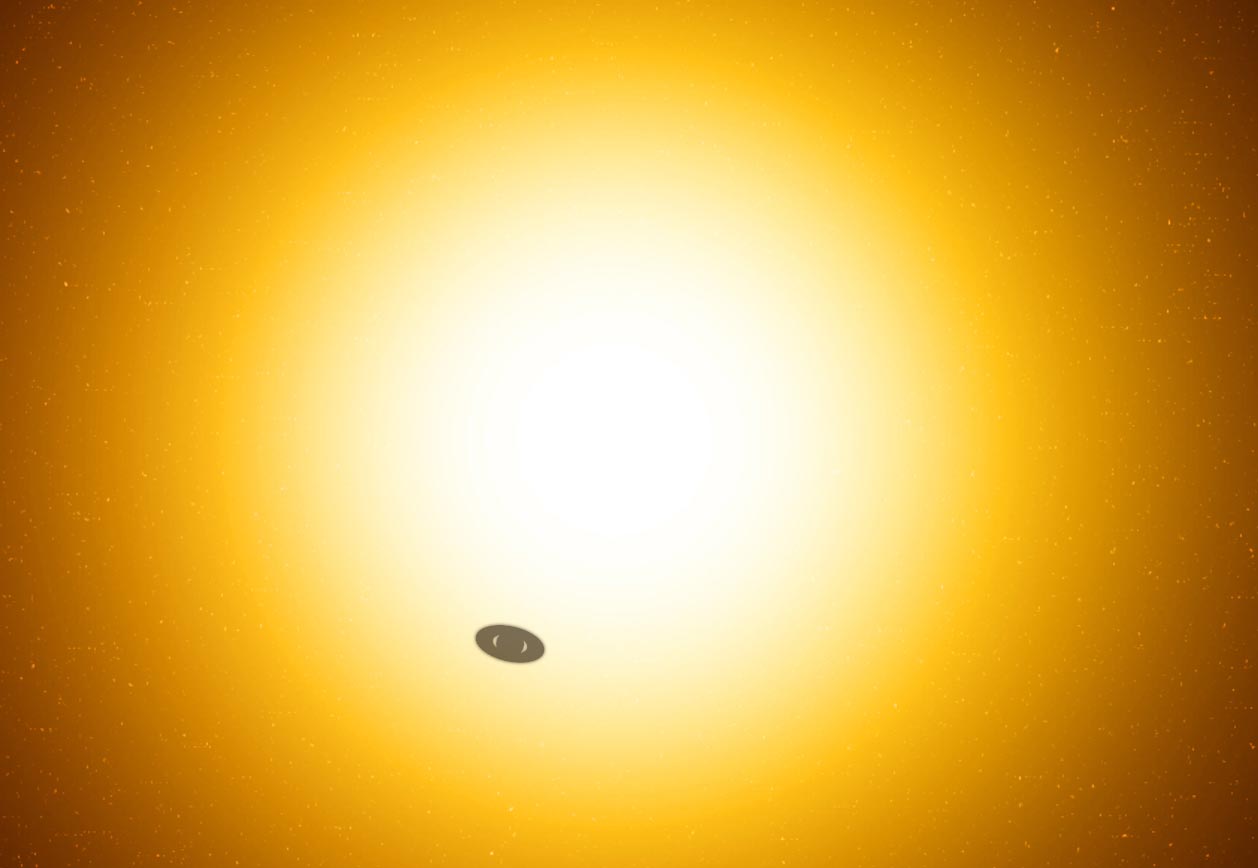
    Transiting Ringed Planet
    An artist’s conception of Piro and Vissapragada’s model of a ringed planet transiting in front of its host star. They used these models to constrain which of the known super-puffs could be explained by rings. Credit: Illustration is by Robin Dienel and courtesy of the Carnegie Institution for Science.

    Some of the extremely low-density, “cotton candy like” exoplanets called super-puffs may actually have rings, according to new research published in The Astronomical Journal by Carnegie’s Anthony Piro and Caltech’s Shreyas Vissapragada.

    Super-puffs are notable for having exceptionally large radii for their masses — which would give them seemingly incredibly low densities. The adorably named bodies have been confounding scientists since they were first discovered, because they are unlike any planets in our Solar System and challenge our ideas of what distant planets can be like.

    “We started thinking, what if these planets aren’t airy like cotton candy at all,” Piro said. “What if the super-puffs seem so large because they are actually surrounded by rings?”

    In our own Solar System, all of the gas and ice giant planets have rings, with the most well-known example being the majestic rings of Saturn. But it has been difficult for astronomers to discover ringed planets orbiting distant stars.

    The radii of exoplanets are measured during transits — when the exoplanet crosses in front of its host star causing a dip in the star’s light. The greater the size of the dip, the larger the exoplanet.

    “We started to wonder, if you were to look back at us from a distant world, would you recognize Saturn as a ringed planet, or would it appear to be a puffy planet to an alien astronomer?” Vissapragada asked.

    To test this hypothesis, Piro and Vissapragada simulated how a ringed exoplanet would look to an astronomer with high-precision instruments watching it transit in front of its host star. They also investigated the types of ring material that could account for observations of super-puffs.

    Their work demonstrated that rings could explain some, but not all, of the super-puffs that NASA’s Kepler mission has discovered so far.

    “These planets tend to orbit in close proximity to their host stars, meaning that the rings would have to be rocky, rather than icy,” Piro explained. “But rocky ring radii can only be so big, unless the rock is very porous, so not every super-puff would fit these constraints.”

    According to Piro and Vissapragada, three super-puffs are especially good candidates for rings — Kepler 87c and 177c as well as HIP 41378f.

    Follow-up observations to confirm their work won’t be possible until NASA’s James Webb Space Telescope launches next year, because existing land- and space-based telescopes lack the precision to confirm the presence of rings around these distant worlds.

    If some of the super-puffs could be confirmed as ringed, this would improve astronomers’ understanding of how these planetary systems formed and evolved around their host stars.

    Reference: “Exploring Whether Super-puffs can be Explained as Ringed Exoplanets” by Anthony L. Piro and Shreyas Vissapragada, 28 February 2020, The Astronomical Journal.
    DOI: 10.3847/1538-3881/ab7192

    This work was supported by the U.S. National Science Foundation and a Paul & Daisy Soros Fellowship for New Americans.

    Never miss a breakthrough: Join the SciTechDaily newsletter.
    Follow us on Google and Google News.

    Astronomy Astrophysics Carnegie Institution for Science Exoplanet Popular
    Share. Facebook Twitter Pinterest LinkedIn Email Reddit

    Related Articles

    JWST Reveals a “Forbidden” Planet With a Baffling Composition

    Webb Telescope Spots “Impossible” Atmosphere Around Ancient Super-Earth

    Astronomers Discover Bizarre “Forbidden” Planet That Should Not Exist

    Fiery Hot Lava Planet Weather Forecast: Supersonic Winds and Rocky Rains

    Rogue Planet About the Size of Earth Discovered in the Milky Way

    VLT GRAVITY: First Direct Observation of Exoplanet β Pictoris C

    Vaporized Metal in the Air of an Ultra-Hot Exoplanet

    One of the Most Extreme Planets in the Universe Analyzed With CHEOPS Space Telescope

    A White Dwarf’s Surprise Planetary Companion: First-of-Its-Kind Exoplanet Detected Around Dead Star

    Leave A Reply Cancel Reply

    • Facebook
    • Twitter
    • Pinterest
    • YouTube

    Don't Miss a Discovery

    Subscribe for the Latest in Science & Tech!

    Trending News

    One of the Universe’s Largest Stars May Be Getting Ready To Explode

    Scientists Discover Enzyme That Could Supercharge Ozempic-Like Weight Loss Drugs

    Popular Sweetener Linked to DNA Damage – “It’s Something You Should Not Be Eating”

    Ancient “Rock” Microbes May Reveal How Complex Life Began

    Researchers Capture Quantum Interference in One of Nature’s Rarest Atoms

    “A Plague Is Upon Us”: The Mass Death That Changed an Ancient City Forever

    Scientists Discover Game-Changing New Way To Treat High Cholesterol

    This Small Change to Your Exercise Routine Could Be the Secret to Living Longer

    Follow SciTechDaily
    • Facebook
    • Twitter
    • YouTube
    • Pinterest
    • Newsletter
    • RSS
    SciTech News
    • Biology News
    • Chemistry News
    • Earth News
    • Health News
    • Physics News
    • Science News
    • Space News
    • Technology News
    Recent Posts
    • New Study Challenges 40-Year Puzzle About Childhood Body Fat
    • 20-Year Study Finds Daily Multivitamins Don’t Extend Lifespan
    • Landmark Study Links Never Marrying to Significantly Higher Cancer Risk
    • Revolutionary Imaging Technique Unlocks Secrets of Matter at Extreme Speeds
    • Where Does Mass Come From? Scientists Find Evidence of a New Exotic Nuclear State
    Copyright © 1998 - 2026 SciTechDaily. All Rights Reserved.
    • Science News
    • About
    • Contact
    • Editorial Board
    • Privacy Policy
    • Terms of Use

    Type above and press Enter to search. Press Esc to cancel.