
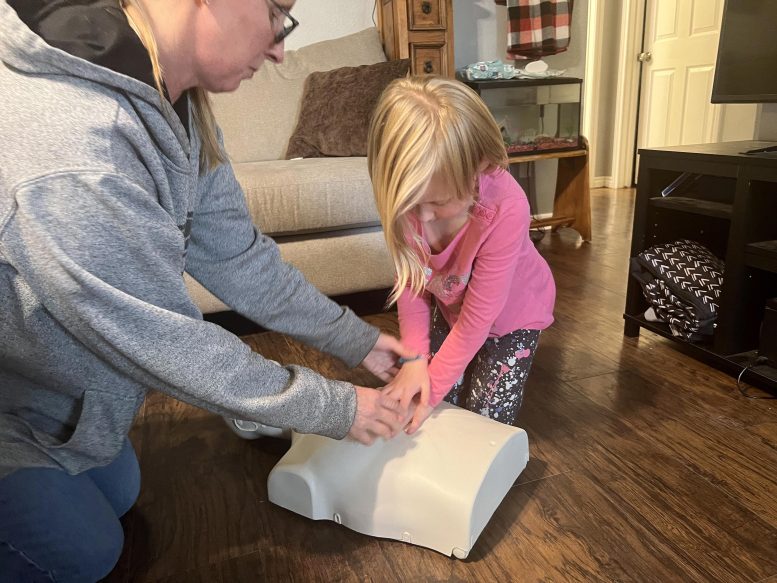
A new scientific statement, co-authored by the American Heart Association, outlines best practices for building skills over time so kids can become lifesavers by middle school.
- School-aged children are highly motivated to learn basic life-saving skills, such as recognizing a cardiac arrest, calling for help and performing cardiopulmonary resuscitation (CPR), according to a new scientific statement from the International Liaison Committee on Resuscitation (ILCOR), the American Heart Association and the European Resuscitation Council.
- The statement identifies age-appropriate best practices to help children learn various skills that are part of the cardiac arrest chain of survival.
- Teaching children about CPR at regular intervals as they age will develop their skills and knowledge. For example, a 4-year-old who can identify when to call an emergency telephone number (911) becomes a 10-year-old who may begin to perform effective chest compressions.
Building the skills for cardiopulmonary resuscitation (CPR) can begin as early as age 4 and layer on as children get older, so that by age 10 they may be able to perform effective chest compressions on training manikins, according to a new scientific statement from ILCOR, the American Heart Association, and the European Resuscitation Council published today (May 17) in the American Heart Association’s flagship, peer-reviewed journal Circulation.
The writing group of resuscitation scientists from around the world reviewed more than 100 research articles about training students in CPR. The review found that school-aged children are highly motivated to learn life-saving skills and often “multiply” their training by passing on what they’ve learned to others.
“Training students has become a key element to increase the number of people ready to perform CPR when cardiac arrest occurs outside of a hospital, and potentially increase rates of CPR and cardiac arrest survival globally,” said Bernd W. Böttiger, M.D., M.L., FAHA, chair of the statement writing group and full professor and head of the Department of Anesthesiology and Intensive Care Medicine at the University Hospital of Cologne in Cologne, Germany. “This research review aims to prompt clinicians, policymakers, local school officials and the general public to take action in a cardiac emergency whenever possible.”
“Given that most cardiac arrests outside of a hospital will happen at home, it’s important that all members of the family understand what to do if someone has a cardiac arrest,” said Comilla Sasson, M.D., Ph.D., FAHA, a member of the statement writing committee, practicing emergency medicine physician and vice president for science and innovation at the American Heart Association. “Building skills at a young age that are reinforced consistently throughout their years in school has the potential to educate generations of students and their parents on how to respond to cardiac arrest, perform chest compressions and rescue breaths, use an AED and ultimately increase survival.”
Cardiac arrest outside of a hospital setting is a leading cause of death worldwide. Survival rates range between 2% and 20% globally and are particularly low without immediate recognition and action from a bystander .
According to the statement, even if children are too young or small to perform an effective chest compression, they may begin learning the steps and rhythm for proper CPR and begin to learn about AEDs. Research has shown impactful results in the amplification of community preparedness as school-aged children share what they are learning with their families, friends and neighbors.
In addition to what may be done in schools, families should have a cardiac emergency response plan in place. Make a plan within the household, and practice regularly by delegating the steps below :
- Who will call 911? Use a cell phone. Put the phone on speaker while talking with the emergency dispatcher and starting CPR.
- Who will start CPR? Double or triple the chance of survival by performing Hands-Only CPR immediately.
- Who will open the door? Make sure your entrance is unlocked, giving first responders easy access to your residence.
Reference: “KIDS SAVE LIVES: Basic Life Support Education for Schoolchildren: A Narrative Review and Scientific Statement From the International Liaison Committee on Resuscitation” by Daniel C. Schroeder, Federico Semeraro, Robert Greif, Janet Bray, Peter Morley, Michael Parr, Naomi Kondo Nakagawa, Taku Iwami, Simon-Richard Finke, Carolina Malta Hansen, Andrew Lockey, Marina Del Rios, Farhan Bhanji, Comilla Sasson, Stephen M. Schexnayder, Tommaso Scquizzato, Wolfgang A. Wetsch, Bernd W. Böttiger and on behalf of the International Liaison Committee on Resuscitation17 May 2023, Circulation.
DOI: 10.1161/CIR.0000000000001128
All writing group members of this statement had expertise in the field of schoolchildren learning CPR. Co-authors are Daniel C. Schroeder, M.D., first author; Vice Chair Federico Semeraro, M.D.; Robert Greif, M.D., M.M.E.; Janet Bray, R.N., Ph.D.; Peter Morley, M.B.B.S., FAHA; Michael Parr, M.B.B.S.; Naomi Kondo Nakagawa, P.T., M.Sc., Ph.D.; Taku Iwami, M.D., Ph.D.; Simon-Richard Finke, M.D.; Carolina Malta Hansen, M.D., Ph.D.; Andrew Lockey, M.B., Ch.B., Ph.D.; Marina del Rios, M.D., M.Sc.; Farhan Bhanji, M.D., M.Sc. (Ed.); Comilla Sasson, M.D., Ph.D., FAHA; Stephen M. Schexnayder, M.D.; Tommaso Scquizzato; and Wolfgang A. Wetsch, M.D. Authors’ disclosures are listed in the manuscript.
Never miss a breakthrough: Join the SciTechDaily newsletter.
Follow us on Google and Google News.