
Close Menu
    Facebook X (Twitter) Instagram
    SciTechDaily
    • Biology
    • Chemistry
    • Earth
    • Health
    • Physics
    • Science
    • Space
    • Technology
    Facebook X (Twitter) Pinterest YouTube RSS
    SciTechDaily
    Home»Space»An Interactive Science Exhibit Based on a Real-Life Gravitational-Wave Detector
    Space

    An Interactive Science Exhibit Based on a Real-Life Gravitational-Wave Detector

    By OzGravAugust 27, 2021No Comments3 Mins Read
    Facebook Twitter Pinterest Telegram LinkedIn WhatsApp Email Reddit
    Share
    Facebook Twitter LinkedIn Pinterest Telegram Email Reddit
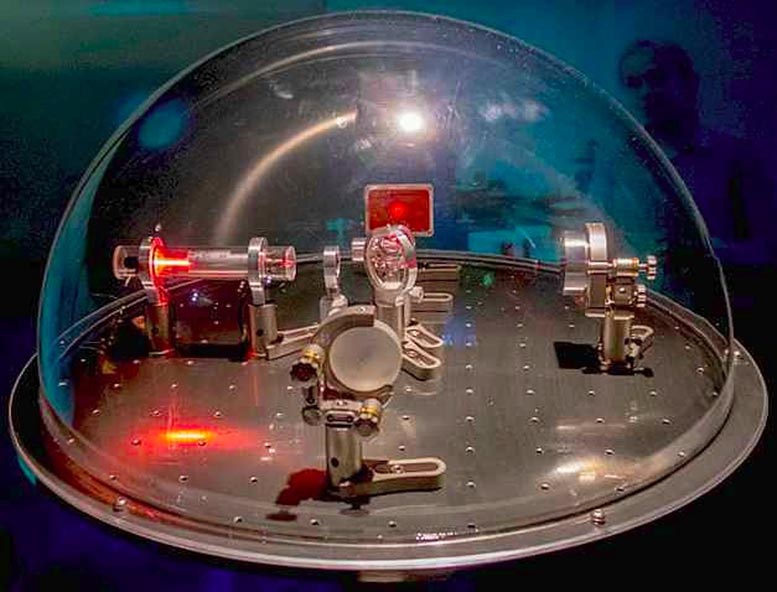
    Michelson Interferometer
    The Michelson interferometer installed at the Thinktank Birmingham Science Museum. Credit: Image supplied from the paper

    Making Waves at the Museum

    Exhuibit modeled after a real-life gravitational-wave detector to explain gravitational-wave science. It was developed by an international team, which includes researchers now at the OzGrav ARC Centre of Excellence for Gravitational Wave Discovery (OzGrav).

    The recently published research paper is now featured in the American Journal of Physics and the exhibit, which is called a Michelson interferometer, is on long-term display at the Thinktank Birmingham Science Museum in the UK. The project has a lasting international impact with online instructions and parts lists available for others to construct their own versions of the exhibit.

    Observations of gravitational waves — ripples in the fabric of space and time — have sparked increased public interest in this area of research. The effect of gravitational waves is a stretching and squashing of distances between objects. Real-life observatories are large complex devices based on the Michelson interferometer that use laser light to search for passing gravitational waves.
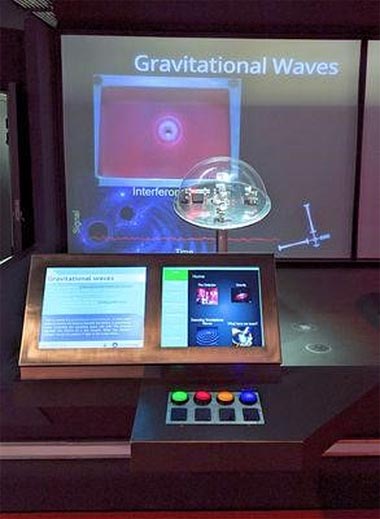
    Michelson Interferometer Thinktank Birmingham Science Museum
    The Michelson interferometer installed at the Thinktank Birmingham Science Museum. The touch screen provides access to videos, images and text and the four arcade buttons allow users to input a simulated gravitational wave to the interferometer. Credit: Figure from the paper

    In a Michelson interferometer, laser light is split into two perpendicular beams by a beam-splitter; the beams of laser light travelling down the detector arms reflect off mirrors back to the beam-splitter where they recombine and produce an interference pattern. If the relative length of the arms changes, the interference pattern will change. The exhibit model cannot detect gravitational waves, but it’s extremely sensitive to vibrations in the room!

    The Michelson interferometer exhibit has an attractive high-shine design, using lab-grade optics and custom-made components, drawing people in to take a closer look. A list of all the parts used in the intricate design is available on the official website — the creators are continuing to investigate low-cost designs using laser pointers and building blocks.

    At science fairs, experts are normally present to explain the items on display; however, this is not the case in a museum. ‘Exhibits need to be easily accessible with self-guided learning,’ explains OzGrav postdoc Dr Hannah Middleton, one of the project leads from the University of Melbourne.

    ‘We’ve developed custom interactive software for the exhibit through which a user can access explanatory videos, animations, images, text, and a quiz. Users can also directly interact with the interferometer by pressing buttons to input a simulated gravitational wave, and produce a visible change in the interference pattern.’

    Reference: “An interactive gravitational-wave detector model for museums and fairs featured” by S. J. Cooper, A. C. Green, H. R. Middleton, C. P. L. Berry, R. Buscicchio, E. Butler, C. J. Collins, C. Gettings, D. Hoyland, A. W. Jones, J. H. Lindon, I. Romero-Shaw, S. P. Stevenson, E. P. Takeva, S. Vinciguerra, A. Vecchio, C. M. Mow-Lowry and A. Freise, 21 June 2021, American Journal of Physics.
    DOI: 10.1119/10.0003534

    Never miss a breakthrough: Join the SciTechDaily newsletter.
    Follow us on Google and Google News.

    Astrophysics Gravitational Waves OzGrav
    Share. Facebook Twitter Pinterest LinkedIn Email Reddit

    Related Articles

    Neutron Star Extreme Matter Observatory (NEMO) – Building a $100M Black Hole Detector

    Elusive Continuous Gravitational Waves — Long-Lasting Ripples in Space-Time — In X-ray Star Systems

    Earth-Shaking Science at Cryogenic Temperatures: Next Generation Vibration Sensors

    Dancing Stars and Black Holes in a Cosmic Cloud of Gas: Investigating the “Common Envelope Phase”

    Massive, Never-Before-Seen Star System Puzzles Scientists

    Supercomputer Simulations of Core-Collapse Supernovae Reveal Complicated Physics of Exploding Massive Stars

    New Possible Explanation of Strange Black Hole Merger Revealed

    Future Gravitational Wave Detectors to Detect Millions of Black Holes & the Evolution of the Universe

    Radio and Gravitational Wave Signatures of Double Neutron Stars – Accurate Clocks to Test Einstein’s Theory of General Relativity

    Leave A Reply Cancel Reply

    • Facebook
    • Twitter
    • Pinterest
    • YouTube

    Don't Miss a Discovery

    Subscribe for the Latest in Science & Tech!

    Trending News

    New Pill Lowers Stubborn Blood Pressure and Protects the Kidneys

    Humans May Have Hidden Regenerative Powers, New Study Suggests

    Scientists Just Solved the Mystery of Why Crabs Walk Sideways

    Doctors Are Surprised by What This Vaccine Is Doing to the Heart

    This Popular Supplement May Boost Your Brain, Not Just Your Muscles

    Scientists Say This Simple Supplement May Actually Reverse Heart Disease

    Warming Oceans Could Trigger a Dangerous Methane Surge

    This Simple Movement Could Be Secretly Cleaning Your Brain

    Follow SciTechDaily
    • Facebook
    • Twitter
    • YouTube
    • Pinterest
    • Newsletter
    • RSS
    SciTech News
    • Biology News
    • Chemistry News
    • Earth News
    • Health News
    • Physics News
    • Science News
    • Space News
    • Technology News
    Recent Posts
    • Researchers Discover Efficient New Way To Split Hydrogen From Water for Energy
    • This Korean Skincare Ingredient Could Help Fight Deadly Superbugs
    • Giant Squid Detected off Western Australia in Stunning Deep-Sea Discovery
    • Popular Sugar-Free Sweetener Linked to Liver Disease, Study Warns
    • Why Weight Loss Isn’t Enough for Everyone at Risk of Diabetes
    Copyright © 1998 - 2026 SciTechDaily. All Rights Reserved.
    • Science News
    • About
    • Contact
    • Editorial Board
    • Privacy Policy
    • Terms of Use

    Type above and press Enter to search. Press Esc to cancel.