

Volcanic eruption from 12 million years ago preserves a snapshot of extinct animal life.
Rhinos that once roamed much of North America 12 million years ago likely lived in large herds, according to a new study by the University of Cincinnati.
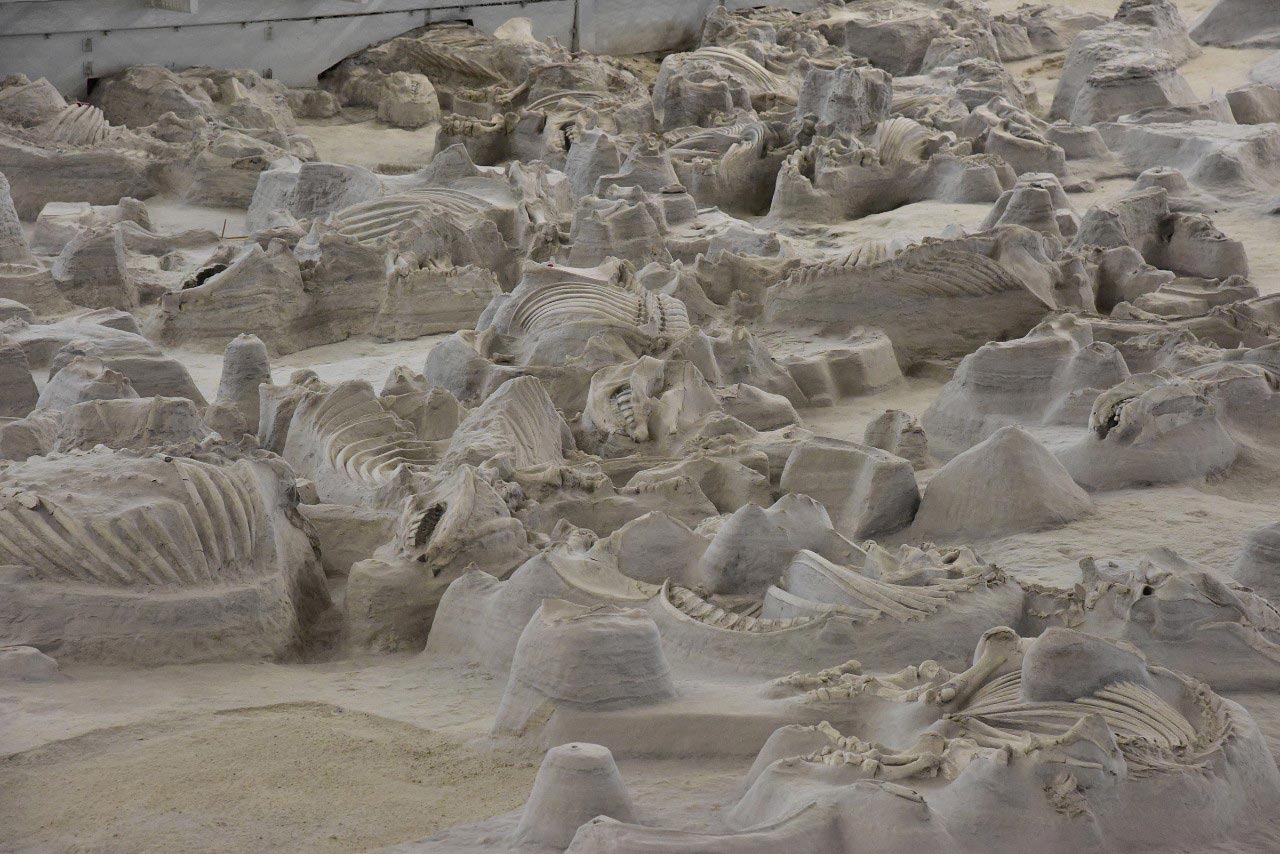
Researchers examined isotopes in the teeth of rhinos found in what is now northeast Nebraska. At this site, more than 100 rhinos died at a single water hole and were buried in volcanic ash from a massive eruption of the Yellowstone supervolcano.
Since the discovery of these fossils at Nebraska’s Ashfall Fossil Beds State Historical Park in 1971, scientists have questioned why so many rhinos died in the same location. Did they converge from far away, perhaps to seek shelter from the unfolding natural disaster of the volcanic eruption with its choking ash?
No evidence of migration or disaster response
“We found they didn’t move very much,” lead author and UC graduate Clark Ward said. “We didn’t find evidence for seasonal migration or any evidence of a response to the disaster.”
The study was published in the Nature journal Scientific Reports.
Ward, who is now pursuing a doctorate at the University of Minnesota, used isotopic analysis of Miocene rhinos as part of a master’s research project under the guidance of advisers and study co-authors Brooke Crowley at UC and University of Nebraska Professor Ross Secord.
How isotopes reveal location, diet, and climate
Researchers examined ratios of isotopes of strontium, oxygen, and carbon in fossil teeth to track the movements of the long-extinct animals across landscapes. Isotopes are atoms of the same element that have the same number of protons but a different number of neutrons.
Grass or leaves that rhinos and other animals eat contain similar ratios of isotopes as the soil and bedrock where plants grow that allow researchers to determine where the animals fed, sometimes with surprising precision depending on how variable the vegetation and geology are.
Scientists use this technique in wildlife conservation. For example, they can track the migrations of wide-ranging animals such as caribou or identify the habitat needs of elusive animals like jaguars.
“By studying carbon in the animal, we can reconstruct carbon in the environment to understand what kinds of vegetation lived there,” Ward said.
Meanwhile, oxygen tells scientists about climate, particularly rainfall.
“We can use it to reconstruct how wet or dry the environment was,” Ward said. “And strontium tells us where the animal was foraging because the ratio of isotopes is related to the soil and supporting bedrock.”
Reimagining rhino ecology in the miocene
Teleoceras major was a one-horned rhino with a barrel-shaped body and stubby legs like a hippo. Like hippos, they fed on grass. And like hippos, researchers think these rhinos spent a lot of time in and around water. Because of their vast size, they had few predators in the Miocene epoch, Ward said.
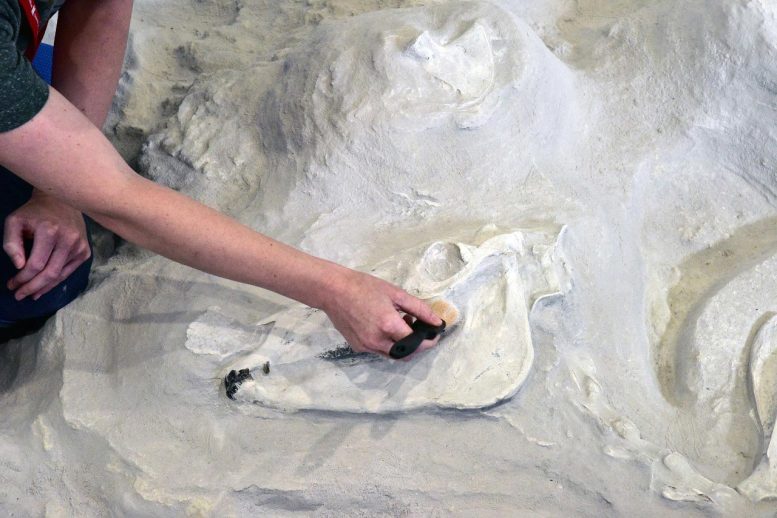
But their calves would have been vulnerable to hyena-like predators called bone-crushing dogs. Indeed, some of the specimens found at the Nebraska site bear evidence that scavengers removed portions of their carcasses after they died. And ancient tracks from the 100-pound dogs have been found there.
Effects of volcanic ash and cause of death
Yellowstone’s enormous volcano has erupted many times over the past 12 million years. Ash from the eruption easily would have traveled 700 miles across what is now Nebraska where it piled up like snow nearly a foot deep in places. But windblown ash continued to fall on Nebraska long after the initial eruption, Ward said.
“That ash would have covered everything: the grass, leaves, and water,” Ward said. “The rhinos likely weren’t killed immediately like the people of Pompeii. Instead, it was much slower. They were breathing in the ash. And they likely starved to death.”
Rhino expert John Payne spent his career working with endangered Sumatran rhinos in Malaysia. Payne, who was not part of the study, said UC’s research addresses scientific debate about the social structure of this ancient species of rhino.
“I am not surprised that the analyses very strongly suggest that Teleoceras major lived in herds, given that this animal resembles modern hippopotamus in form and hippos live in herds of several tens of animals — with several herds in one geographical area,” he said.
Ward worked as an intern at the place he loved as a child, Ashfall Fossil Beds State Historical Park, answering visitors’ questions about the fossils and participating in fossil excavations and preparation at the site.
“I’m honored and privileged to have my name in science attached to the site,” Ward said. “As someone who used to go to Ashfall as a kid, it’s come full circle.”
Reference: “Enamel carbon, oxygen, and strontium isotopes reveal limited mobility in an extinct rhinoceros at Ashfall Fossil Beds, Nebraska, USA” by Clark T. Ward, Brooke E. Crowley and Ross Secord, 4 April 2025, Scientific Reports.
DOI: 10.1038/s41598-025-94263-z
Never miss a breakthrough: Join the SciTechDaily newsletter.
Follow us on Google and Google News.
4 Comments
“…derived from the Bruneau-Jarbidge Volcanic Field in the Snake River Province in southwestern Idaho… from your cited article. YELLOWSTONE WAS NOT THE SOURCE OF THE ASHFALL. Discovery Magazine had it wrong, too. Also, University of Nebraska has a good article on the beds, citing source as SE ID. BJ was along the path of North America as it traveled over the mantle plume.
The Hotspot that is currently under Yellowstone NP is referred to as the Yellowstone Hotspot.
Since language is inexact, some who say it was Yellowstone are referring to any volcano over the Yellowstone Hotspot at the time of eruption rather than the current park.
This does cause confusion for some, but it reflects the nature of the fact that the plate is moving.
A large herd “died slowly from volcanic ashfall…” this article is a clownshow, like the modern science community.
I have been to the site. It is really cool.
There is evidence on the bones of the rhinos of lung failure, so a lingering death that was likely weeks.