
Close Menu
    Facebook X (Twitter) Instagram
    SciTechDaily
    • Biology
    • Chemistry
    • Earth
    • Health
    • Physics
    • Science
    • Space
    • Technology
    Facebook X (Twitter) Pinterest YouTube RSS
    SciTechDaily
    Home»Earth»New Discovery Changes Perceptions of the Evolution of Earth’s Biosphere
    Earth

    New Discovery Changes Perceptions of the Evolution of Earth’s Biosphere

    By Shona East, University of BristolFebruary 19, 2018No Comments4 Mins Read
    Facebook Twitter Pinterest Telegram LinkedIn WhatsApp Email Reddit
    Share
    Facebook Twitter LinkedIn Pinterest Telegram Email Reddit
    Plants Colonized Earth 100 Million Years Earlier Than Previously Thought
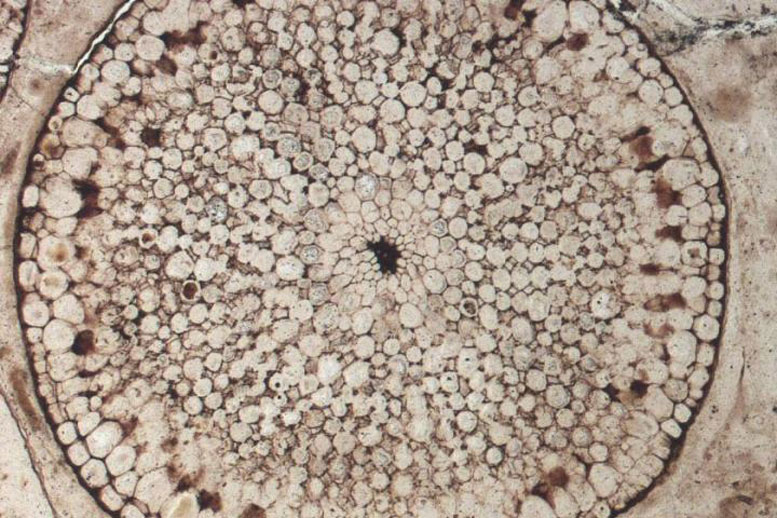
    Rhynia gwynne-vaughanii — 400 million-year-old fossil plant stem from Aberdeenshire, Scotland. Image courtesy of The Natural History Museum, London.

    For the first four billion years of Earth’s history, our planet’s continents would have been devoid of all life except microbes. All of this changed with the origin of land plants from their pond scum relatives, greening the continents and creating habitats that animals would later invade. The timing of this episode has previously relied on the oldest fossil plants which are about 420 million years old.

    New research, published today in the journal Proceedings of the National Academy of Sciences USA, indicates that these events actually occurred a hundred million years earlier, changing perceptions of the evolution of the Earth’s biosphere.

    Plants are major contributors to the chemical weathering of continental rocks, a key process in the carbon cycle that regulates Earth’s atmosphere and climate over millions of years.
    New Research Shows Plants Colonized Earth Millions Years Earlier Than Previously Thought
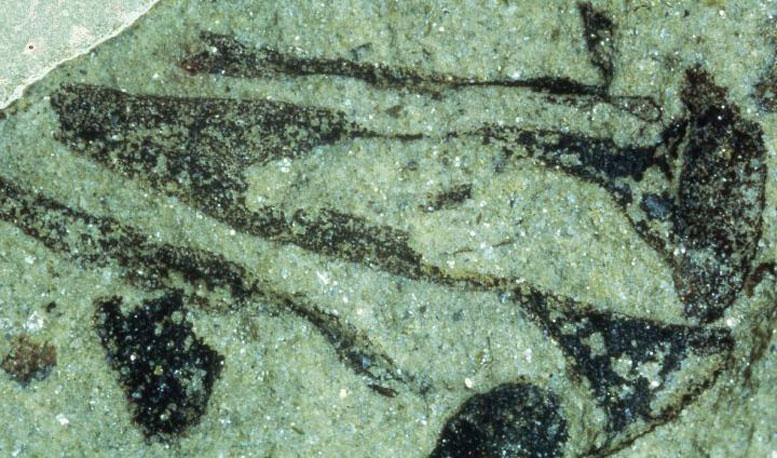
    Cooksonia pertoni collected by co-author Dianne Edwards from the type locality (Pridoli). It is about 12mm high. It was first published in Palaeontology Vol 22 Edwards 1979 plate 4 fig13. It is now housed in the National Museum, Wales. Credit: Diane Edwards

    The team used ‘molecular clock’ methodology, which combined evidence on the genetic differences between living species and fossil constraints on the age of their shared ancestors, to establish an evolutionary timescale that sees through the gaps in the fossil record.

    Dr. Jennifer Morris, from the University of Bristol’s School of Earth Sciences and co-lead author on the study, explained: “The global spread of plants and their adaptations to life on land, led to an increase in continental weathering rates that ultimately resulted in a dramatic decrease the levels of the ‘greenhouse gas’ carbon dioxide in the atmosphere and global cooling.”

    “Previous attempts to model these changes in the atmosphere have accepted the plant fossil record at face value – our research shows that these fossil ages underestimate the origins of land plants, and so these models need to be revised.”

    Co-lead author Mark Puttick described the team’s approach to produce the timescale. He said: “The fossil record is too sparse and incomplete to be a reliable guide to date the origin of land plants. Instead of relying on the fossil record alone, we used a ‘molecular clock’ approach to compare differences in the make-up of genes of living species – these relative genetic differences were then converted into ages by using the fossil ages as a loose framework.”
    Early Life on Earth Resembled Cryptogamic Ground Covers
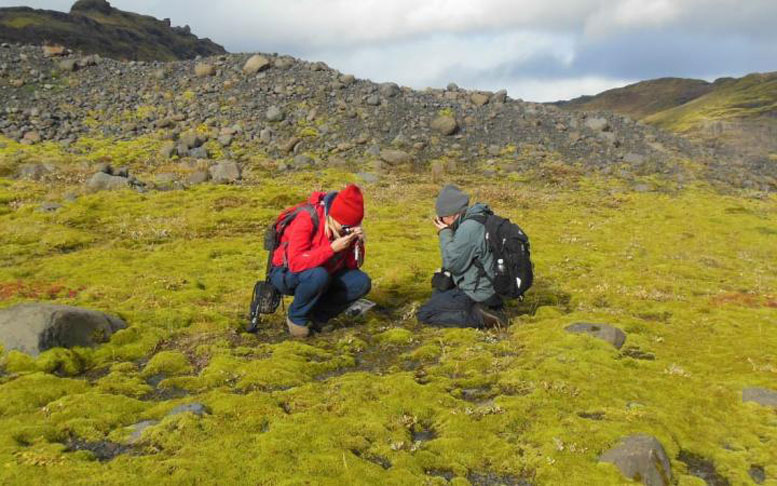
    Early life on land resembled cryptogamic ground covers like this lava field in Iceland. Co-author Sylvia Pressel appears in the right of the picture. Credit: Image courtesy of Paul Kenrick

    “Our results show the ancestor of land plants was alive in the middle Cambrian Period, which was similar to the age for the first known terrestrial animals.”

    One difficulty in the study is that the relationships between the earliest land plants are not known. Therefore the team, which also includes members from Cardiff University and the Natural History Museum, London, explored if different relationships changed the estimated origin time for land plants.

    Leaders of the overall study, Professor Philip Donoghue and Harald Schneider added: “We used different assumptions on the relationships between land plants and found this did not impact the age of the earliest land plants.”

    “Any future attempts to model atmospheric changes in deep-time must incorporate the full range of uncertainties we have used here.”

    Reference: “Timescale of early land plant evolution” by Jennifer L. Morris, Mark N. Puttick, James W. Clark, Dianne Edwards, Paul Kenrick, Silvia Pressel, Charles H. Wellman, Ziheng Yang, Harald Schneider and Philip C. J. Donoghue, 20 February 2018, Proceedings of the National Academy of Sciences.
    DOI: 10.1073/pnas.1719588115

    Never miss a breakthrough: Join the SciTechDaily newsletter.
    Follow us on Google and Google News.

    Archaeology Earth Science Fossils Paleontology University of Bristol
    Share. Facebook Twitter Pinterest LinkedIn Email Reddit

    Related Articles

    Scientists Discover Ice Age Forests in the North Sea’s Sunken “Lost World”

    Giant Armored Fish Fed Similar to Basking Sharks 380-Million-Years Ago

    New Fossil Discovery Pushes Back Evidence of Insect Pollination to a Time When Pterodactyls Still Roamed the Skies

    Researchers Date the Origins of Photosynthesis to 1.25 Billion Years Ago

    Archaeologists Discover Oldest Known Funereal Fish Hooks

    Mongolian Microfossils Shed Light on the Rise of Animals

    Drepanosaurus – A Small Reptile with a Rearsome Finger

    Ash Preserved Fossils of Rangeomorphs Discovered in Newfoundland

    27-Foot Long Crocodylus Thorbjarnarsoni Roamed Kenya

    Leave A Reply Cancel Reply

    • Facebook
    • Twitter
    • Pinterest
    • YouTube

    Don't Miss a Discovery

    Subscribe for the Latest in Science & Tech!

    Trending News

    Millions Take These IBS Drugs, But a New Study Finds Serious Risks

    Scientists Unlock Hidden Secrets of 2,300-Year-Old Mummies Using Cutting-Edge CT Scanner

    Bread Might Be Making You Gain Weight Even Without Eating More Calories

    Scientists Discover Massive Magma Reservoir Beneath Tuscany

    Europe’s Most Active Volcano Just Got Stranger – Here’s Why Scientists Are Rethinking It

    Alzheimer’s Symptoms May Start Outside the Brain, Study Finds

    Millions Take This Popular Supplement – Scientists Discover a Concerning Link to Heart Failure

    The Universe Is Expanding Too Fast and Scientists Can’t Explain Why

    Follow SciTechDaily
    • Facebook
    • Twitter
    • YouTube
    • Pinterest
    • Newsletter
    • RSS
    SciTech News
    • Biology News
    • Chemistry News
    • Earth News
    • Health News
    • Physics News
    • Science News
    • Space News
    • Technology News
    Recent Posts
    • U.S. Waste Holds $5.7 Billion Worth of Crop Nutrients
    • Scientists Say a Hidden Structure May Exist Inside Earth’s Core
    • Doctors Surprised by the Power of a Simple Drug Against Colon Cancer
    • Why Popular Diabetes Drugs Like Ozempic Don’t Work for Everyone: The “Genetic Glitch”
    • Scientists Create Improved Insulin Cells That Reverse Diabetes in Mice
    Copyright © 1998 - 2026 SciTechDaily. All Rights Reserved.
    • Science News
    • About
    • Contact
    • Editorial Board
    • Privacy Policy
    • Terms of Use

    Type above and press Enter to search. Press Esc to cancel.