

Ancient DNA preserved in seabed sediments suggests Doggerland hosted temperate forests far earlier than expected.
Forests covered parts of Doggerland, the now-submerged landmass beneath the North Sea, thousands of years earlier than scientists once thought. The conclusion comes from a large study of sedimentary ancient DNA (sedaDNA) led by researchers at the University of Warwick.
The results indicate that Doggerland may have served as a favorable refuge for plants, animals, and possibly humans long before forests became common across Britain and northern Europe.
The study, published in Proceedings of the National Academy of Sciences (PNAS), found evidence that temperate tree species such as oak, elm, and hazel were present more than 16,000 years ago. Researchers also identified DNA from a tree genus believed to have disappeared from the region about 400,000 years ago. The data further suggest that parts of Doggerland remained above water during major flooding events, including the Storegga tsunami about 8,150 years ago. Some areas appear to have persisted until roughly 7,000 years ago.
Professor Robin Allaby at the University of Warwick and lead author of this study says, “By analyzing sedaDNA from Southern Doggerland at a scale not seen before, we have reconstructed the environment of this lost land from the end of the last Ice Age until the North Sea arrived. We unexpectedly found trees thousands of years earlier than anyone expected — and evidence that the North Sea fully formed later than previously thought.
“From a human perspective, this is the best evidence that Doggerland’s wooded environment could have supported early Mesolithic communities prior to flooding and may help explain why relatively little early Mesolithic evidence survives on mainland Britain today.”
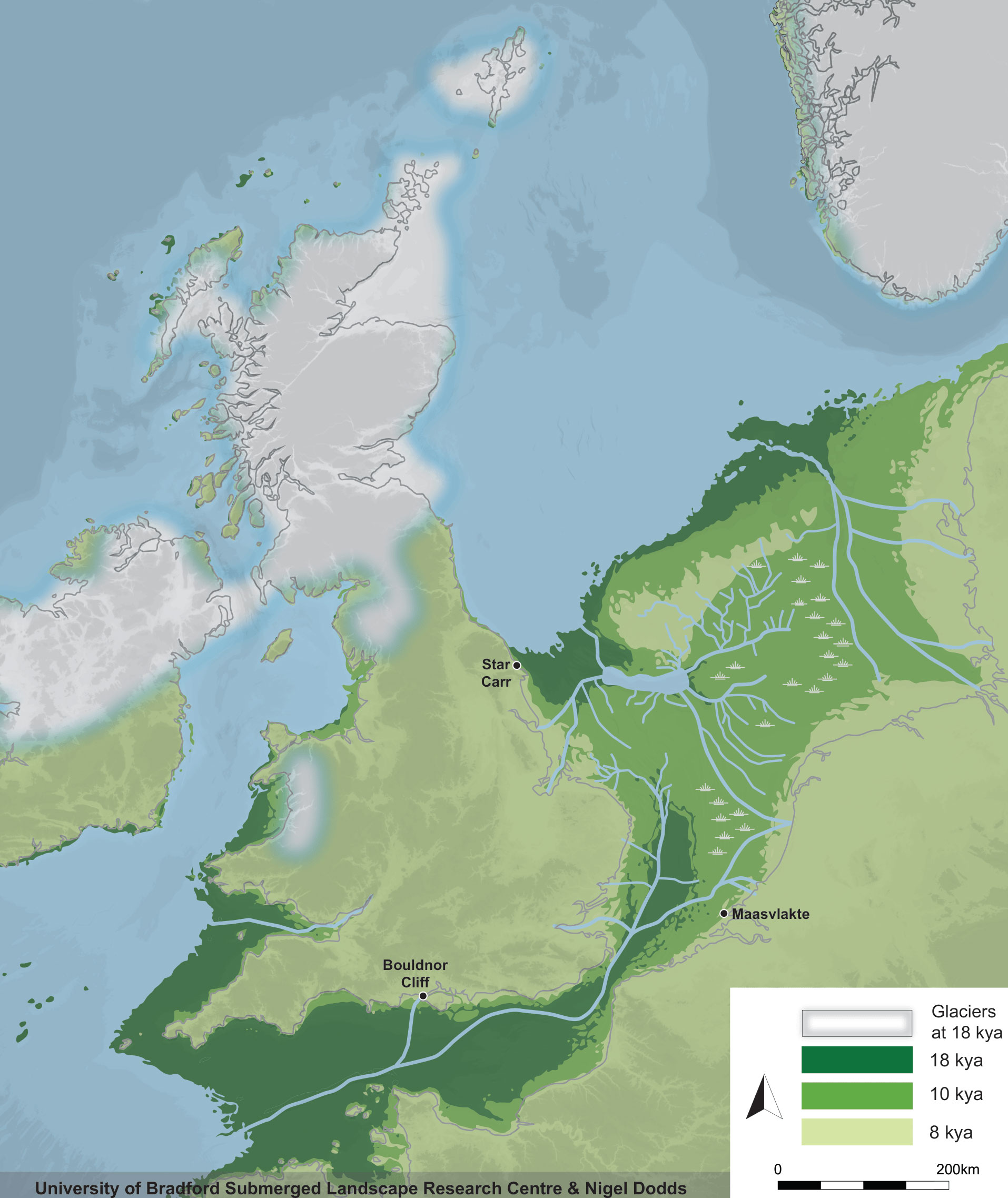
The lost trees of Doggerland
Before rising sea levels flooded the region, Doggerland formed a land connection between Britain and mainland Europe. Over time the advancing sea submerged this landscape and created what is now the North Sea. While scientists already knew that forests eventually grew there, the timing of when trees first appeared and how favorable the region was for early human populations has remained uncertain.
To explore these questions, researchers analyzed sedimentary ancient DNA from 252 samples taken from 41 marine sediment cores along the prehistoric Southern River (chosen for its well-preserved sediments and potential to reveal past habitats). These samples allowed the team to reconstruct the ecological history of Doggerland from around 16,000 years ago until the region was finally submerged.
The analysis shows that temperate woodland species, including oak, elm, and hazel, appeared thousands of years earlier than suggested by pollen records from Britain. Lime (Tilia), a tree that prefers warmer conditions, also shows up roughly 2,000 years earlier than previously documented in mainland Britain. This pattern suggests that parts of Doggerland may have served as a northern refuge for certain tree species during the last Ice Age.
Researchers also discovered DNA belonging to Pterocarya, a relative of the walnut tree that scientists believed disappeared from northwestern Europe about 400,000 years ago. Its presence indicates that the species survived in this region far longer than previously recognized.
Rethinking Ice Age Europe
The study supports growing evidence that small-scale “microrefugia” allowed temperate plant species to survive northern Europe’s Ice Age conditions, helping explain Reid’s Paradox — how trees recolonised the region so rapidly after the last Ice Age retreated.
The presence of woodland habitats in southern Doggerland 16,000 years ago suggests the area may have offered rich ecological resources for humans, including forest animals such as boars, long before the emergence of early peoples such as the well-documented Maglemosian culture around 10,300 years ago.
Co-author, Professor Vincent Gaffney at the University of Bradford says, “For many years, Doggerland was often described as a land bridge, only significant as a route for prehistoric settlement of the British Isles. Today, we understand that Doggerland was not only a heartland of early human settlement, but also that the presence of the land mass may have provided a refuge for plants and animals and acted as a fulcrum for how prehistoric communities settled and resettled northern Europe over millennia.”
Reference: “Early colonization before inundation consistent with northern glacial refugia in Southern Doggerland revealed by sedimentary ancient DNA” by Robin G. Allaby, Rosie Ware, Rebecca Cribdon, Teri A. Hansford, Tim Kinnaird, Derek Hamilton, Logan Kistler, Phil Murgatroyd, Richard Bates, Simon Fitch and Vincent Gaffney, 10 March 2026, Proceedings of the National Academy of Sciences.
DOI: 10.1073/pnas.2508402123
Funding: H2020 European Research Council, Arts and Humanities Research Council, Natural Environment Research Council
Never miss a breakthrough: Join the SciTechDaily newsletter.
Follow us on Google and Google News.
2 Comments
I am new to your science news and I am thrilled to find it. I have it on notifications so I don’t miss anything. Thank you so much for the breakdown of what good work is going on in the world.
Realist