
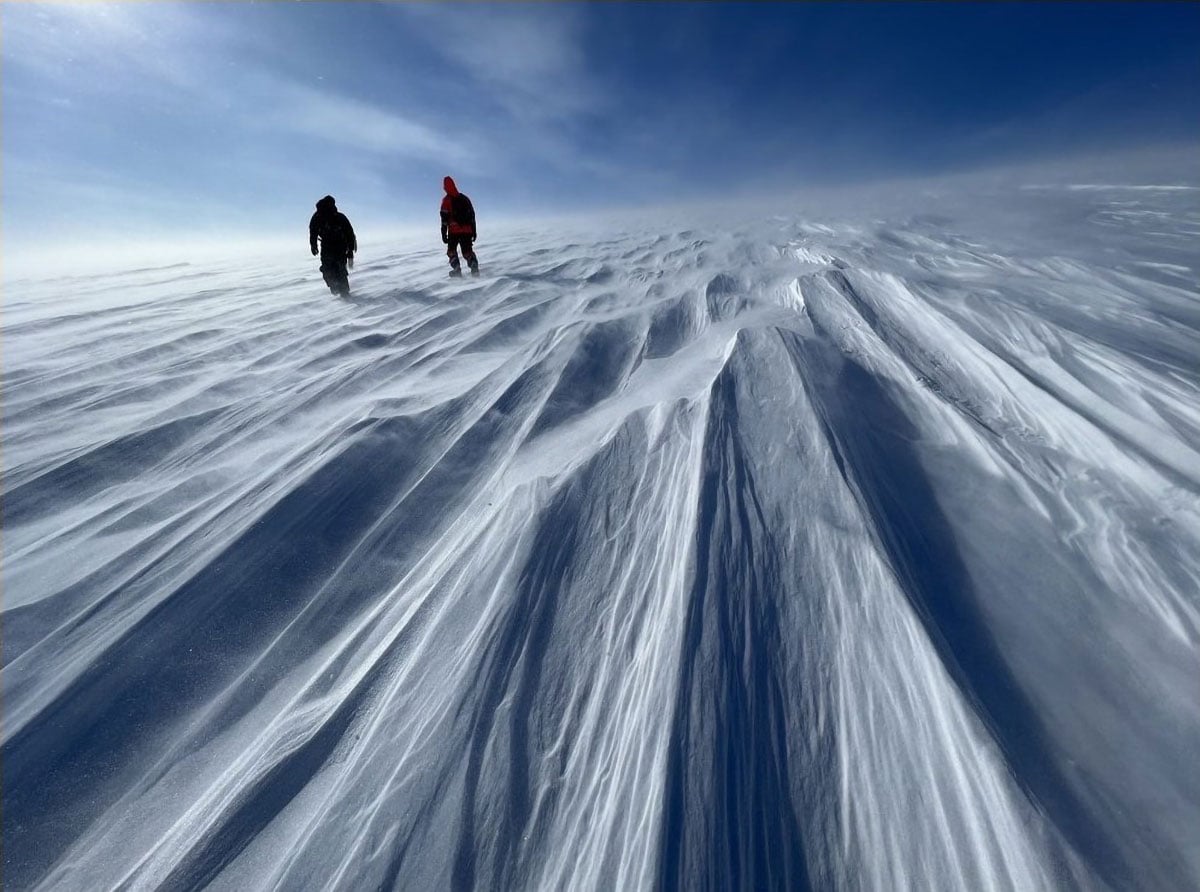
Analysis of core samples extracted from beneath an ice sheet indicates that the region is extremely responsive to the temperatures characteristic of today’s interglacial period.
Researchers involved in GreenDrill, a project jointly led by the University at Buffalo to recover rock and sediment from beneath the Greenland Ice Sheet, report that the Prudhoe Dome ice cap completely disappeared about 7,000 years ago. This timing is far more recent than scientists had previously estimated.
The results, published in Nature Geoscience, indicate that this elevated area along the ice sheet’s northwest margin responds strongly to the modest warmth of the Holocene. This interglacial period began roughly 11,000 years ago and extends to the present day.
“This is a time known for climate stability, when humans first began developing farming practices and taking steps toward civilization. So for natural, mild climate change of that era to have melted Prudhoe Dome and kept it retreated for potentially thousands of years, it may only be a matter of time before it begins peeling back again from today’s human-induced climate change,” says Jason Briner, PhD, professor and associate chair of the Department of Earth Sciences in the UB College of Arts and Sciences, who co-led GreenDrill with Joerg Schaefer PhD, research professor at Columbia University’s Lamont-Doherty Earth Observatory.
Drilling into Greenland’s Past
Supported by the U.S. National Science Foundation, GreenDrill represents a unique effort to bore through the Greenland Ice Sheet to reach the ancient bedrock and sediment locked beneath it. Scientists currently possess less material from under Greenland’s ice than they do from lunar samples, yet these buried sediments are especially valuable. Their chemical characteristics reveal when they were last exposed to open air, offering direct evidence of past ice retreat.
For this initial study, the team examined core samples extracted from a depth of 1,669 feet during a weeks-long field campaign conducted at the summit of Prudhoe Dome in 2023.
The sediment was analyzed using luminescence dating. While buried, natural radiation causes electrons to become trapped within tiny mineral grains. These electrons remain stored until the sediment is re-exposed to light, at which point they emit a detectable glow that can be measured to determine how long the material has remained underground.
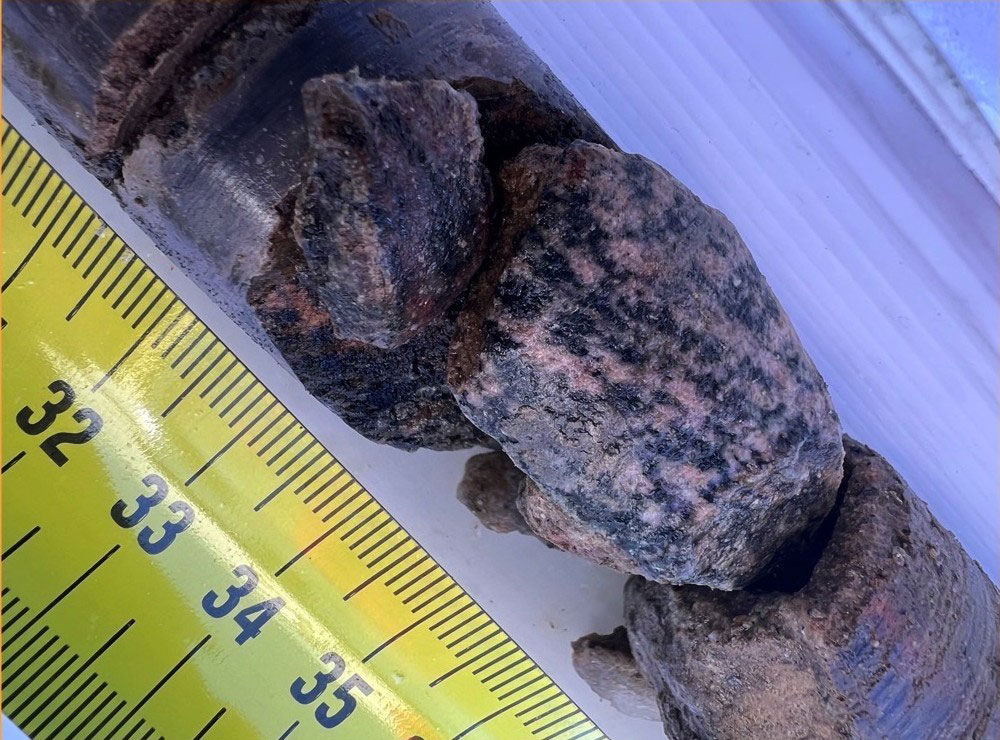
The intensity of that glow revealed that the Prudhoe Dome sediment was last exposed to daylight sometime between 6,000 and 8,200 years ago.
“This means Prudhoe Dome melted sometime before this period, likely during the early Holocene, when temperatures were around 3 to 5 degrees Celsius warmer than they are today. Some projections indicate we could reach those levels of warming at Prudhoe Dome by the year 2100,” says the study’s lead author, Caleb Walcott-George, PhD, a former UB graduate student and now assistant professor at the University of Kentucky.
The results also have large implications for sea level rise. Analyzing vulnerable areas along the edge of the ice sheet like Prudhoe Dome can give scientists an idea of where the ice sheet will melt first and, thus, which coastal communities are at the most immediate risk.
“Rock and sediment from below the ice sheet tell us directly which of the ice sheet’s margins are the most vulnerable, which is critical for accurate local sea level predictions. This new science field delivers this information via direct observations and is a game-changer in terms of predicting ice-melt,” Schaefer says.
On the ice
GreenDrill set up two drill sites on Prudhoe Dome — one on the summit and another near the edge, where the ice is much thinner. (This study analyzed the sample collected from the summit.)
Their sites were not far from the Cold War-era base Camp Century, where U.S. Army scientists attempted to drill into the ice to hide nuclear missiles but instead serendipitously pulled up the sediment underneath. That sediment was stored at UB for many years and would later help scientists learn that the ice sheet was much smaller approximately 400,000 years ago.
The GreenDrill sites where Briner, Schaefer, Walcott-George, and colleagues all spent time in the spring of 2023 were a collection of yellow tents and pathways marked by red, black, and green flags. Their days consisted of collecting ice chips pushed up by drilling fluid and shoveling out the camp from windblown snow, while ice drillers from the NSF Ice Drilling Program worked on pushing through hundreds of feet of ice.
There was plenty of drama, too — a fracture in the ice at the summit site nearly doomed the project at its final stage. A last-minute solution, using a drill bit normally reserved for rocks, allowed them to finish drilling the last 390 feet of ice and sample the bed just before planes arrived to remove their equipment.
“It was like watching a Buffalo Bills game,” Briner says. “Just stressful until the final minute.”
He credits the teamwork and camaraderie of the scientists and drillers on the ice, as well as the support crew behind the scenes, handling logistics. Collaborators on the project included Nicolás Young, PhD, associate research professor at Lamont and GreenDrill co-principal investigator; Allie Balter-Kennedy, PhD, a former postdoc at Lamont and now assistant professor at Tufts University; and Nathan Brown, PhD, assistant professor at the University of Texas at Arlington.
“This project involved more complicated logistics than any I’ve been involved with in my career. So many moving parts, and so much talent among the scientists, drillers, and support staff,” Briner says.
Walcott-George, who took a leading role setting up the camps and ultimately based his dissertation on the project, called his time on the ice “humbling.”
“When all you see is ice in all directions, to think of that ice being gone in the recent geological past and again in the future is just really humbling,” he says.
Project’s future
The GreenDrill team says this is the first of many studies they expect to produce. The other core drilled from near the edge of Prudhoe Dome promises to give insight into the ice cap’s most vulnerable point. Traces of plants in the samples could also shed light on Greenland’s ancient environment.
“We have a treasure chest in our hands now that we can pick apart and explore,” Briner says.
They also hope to possibly drill again and inspire other groups to do the same. The Camp Century team, as well as the Greenland Ice Sheet Project 2 in the 1990s, collected material below their ice cores, but GreenDrill is the first time that researchers selected drill sites based on collecting material from below the ice sheet.
“GreenDrill really demonstrated that, if you can logistically pull it off, there is the technology available to drill down to the bedrock and there’s an analytical toolkit to then analyze it,” Briner says. “We have very reliable, numerical models that can predict the rate of melting, but we also want real, observational data points that can tell us indisputably that X amount of warming in the past led to X amount of ice being gone.”
Reference: “Deglaciation of the Prudhoe Dome in northwestern Greenland in response to Holocene warming” by Caleb K. Walcott-George, Nathan D. Brown, Jason P. Briner, Allie Balter-Kennedy, Nicolás E. Young, Tanner Kuhl, Elliot Moravec, Sridhar Anandakrishnan, Nathan T. Stevens, Benjamin Keisling, Robert M. DeConto, Vasileios Gkinis, Joseph A. MacGregor and Joerg M. Schaefer, 5 January 2026, Nature Geoscience.
DOI: 10.1038/s41561-025-01889-9
Funding: U.S. National Science Foundation
Never miss a breakthrough: Join the SciTechDaily newsletter.
Follow us on Google and Google News.
4 Comments
“… the Prudhoe Dome ice cap completely disappeared about 7,000 years ago.”
And here we are just finding evidence for a forecast event that is commonly referred to as an “irreversible tipping point,” that happened at least once before.
“Their sites were not far from the Cold War-era base Camp Century, where U.S. Army scientists attempted to drill into the ice to hide nuclear missiles but instead serendipitously pulled up the sediment underneath. That sediment was stored at UB for many years and would later help scientists learn that the ice sheet was much smaller approximately 400,000 years ago.”
That description is far from being accurate or complete. When I was in the Army, I was assigned to the Cold Regions Research and Engineering Laboratory (CRREL, Hanover, NH) and spent a month at Camp Tuto, the jumping off point for over-ice travel to Camp Century. I supervised the final (10th) closure-survey for ice deformation in an ice tunnel at Camp Tuto in 1966. I have more than a passing acquaintance with the projects.
The drilling project at Camp Century, run by glaciologist Dr. Chester Langway, was a legitimate science project that developed ways to drill in ice that were followed up with similar ice-core retrieval programs in Antarctica: https://www.science.org/content/article/ancient-soil-secret-greenland-base-suggests-earth-could-lose-lot-ice
While the drilling did cover effectively for the failed, classified Project Iceworm, ( https://en.wikipedia.org/wiki/Project_Iceworm ) that should not be viewed in any way as a distraction from the importance of the innovative technology developed for the drilling or what was learned from the ice cores. One of the conclusions is that 400,000 years BP, or the more recent Eemian (129 – 116,000 years BP) weren’t just times when the continental ice sheet was “much smaller,” they were probably a time when the ice was reduced to alpine glaciers only present in the higher peaks. The drilling site shows that Arctic vegetation was abundant at the then-future Camp Century site.
I disnt k ow we had a clinitr crisis 7000 years ago whrr green house gases and humans with camp fires was avle to destavle the clinite to cause ice to melt.
How sis the humans of 7000 years ago reverse it?
Or
Like everything else in life its in cycles.?
Yeah but whats the chances a Meteor of solid iron will hit greenland and melt the ice of Canada/greenland sink the atlantic cause the warm weather that created the world deserts, flood the black sea, Sink adams bridge and the russia to yukon land path twice ? Or fill the atlantic ocean with so mud that oral history remembers it as a time were we could not sail as the Ocean north of the cleft of hurcules was Nothing but mud when atlantis sank beneath the sea? Lets just ignore all the evidence in the mountains of turkey were the worlds oldest observatory depicts it’s crash and the physical evidence ignored in greenland? I mean name one time other then that time Carbon dating was Ignored due to a lack of evidence of a world flood or that the glaciets of greenland melted 11,000 years ago. Which was the estimated impact site. Lets ignore the oral history of the proto inuit that survived in iceland and passed the story along.