
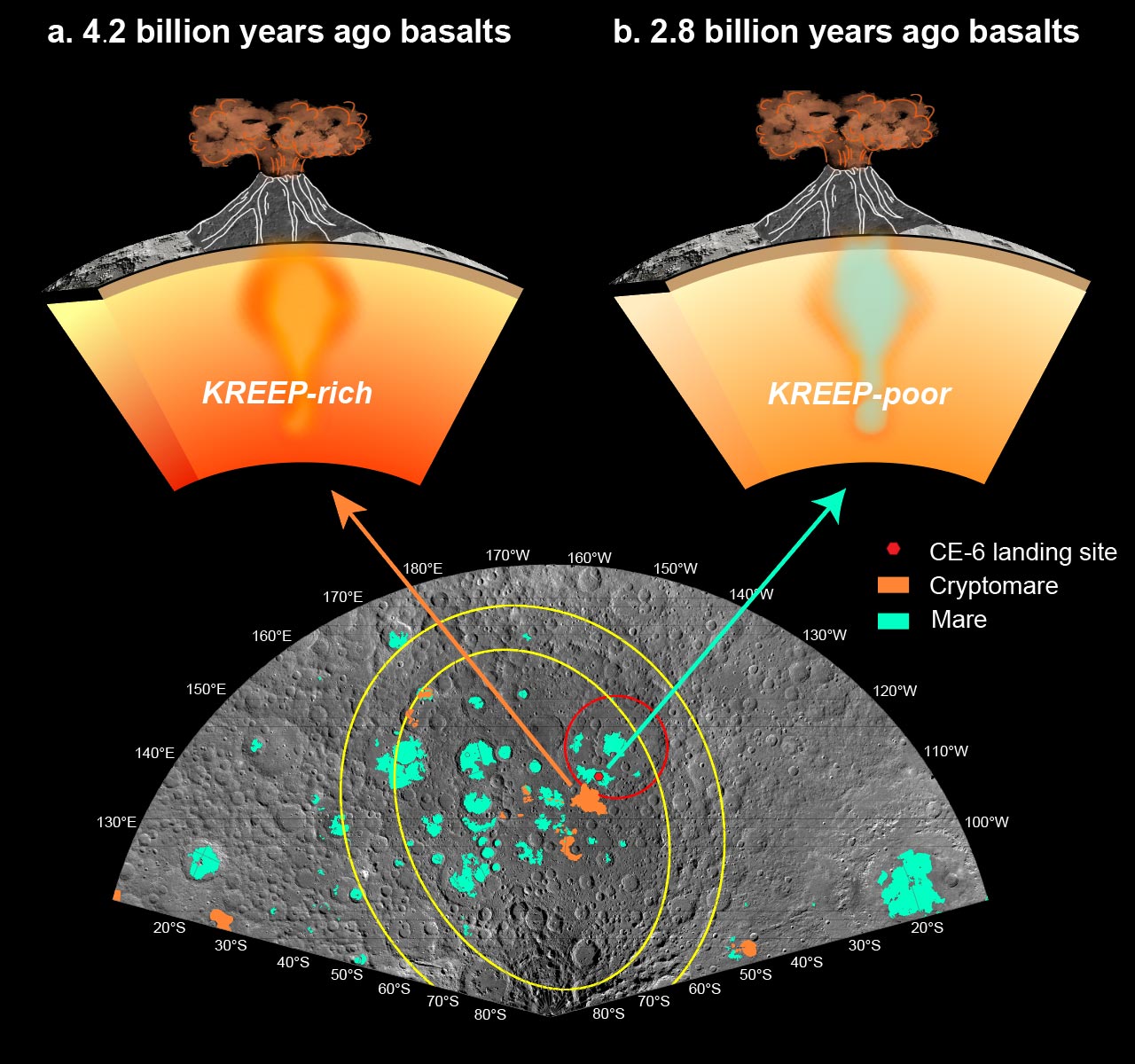
New findings from basalt samples retrieved by China’s Chang’e-6 mission reveal that volcanic activity on the Moon’s farside dates back between 4.2 and 2.8 billion years.
This research provides key insights into the lunar geological dichotomy and aids in the precision of lunar dating methods.
Lunar Farside’s Volcanic History Revealed
Basalt samples collected by China’s Chang’e-6 mission have uncovered volcanic activity on the Moon’s farside dating back 2.8 billion years (Ga) and 4.2 Ga. This groundbreaking research, led by Prof. Qiuli Li’s team at the Institute of Geology and Geophysics of the Chinese Academy of Sciences, was recently published in Nature.
“Unraveling the volcanic history of the lunar farside is crucial for understanding the hemispheric dichotomy of the Moon,” explained Prof. Li.
The Moon’s nearside and farside differ significantly in features like basalt distribution, topography, crustal thickness, and thorium (Th) concentration, presenting a longstanding puzzle for scientists. The Chang’e-6 mission, the first to return samples from the farside, has provided an invaluable 1,935.3-gram lunar soil sample, offering new insights into the volcanic history of this mysterious hemisphere.
Uncovering Ancient Volcanic Episodes
Led by Prof. Li, postdoctoral researcher ZHANG Qian conducted systematic radioisotope dating on 108 basalt fragments from this sample. Of these, 107 fragments revealed a consistent formation age of 2807 ± 3 million years ago (Ma), indicating the eruption age of local basalts at the Chang’e-6 landing site. Notably, this 2.8 Ga volcanic episode has not been observed in nearside samples.
The remaining fragment, of high-aluminum basalt and dating to 4203 ± 4 Ma, is thought to have originated from a cryptomare region south of the landing site. It is the oldest lunar basalt sample yet returned whose age has been precisely determined.
Implications for Lunar Geological Models
These data indicate that volcanic activity on the lunar farside persisted for at least 1.4 billion years, from 4.2 Ga to 2.8 Ga. Initial lead isotope analysis suggests that these basalts derive from distinct mantle sources: The 4.2 Ga basalt came from a KREEP-rich source, i.e., one with abundant potassium (K), rare earth elements (REE), and phosphorous (P), while the 2.8 Ga basalt came from a KREEP-poor source.
The close alignment between the 2.8 Ga basalt age and crater-counting estimates suggests that the cratering chronology model, established based on nearside observations, is also applicable to the lunar farside. The radioisotope ages of the Chang’e-6 basalts provide an essential calibration point for refining lunar crater-counting chronology, thus enhancing its accuracy, according to Prof. Li.
Reference: “Lunar farside volcanism 2.8 billion years ago from Chang’e-6 basalts” by Qian W. L. Zhang, Mu-Han Yang, Qiu-Li Li, Yu Liu, Zong-Yu Yue, Qin Zhou, Liu-Yang Chen, Hong-Xia Ma, Sai-Hong Yang, Xu Tang, Guang-Liang Zhang, Xin Ren and Xian-Hua Li, 15 November 2024, Nature.
DOI: 10.1038/s41586-024-08382-0
This research was conducted in collaboration with the National Astronomical Observatories, with samples provided by the China National Space Administration. Funding was provided by the National Natural Science Foundation of China, the Strategic Priority Research Program (Category B) of the Chinese Academy of Sciences, and the Key Research Program of the Institute of Geology and Geophysics, Chinese Academy of Sciences.
Never miss a breakthrough: Join the SciTechDaily newsletter.
Follow us on Google and Google News.