
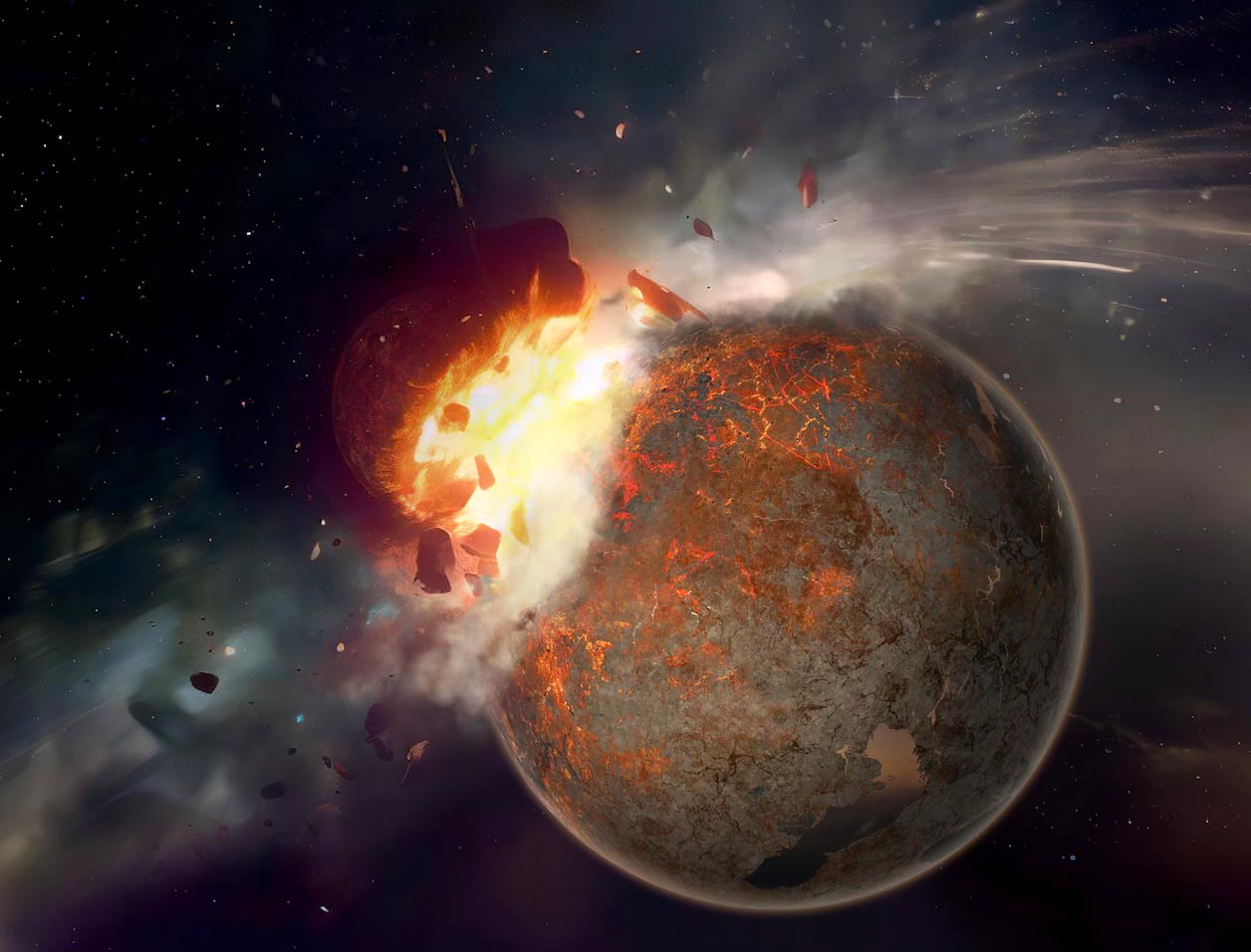
Recent research indicates that Earth’s mantle contains two large blobs, remnants of Theia, the ancient planet whose collision with Earth led to the moon’s creation. This discovery offers fresh insights into the moon’s formation and Earth’s early history.
In the 1980s, geophysicists made a startling discovery: Two continent-sized blobs of unusual material were found deep near the center of the Earth, one beneath the African continent and one beneath the Pacific Ocean.
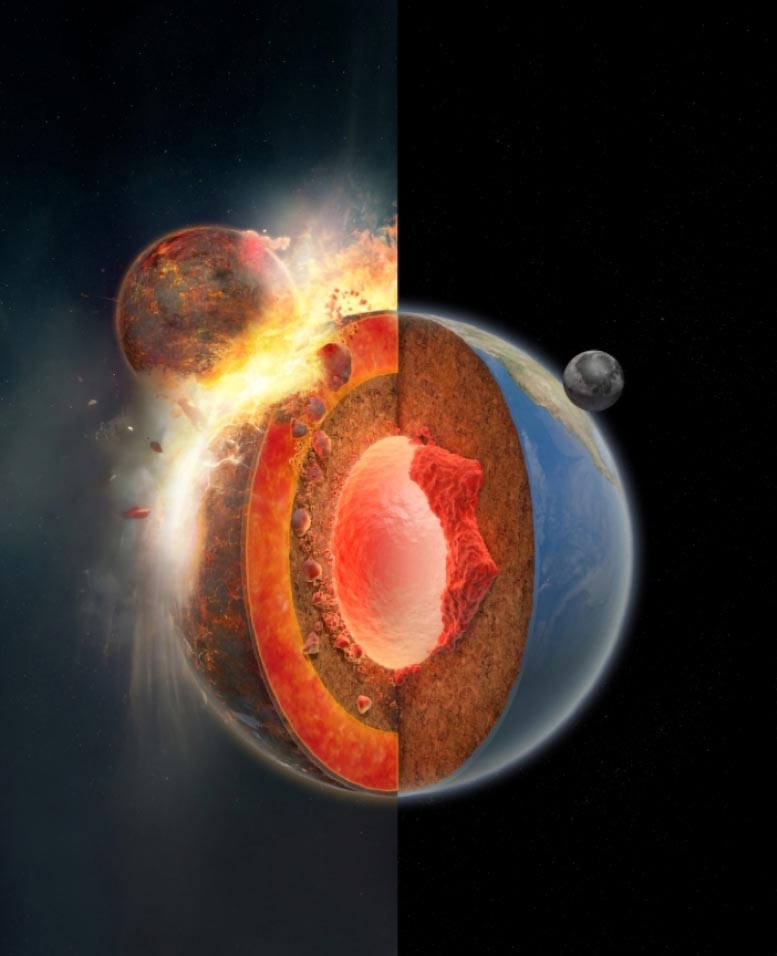
Each blob is twice the size of the moon, and research over the last decade has shown that they are likely composed of different proportions of elements than the mantle surrounding it.
The Origin of LLVPs
Where did these strange blobs — formally known as large low-velocity provinces (LLVPs) — come from? A new study suggests that they are remnants of an ancient planet that violently collided with Earth billions of years ago, in the same giant impact that created our moon.
An interdisciplinary team including Arizona State University School of Earth and Space Exploration scientists, was led by ASU alumnus Qian Yuan, currently an O.K. Earl Postdoctoral Fellow at Caltech. The study, published in the journal Nature, also proposes a solution for another planetary science mystery.
Theia’s Legacy
For more than 20 years, scientists have known that Earth has giant blobs in its interior, with unusual composition and an unknown origin. These structures are so massive that if you put them on Earth’s surface, they would make a layer roughly 60 miles (100 km) thick around the entire planet.
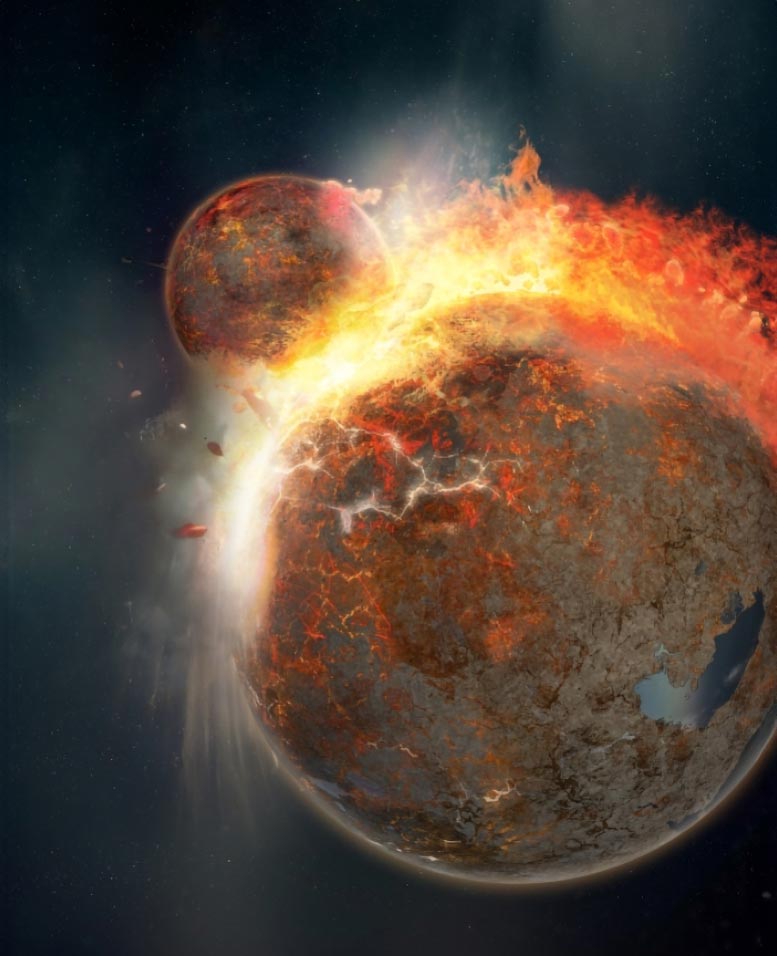
Furthermore, it has been hypothesized that the moon was created in the aftermath of a giant impact between Earth and a smaller planet dubbed Theia. Still, no trace of Theia has ever been discovered in the asteroid belt or meteorites.
This new study suggests that most of Theia was absorbed into the young Earth, forming the LLVP blobs, while residual debris from the impact coalesced into the moon.
“The moon appears to have materials within it representative of both the pre-impact Earth and Theia, but it was thought that any remnants of Theia in the Earth would have been ‘erased’ and homogenized by billions of years of dynamics (e.g., mantle convection) within the Earth,” said Steven Desch, professor at ASU’s School of Earth and Space Exploration. “This is the first study to make the case that distinct ‘pieces’ of Theia still reside within the Earth, at its core-mantle boundary.”
Seismic Discoveries and Implications
Scientists first discovered the LLVPs by measuring seismic waves traveling through the Earth. Seismic waves travel at different speeds through different materials, and in the 1980s, the first hints emerged of large-scale three-dimensional variations deep within the structure of the Earth.
In the deepest mantle, the seismic wave pattern is dominated by the signatures of two continent-sized structures near the Earth’s core. They are interpreted as regions with unusually high iron content, whose increased density and temperature slow down seismic waves passing through, leading to the name “large low-velocity provinces.”
“But now we have an explanation for them. It appears that Earth’s blobs are remnants of a planetary collision that formed our moon,” said Ed Garnero, professor at ASU’s School of Earth and Space Exploration. “In other words, the massive blobs currently inside Earth, deep beneath our feet, are extraterrestrial. Earth not only has ‘blobs,’ Earth has extraterrestrial blobs!”
Yuan, a geophysicist by training, was one day attending a seminar about planet formation given by Mikhail Zolotov, a professor at ASU. Zolotov presented the giant-impact hypothesis, while Qian noted that the moon is relatively rich in iron. Zolotov added that no trace had been found of the impactor that must have collided with the Earth.
“Right after Mikhail had said that no one knows where the impactor is now, I had a ‘eureka moment’ and realized that the iron-rich impactor could have transformed into mantle blobs,” Yuan said.
A Multidisciplinary Approach
The multidisciplinary team of collaborators modeled different scenarios for Theia’s chemical composition and its impact with Earth. The simulations confirmed that the physics of the collision could have led to both the LLVPs’ formation and the moon’s formation.
“This work showed that the large blobs (the LLVPs) in Earth’s deep mantle may be made of materials from a planetary body that impacted the proto-Earth and formed the moon,” said Mingming Li, professor at ASU’s School of Earth and Space Exploration. “Therefore, the moon and the blobs have the same origin.”
Given such a violent impact, why did Theia’s material clump into the two distinct blobs instead of mixing together with the rest of the forming planet? The researchers’ simulations showed that much of the energy delivered by Theia’s impact remained in the upper half of the mantle, leaving the lower mantle of the Earth cooler than estimated by earlier, lower-resolution impact models. Because the impact did not totally melt the lower mantle, the blobs of iron-rich material from Theia stayed largely intact.
“Through mantle convection simulations, we found that the dense, iron-rich materials from Theia could sink to and accumulate at the base of Earth’s mantle. These materials could stay there throughout Earth’s history of about 4.5 billion years,” Li said.
“By looking inward, towards Earth’s interior, instead of outward, towards the moon, we have found yet another piece of evidence of the cosmic catastrophe that is the moon-forming giant impact,” said co-author Travis Gabriel, of the U.S. Geological Survey.
“The study really places Earth into the context of the inner solar system formation,” said co-author Hongping Deng of the Chinese Academy of Sciences. “Imagine that if we managed to recover some Theia signals from the deepest mantle, we could better understand the architecture and composition of the infant solar system without turning to present-day meteorites with messed-up signals.”
For more on this research:
- Strange Blobs in Earth’s Deep Mantle Are the Remains of an Ancient Planet
- Fragments of Ancient Planet Found in Earth’s Mantle
Reference: “Moon-forming impactor as a source of Earth’s basal mantle anomalies” by Qian Yuan, Mingming Li, Steven J. Desch, Byeongkwan Ko, Hongping Deng, Edward J. Garnero, Travis S. J. Gabriel, Jacob A. Kegerreis, Yoshinori Miyazaki, Vincent Eke and Paul D. Asimow, 1 November 2023, Nature.
DOI: 10.1038/s41586-023-06589-1
Additional authors on this study include ASU alumni Byeongkwan Ko, a postdoc at Michigan State University; Paul Asimow and Yoshinori Miyazaki at Caltech; Jacob Kegerreis of NASA Ames Research Center; and Vincent Eke of Durham University.
This work was supported by the National Science Foundation, the O.K. Earl Postdoctoral Fellowship at Caltech, the U.S. Geological Survey, NASA and the Caltech Center for Comparative Planetary Evolution.
Never miss a breakthrough: Join the SciTechDaily newsletter.
Follow us on Google and Google News.