
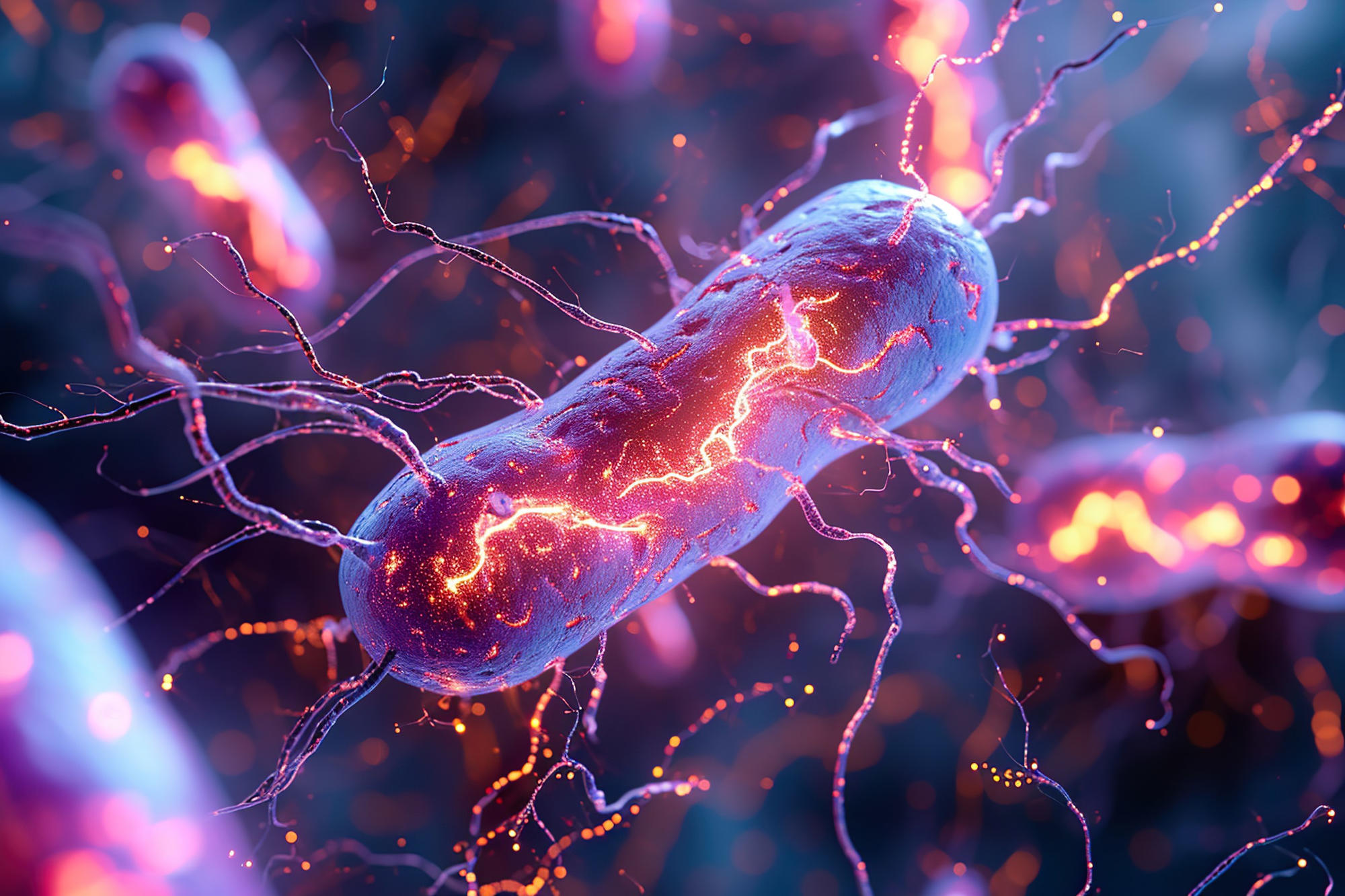
Biologists from Konstanz have unveiled a unique and ancient phosphorus-based bacterial metabolism. Central to this discovery are four elements: an analytical calculation dating back to the 1980s, a modern sewage treatment facility, the identification of a novel bacterial species, and a remnant from around 2.5 billion years ago.
Our story begins at the end of the 1980s, with a sheet of paper. On this sheet, a scientist calculated that the conversion of the chemical compound phosphite to phosphate would release enough energy to produce the cell’s energy carrier – the ATP molecule. In this way, it should therefore be possible for a microorganism to supply itself with energy. Unlike most living organisms on our planet, this organism would not be dependent on energy supply from light or from the decomposition of organic matter.
The scientist actually succeeded in isolating such a microorganism from the environment. Its energy metabolism is based on the oxidation of phosphite to phosphate, just as predicted by the calculation. But how exactly does the biochemical mechanism work? Regrettably, the key enzyme needed to understand the biochemistry behind the process remained hidden – and thus the mystery remained unsolved for many years. In the following three decades, the sheet stayed in the drawer, the research approach was put on the back burner. Yet the scientist couldn’t get the thought out of his head.
The scientist is Bernhard Schink, a professor at the Limnological Institute of the University of Konstanz. Three decades after he made the calculation on paper, an unexpected discovery set the ball rolling again …
A sewage plant, an unexpected find, and a new species
What had been in the back of his mind for many years was finally found: of all places, in a sewage plant in Konstanz, only a few kilometers from Bernhard Schink’s laboratory. Zhuqing Mao, a biology doctoral researcher from Konstanz, examined a sewage sludge sample and discovered a second microorganism that also gets its energy from phosphite. The Konstanz biologists led by Bernhard Schink placed this bacterium in an environment in which it had only phosphite as a food source. And indeed: the bacterial population grew.
“This bacterium subsists on phosphite oxidation, and as far as we know, exclusively on this reaction. It covers its energy metabolism this way, and can build up its cell substance from CO2 at the same time,” explains Schink. “This bacterium is an autotrophic organism, like a plant. It does, however, not need light like a plant, as it draws its energy from phosphite oxidation”. Surprisingly, it turned out that the bacterium is not only a new species, but actually forms an entirely new genus of bacteria.
Tracking down the molecular mechanism
From that point on, things happened very quickly. A whole network of Konstanz researchers dedicated themselves to unraveling the mystery, including Bernhard Schink, Nicolai Müller, David Schleheck, Jennifer Fleming, and Olga Mayans. They produced a pure culture of this new bacterial strain, in which they were finally able to identify the key enzyme that triggers the oxidation of phosphite to phosphate.
“The breakthrough came with Nicolai Müller and his enzyme experiments”, says David Schleheck. Nicolai Müller succeeded in clearly demonstrating the enzyme’s activity, thereby uncovering the biochemical mechanism behind the key enzyme. Olga Mayans and Jennifer Fleming created a three-dimensional model of its enzyme structure and active center to understand the reaction pathway.
“What was very surprising was that during its oxidation, phosphite is apparently coupled directly to the energy-carrier precursor AMP, whereby the energy carrier ADP is created. In a subsequent reaction, two of the generated ADPs are converted to one ATP, on which the organism ultimately lives,” Nicolai Müller outlines the reaction pathway.
Finally, everything came together: The original sheet became a whole pile of papers, resulting in a publication in the scientific journal PNAS.
A remnant from 2.5 billion years ago
The discovery of a new type of energy metabolism is in itself a great scientific success. However, the research team thinks that this type of metabolism is by no means new, but very old, even ancient: around 2.5 billion years old.
“It is assumed that in the early days of evolution, when the Earth was cooling down, phosphorus was still present to a large extent in a partially reduced form and was only later gradually oxidized. The metabolism we have now discovered fits very well into the early phase of the evolution of microorganisms,” Bernhard Schink explains.
The biochemical mechanism that the bacterium uses for its metabolism is therefore not new, but has most probably been preserved from the primeval times of our planet: back when life on our planet began and the first microorganisms had to feed on inorganic compounds such as phosphite. Thus the new scientific findings provide clues to the early biochemical evolution on our planet. In addition, they provide the key to a biochemical mechanism that makes life possible in very hostile places, possibly even on alien planets.
Who would have thought at the end of the 1980s that a piece of paper would set all this in motion…
Reference: “AMP-dependent phosphite dehydrogenase, a phosphorylating enzyme in dissimilatory phosphite oxidation” by Zhuqing Mao, Jennifer R. Fleming, Olga Mayans, Jasmin Frey, David Schleheck, Bernhard Schink and Nicolai Müller, 3 November 2023, Proceedings of the National Academy of Sciences.
DOI: 10.1073/pnas.2309743120
Never miss a breakthrough: Join the SciTechDaily newsletter.
Follow us on Google and Google News.