
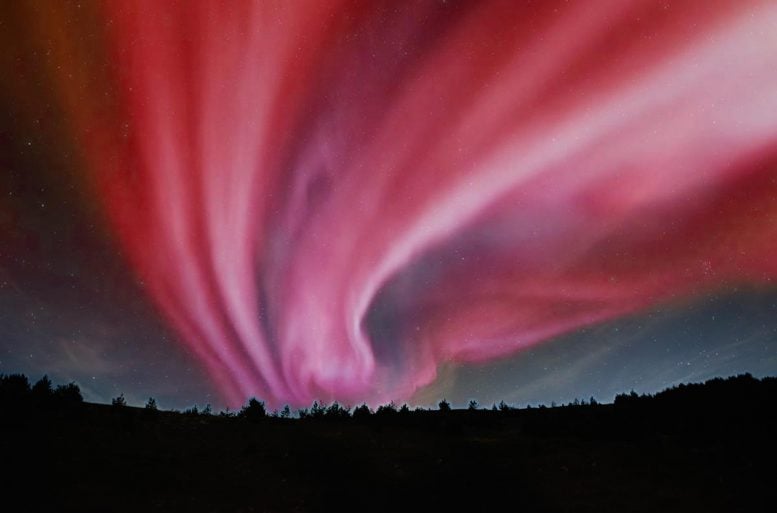
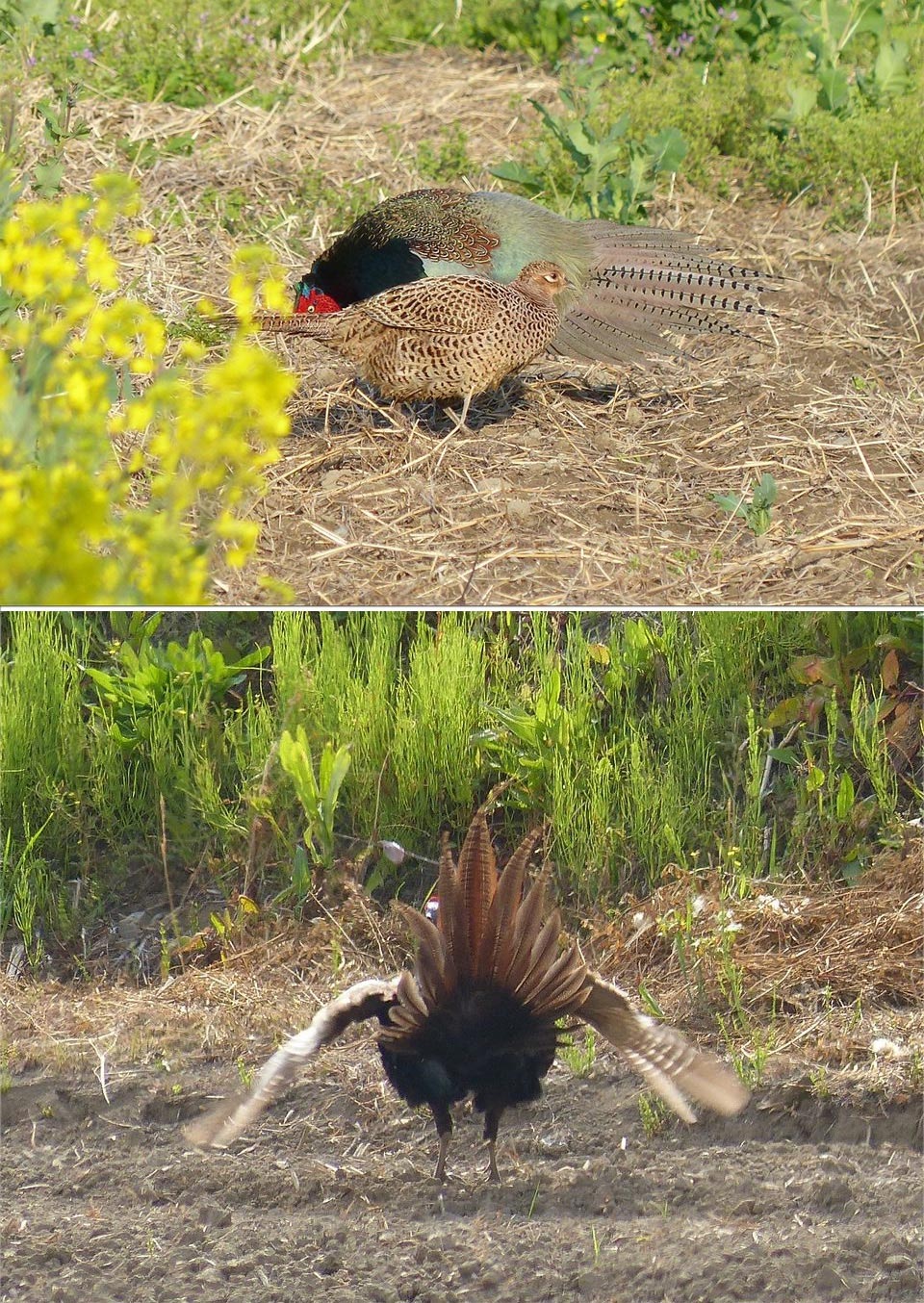
Nearly a millennium and a half ago, red light streaked the night sky over Japan. Witnesses compared it to the tail of a pheasant — it appeared as a fan of beautiful red feathers stretched across the sky. Since the event, scientists have studied the witness accounts written in the year 620 A.D. and speculated about what the cosmic phenomenon could have actually been. Now, researchers from The Graduate University for Advanced Studies may have found the answer.
They published their results on March 31, 2020, in the Sokendai Review of Culture and Social Studies.
“It is the oldest Japanese astronomical record of a ‘red sign,'” said Ryuho Kataoka, a researcher with the Department of Polar Science in the School of Multidisciplinary Sciences at The Graduate University for Advanced Studies and the National Institute of Polar Research. “It could be a red aurora produced during magnetic storms. However, convincing reasons have not been provided, although the description has been very famous among Japanese people for a long time.”
The problem with the aurora hypothesis, according to Kataoka, is that auroras do not look like pheasant tails. Instead, they are ribbon-esque, waving across the sky. It could have been a comet, some researchers speculated, but comets do not often appear red.
To better understand the phenomenon, Kataoka and his team adjusted their view — literally. The magnetic latitude of Japan was 33 degrees in 620, compared to 25 degrees today. The pheasant tail appeared to be about 10 degrees long, placing it well within the area that would be affected by a strong magnetic storm.
“Recent findings have shown that auroras can be ‘pheasant tail’ shaped specifically during great magnetic storms,” Kataoka said. “This means that the 620 A.D. phenomenon was likely an aurora.”
The researchers plan to continue examining literary references for modern scientific relevance.
“This is an interesting and successful example that modern science can benefit from the ancient Japanese emotion evoked when the surprising appearance of heaven reminded them of a familiar bird,” Kataoka said.
Pheasants are culturally significant in Japan and have been for generations. They were considered messengers of the heaven in traditional Japanese folklore. According to Kataoka, it is likely meaningful that the historical records used the shape of a pheasant’s tail to describe the “heavenly” phenomenon of the fan-shaped auroras.
“We hope to continue exploring this collaboration between science and literature,” Kataoka said.
Reference: “Pheasant Tail: Consideration of the Shape of the Red Sign in the Nihon-Shoki” by Ryuho Kataoka, Kazuaki Yamamoto, Yasunori Fujiwara, Kozue Shiomi and Nobuo Kokubun, 31 March 2020, Sokendai Review of Culture and Social Studies.
Other contributors include Kozue Shiomi and Nobuo Kokubun, both with the Department of Polar Science in the School of Multidisciplinary Sciences at The Graduate University for Advanced Studies and the National Institute of Polar Research; Kazuaki Yamamoto, with the Department of Japanese Literature in the School of Culture and Social Studies in The Graduate University for Advanced Studies and the National Institute of Japanese Literature; and Yasunori Fujiwara, of the Department of Polar Science in the School of Multidisciplinary Sciences at The Graduate University for Advanced Studies.
Never miss a breakthrough: Join the SciTechDaily newsletter.
Follow us on Google and Google News.
1 Comment
One night my wife and I spotted a red glow in the sky but not high up, it looked as though there was something on earth that was causing that part of the sky to glow red. We thought it was a few miles away but no matter how far we drove it still appeared to be just a few miles away 33 miles later and it wasn’t getting any closer nor was it changing in size. The brightness remained the same throughout the night. Just a round red glow.