
Close Menu
    Facebook X (Twitter) Instagram
    SciTechDaily
    • Biology
    • Chemistry
    • Earth
    • Health
    • Physics
    • Science
    • Space
    • Technology
    Facebook X (Twitter) Pinterest YouTube RSS
    SciTechDaily
    Home»Science»Animal Bones Reveal Huge Feasts at Ancient Capital of Ulster Drew Crowds From Across Iron Age Ireland
    Science

    Animal Bones Reveal Huge Feasts at Ancient Capital of Ulster Drew Crowds From Across Iron Age Ireland

    By Cardiff UniversityDecember 30, 2019No Comments3 Mins Read
    Facebook Twitter Pinterest Telegram LinkedIn WhatsApp Email Reddit
    Share
    Facebook Twitter LinkedIn Pinterest Telegram Email Reddit
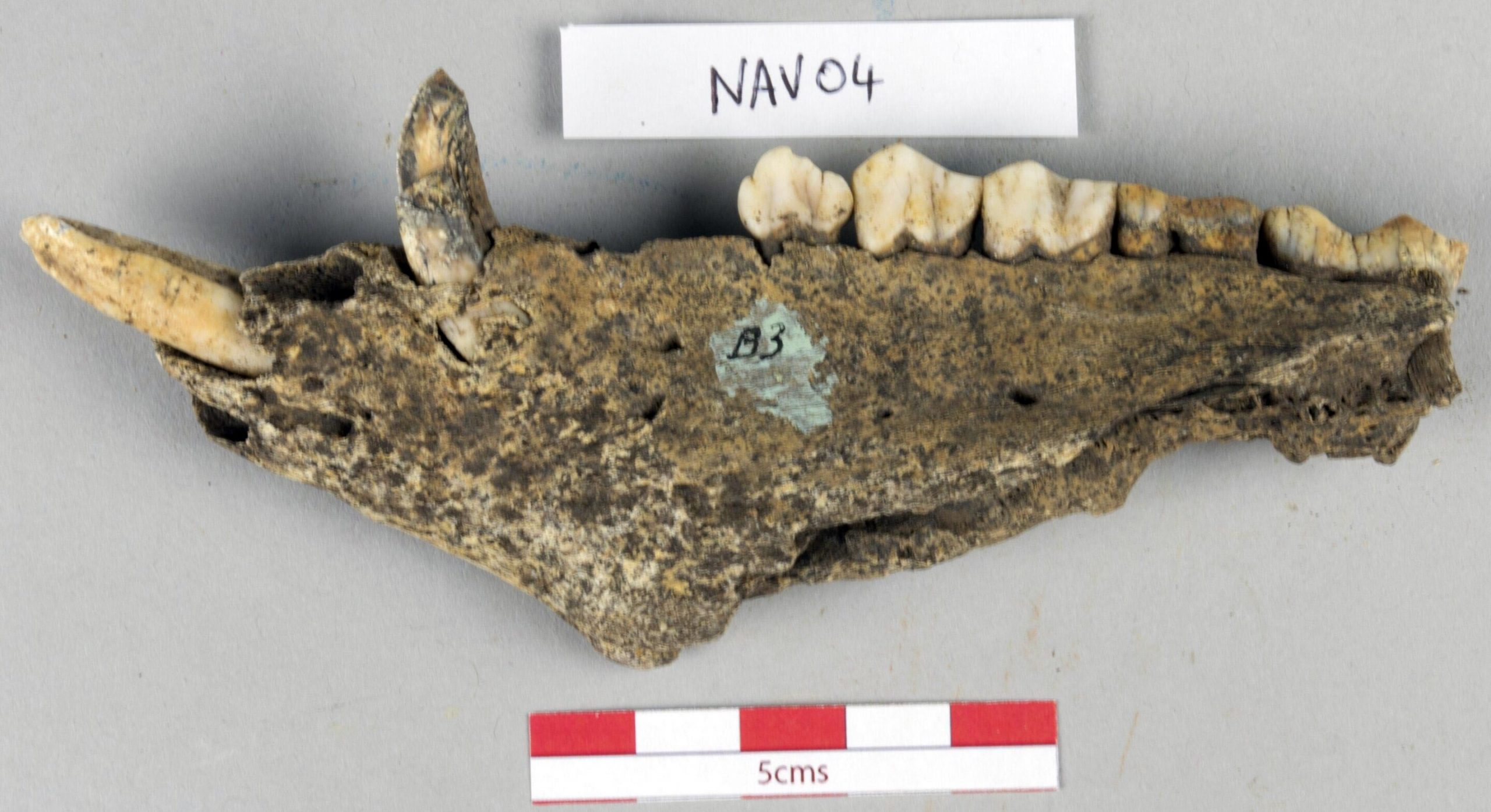
    Analyzed Pig Jaws
    One of the analyzed pig jaws for the study. Credit: Dr. Richard Madgwick

    Study explores scale of human mobility through analysis of animal bones.

    People transported animals over huge distances for mass gatherings at one of Ireland’s most iconic archaeological sites, research concludes.

    Dr. Richard Madgwick of Cardiff University led the study, which analyzed the bones of 35 animals excavated from Navan Fort, the legendary capital of Ulster. Researchers from Queen’s University Belfast, Memorial University Newfoundland and the British Geological Survey were also involved in the research.

    The site had long been considered a center for ritual gatherings, as excavations found a huge 40m diameter building and a barbary ape cranium, likely from at least as far as Iberia. Results suggest the pigs, cattle, and sheep were brought from across Ireland, perhaps being reared as far afield as Galway, Donegal, Down, Tyrone and Antrim. Evidence suggests some were brought over more than 100 miles.

    Dr. Madgwick, based in Cardiff University’s School of History, Archaeology, and Religion, said: “Our results provide clear evidence that communities in Iron Age Ireland were very mobile and that livestock were also moved over greater distances than was previously thought.

    “The high proportion of pig remains found there is very rare for this period. This suggests that Navan Fort was a feasting center, as pigs are well-suited as feasting animals, and in early Irish literature pork is the preferred food of the feast.

    “It is clear that Navan Fort had a vast catchment and that the influence of the site was far-reaching.”

    Researchers used multi-isotope analysis on samples of tooth enamel to unlock the origins of each animal. Food and water have chemical compositions linked to the geographical areas where they are sourced. When animals eat and drink, these chemical signals are archived in their teeth, allowing scientists to investigate the location where they were raised.

    Co-author of the research, Dr. Finbar McCormick, of Queen’s University, Belfast, said: “In the absence of human remains, multi-isotope analysis of animals found at Navan Fort provides us with the best indication of human movement at that time.

    “Feasting, almost invariably associated with sacrifice, was a social necessity of early societies where the slaughter of a large domesticate necessitated the consumption of a large amount of meat in a short period of time.”

    Earlier this year, Dr. Madgwick’s research of 131 pigs found at sites near Stonehenge revealed animals came from as far away as Scotland and numerous other locations across the British Isles. Before this, the origins of people who visited this area and the extent of the population’s movements at the time had been long-standing enigmas in British prehistory.

    Dr. Madgwick added: “Transporting animals across the country would have involved a great deal of time and effort so our findings demonstrate the important role they played in society. Food was clearly a central part of people’s exchanges and traditions.”

    Reference: “Feasting and Mobility in Iron Age Ireland: Multi-isotope analysis reveals the vast catchment of Navan Fort, Ulster” by Richard Madgwick, Vaughan Grimes, Angela L. Lamb, Alexandra J. Nederbragt, Jane A. Evans and Finbar McCormick, 24 December 2019, Scientific Reports.
    DOI: 10.1038/s41598-019-55671-0

    Never miss a breakthrough: Join the SciTechDaily newsletter.
    Follow us on Google and Google News.

    Archaeology Cardiff University Food Science
    Share. Facebook Twitter Pinterest LinkedIn Email Reddit

    Related Articles

    Viking Horses Crossed Seas for Sacrifice: New Study Reveals Long-Distance Rituals

    Humans Were Apex Predators for Two Million Years – Our Stone Age Ancestors Mostly Ate Meat

    Ancient DNA Continues to Rewrite the 9,000-Year Society-Shaping History of Corn

    Reconstructing the Meals That People Consumed in the Past From Chemical Residues on Ancient Cooking Pots

    The Origin of Feces: Using AI & DNA to Reliably Predict Sources of Ancient Poop

    Middle Stone Age Innovation Linked to Rapid Climate Change

    More Dolphins Being Eaten In Poor Countries

    Dingo Solves Complex Problem, Moves Furniture to Reach Food

    Archaeologists Inch Closer to Understanding Stonehenge

    Leave A Reply Cancel Reply

    • Facebook
    • Twitter
    • Pinterest
    • YouTube

    Don't Miss a Discovery

    Subscribe for the Latest in Science & Tech!

    Trending News

    Scientists Uncover Potential Brain Risks of Popular Fish Oil Supplements

    Scientists Discover a Surprising Way To Make Bread Healthier and More Nutritious

    After 60 Years, Scientists Uncover Unexpected Brain Effects of Popular Diabetes Drug Metformin

    New Research Uncovers Hidden Side Effects of Popular Weight-Loss Drugs

    Scientists Rethink Extreme Warming After Surprising Ocean Discovery

    Landmark Study Links Never Marrying to Significantly Higher Cancer Risk

    Researchers Discover Unknown Beetle Species Just Steps From Their Lab

    Largest-Ever Study Finds Medicinal Cannabis Ineffective for Anxiety, Depression, PTSD

    Follow SciTechDaily
    • Facebook
    • Twitter
    • YouTube
    • Pinterest
    • Newsletter
    • RSS
    SciTech News
    • Biology News
    • Chemistry News
    • Earth News
    • Health News
    • Physics News
    • Science News
    • Space News
    • Technology News
    Recent Posts
    • Students Build Dark Matter Detector and Set New Experimental Limits
    • Scientists Discover Caffeine Can Repair Key Memory Circuits After Sleep Loss
    • Strange 65-Foot Dinosaur Discovered in Argentina
    • Researchers Uncover Source of Strange Deformation in Earth’s Largest Continental Rift
    • Scientists Solve Mystery of Where the Colorado River Vanished Millions of Years Ago
    Copyright © 1998 - 2026 SciTechDaily. All Rights Reserved.
    • Science News
    • About
    • Contact
    • Editorial Board
    • Privacy Policy
    • Terms of Use

    Type above and press Enter to search. Press Esc to cancel.