

In a remote area, a mix of geophysical methods identifies magma transfer below the seafloor as the cause.
Even off the coast of Antarctica, volcanoes can be found. A sequence of more than 85,000 earthquakes was recorded in 2020 at the deep-sea volcano Orca, which has been inactive for a long time, a swarm quake that reached proportions not previously observed for this region. The fact that such events can be studied and described in remarkable detail even in such remote, and therefore poorly instrumented areas, is now shown by a study published in the journal Communications Earth and Environment by an international team of researchers.
Researchers from Germany, Italy, Poland, and the United States were involved in the study, which was led by Simone Cesca of the German Research Center for Geosciences (GFZ) Potsdam. They were able to combine seismological, geodetic, and remote sensing techniques to determine how the rapid transfer of magma from the Earth’s mantle near the crust-mantle boundary to almost the surface caused the swarm quake.
The Orca Volcano Between the Tip of South America and Antarctica
Swarm quakes mainly occur in volcanically active regions. The movement of fluids in the Earth’s crust is therefore suspected as the cause. Orca seamount is a large submarine shield volcano with a height of about 900 meters (2,950 feet) above the seafloor and a base diameter of about 11 kilometers (6.8 miles). It is located in the Bransfield Strait, an ocean channel between the Antarctic Peninsula and the South Shetland Islands, southwest of the southern tip of Argentina.
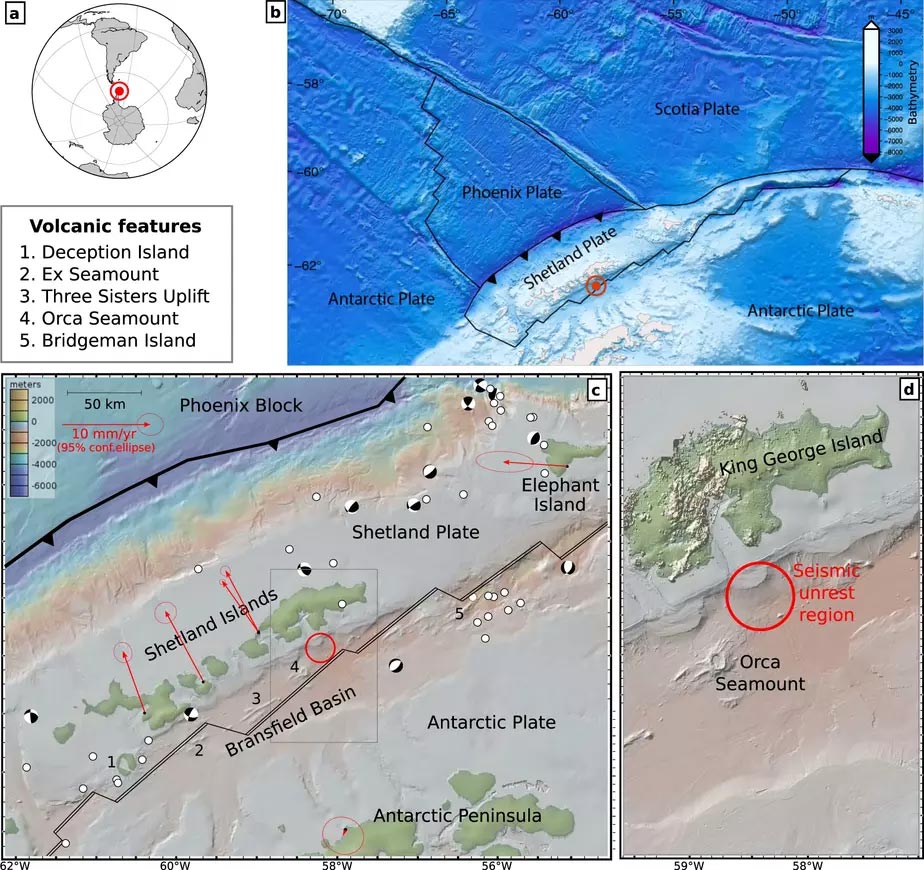
“In the past, seismicity in this region was moderate. However, in August 2020, an intense seismic swarm began there, with more than 85,000 earthquakes within half a year. It represents the largest seismic unrest ever recorded there,” reports Simone Cesca, a scientist in GFZ’s Section 2.1 Earthquake and Volcano Physics and lead author of the now published study. At the same time as the swarm, a lateral ground displacement of more than ten centimeters and a small uplift of about one centimeter were recorded on neighboring King George Island.
Challenges of Research in a Remote Area
Cesca studied these events with colleagues from the National Institute of Oceanography and Applied Geophysics — OGS and the University of Bologna (Italy), the Polish Academy of Sciences, Leibniz University Hannover, the German Aerospace Centre (DLR) and the University of Potsdam. The challenge was that there are few conventional seismological instruments in the remote area, namely only two seismic and two GNSS stations (ground stations of the Global Navigation Satellite System which measure ground displacement). In order to reconstruct the chronology and development of the unrest and to determine its cause, the team therefore additionally analyzed data from farther seismic stations and data from InSAR satellites, which use radar interferometry to measure ground displacements. An important step was the modeling of the events with a number of geophysical methods in order to interpret the data correctly.
Reconstructing the Seismic Events
The researchers backdated the start of the unrest to 10 August 2020 and extend the original global seismic catalog, containing only 128 earthquakes, to more than 85,000 events. The swarm peaked with two large earthquakes on 2 October (Mw 5.9) and 6 November (Mw 6.0) 2020 before subsiding. By February 2021, seismic activity had decreased significantly.
The scientists identify a magma intrusion, the migration of a larger volume of magma, as the main cause of the swarm quake, because seismic processes alone cannot explain the observed strong surface deformation on King George Island. The presence of a volumetric magma intrusion can be confirmed independently on the basis of geodetic data.
Starting from its origin, seismicity first migrated upward and then laterally: deeper, clustered earthquakes are interpreted as the response to vertical magma propagation from a reservoir in the upper mantle or at the crust-mantle boundary, while shallower, crustal earthquakes extend NE-SW triggered on top of the laterally growing magma dike, which reaches a length of about 20 kilometers.
The seismicity decreased abruptly by mid-November, after about three months of sustained activity, in correspondence to the occurrence of the largest earthquakes of the series, with a magnitude Mw 6.0. The end of the swarm can be explained by the loss of pressure in the magma dike, accompanying the slip of a large fault, and could mark the timing of a seafloor eruption which, however, could not yet be confirmed by other data.
By modeling GNSS and InSAR data, the scientists estimated that the volume of the Bransfield magmatic intrusion is in the range 0.26-0.56 km³. That makes this episode also the largest magmatic unrest ever geophysically monitored in Antarctica.
Conclusion
Simone Cesca concludes: “Our study represents a new successful investigation of a seismo-volcanic unrest at a remote location on Earth, where the combined application of seismology, geodesy, and remote sensing techniques are used to understand earthquake processes and magma transport in poorly instrumented areas. This is one of the few cases where we can use geophysical tools to observe intrusion of magma from the upper mantle or crust-mantle boundary into the shallow crust — a rapid transfer of magma from the mantle to almost the surface that takes only a few days.”
Reference: “Massive earthquake swarm driven by magmatic intrusion at the Bransfield Strait, Antarctica” by Simone Cesca, Monica Sugan, Łukasz Rudzinski, Sanaz Vajedian, Peter Niemz, Simon Plank, Gesa Petersen, Zhiguo Deng, Eleonora Rivalta, Alessandro Vuan, Milton Percy Plasencia Linares, Sebastian Heimann and Torsten Dahm, 11 April 2022, Communications Earth & Environment.
DOI: 10.1038/s43247-022-00418-5
Never miss a breakthrough: Join the SciTechDaily newsletter.
Follow us on Google and Google News.