
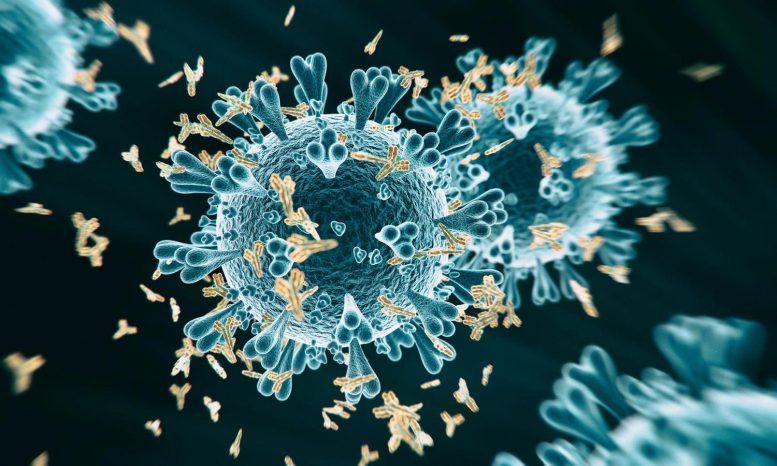
In the absence of approved, effective treatments for COVID-19, some hospitals have been treating patients with severe COVID symptoms with blood plasma from recovering patients. The blood of recovered patients contains antibodies that act against the coronavirus. While plasma hasn’t yet shown a benefit in randomized trials, some small retrospective studies suggest it may reduce illness severity and reduce hospitalization time.
This week in mBio, an open-access journal of the American Society for Microbiology, researchers report that antibody levels in the blood of COVID-19 patients drop rapidly during the weeks after their bodies have cleared the virus and symptoms have subsided. If convalescent plasma is ultimately shown to have a clear benefit, the authors concluded, then it needs to be collected during a specific window of time after recovery. However, recovering patients can’t donate blood until at least 14 days after symptoms have subsided, to give the body time to clear viral particles.
“We don’t want to transfuse the virus, just transfuse the antibodies,” said Andrés Finzi, Ph.D., at the University of Montreal, in Canada. “But at the same time, our work shows that the capacity of the plasma to neutralize viral particles is going down during those first weeks.”
The spike protein of SARS-CoV-2 plays a crucial role in helping the virus grab and invade host cells. Antibodies produced by the body’s immune system bind to a part of this protein and block the capacity of this “key” to engage with the host’s cellular “lock”, said Finzi, preventing the viral particle from infecting a cell host.
Previous studies suggest that antibodies against the SARS-CoV-2 spike protein peak 2 or 3 weeks after the onset of symptoms. Findings from an earlier cross-sectional study by Finzi’s group, involving more than 100 patients, suggested that the ability of plasma to neutralize the virus decreased significantly between 3 and 6 weeks after symptom onset.
In the new longitudinal study, Finzi and his colleagues analyzed blood samples collected at one-month intervals from 31 individuals recovering from COVID-19. They measured levels of immunoglobulins that act against the coronavirus S protein and tested the ability of the antibodies to neutralize the virus.
The researchers observed variation on the level of individual patients but identified a consistent overall signal: The levels of Immunoglobulins G, A, and M that target the binding site decreased between 6 and 10 weeks after symptoms began. During the same time period, the ability of the antibodies to neutralize the virus similarly fell.
Finzi’s group has continued to study blood samples from the patients. Understanding how the levels of antibodies change over time, he said, is critical not only for optimizing the use of convalescent plasma but also for understanding vaccine efficacy and whether or not previously infected people are at risk of re-infection.
“How long do antibodies protect you?” he asked.
Finzi’s other research focuses on the immune response to human immunodeficiency virus, or HIV, which differs dramatically from SARS-CoV-2.
Reference: “Decline of Humoral Responses against SARS-CoV-2 Spike in Convalescent Individuals” by Guillaume Beaudoin-Bussières, Annemarie Laumaea, Sai Priya Anand, Jérémie Prévost, Romain Gasser, Guillaume Goyette, Halima Medjahed, Josée Perreault, Tony Tremblay, Antoine Lewin, Laurie Gokool, Chantal Morrisseau, Philippe Bégin, Cécile Tremblay, Valérie Martel-Laferrière, Daniel E. Kaufmann, Jonathan Richard, Renée Bazin and Andrés Finzi, 16 October 2020, mBio.
DOI: 10.1128/mBio.02590-20
ASM is keeping the pulse on the SARS-CoV-2 pandemic with the COVID-19 Research Registry of top-ranked research articles curated by experts. In the eye of a pandemic, this curated database will ensure that scientists, journalists and the public have an efficient way to find the timeliest and most valuable SARS-CoV-2/COVID-19 research from the latest journal articles and preprints.
The American Society for Microbiology is one of the largest professional societies dedicated to the life sciences and is composed of 30,000 scientists and health practitioners. ASM’s mission is to promote and advance the microbial sciences.
ASM advances the microbial sciences through conferences, publications, certifications and educational opportunities. It enhances laboratory capacity around the globe through training and resources. It provides a network for scientists in academia, industry and clinical settings. Additionally, ASM promotes a deeper understanding of the microbial sciences to diverse audiences.
Never miss a breakthrough: Join the SciTechDaily newsletter.
Follow us on Google and Google News.
9 Comments
Your article is flawed.
I was tested three months after having coronavirus and I was still positive for having antibodies.
Here’s another study that shows that the body self-destructs after a certain amount of time and it will be incredibly hard to prevent it. Just live everyday and with time to go go 💥💯
The article did not say antibodies go to zero, and it’s not suggesting that everyone will lose their antibodies in the same time frame. it says they’ve seen a decrease in the quantity of anti-bodies in patients donating plasma within that time frame. This is also noted with the current few patients that have been re-infected. Also note, that this is a single study and is still under peer review. And, in fact, it may be that some people keep their antibodies longer than others.
Does this mean that when a vaccine is available, the antibodies that are produced as a result of receiving the vaccine will not last very long and therefore we’ll need to be re-vaccinated every few months?
Maybe. But the vaccine will target to stop the transmission chain, besides to protecting the individual
Bravo, John Bassinger
Reinfection after 2 to 3 months is possible. A working vaccine can’t come soon enough. `In the new longitudinal study, Finzi and his colleagues analyzed blood samples collected at one-month intervals from 31 individuals recovering from COVID-19. They measured levels of immunoglobulins that act against the coronavirus S protein and tested the ability of the antibodies to neutralize the virus. | The researchers observed variation on the level of individual patients but identified a consistent overall signal: The levels of Immunoglobulins G, A, and M that target the binding site decreased between 6 and 10 weeks after symptoms began. During the same time period, the ability of the antibodies to neutralize the virus similarly fell.`
So let’s get this all straight. If the infection caused antibodies don’t last but a few weeks… How the hell is a vaccine going to be of any value if the antibodies produced by the vaccine only lasts for a few weeks? We need to get weekly vaccines? Not sounding effective in any way. This all sounds like more fear mongering BS to scare the rubes. Please name one person who got sick from COVID-19 and recovered from it, who was reinfected much later a second time? Not one case has been shown.
All this is really beside the point it must be found out where this virus came from.