
Close Menu
    Facebook X (Twitter) Instagram
    SciTechDaily
    • Biology
    • Chemistry
    • Earth
    • Health
    • Physics
    • Science
    • Space
    • Technology
    Facebook X (Twitter) Pinterest YouTube RSS
    SciTechDaily
    Home»Science»Aquilops Americanus – Oldest Known Species of Horned Dinosaur from North America
    Science

    Aquilops Americanus – Oldest Known Species of Horned Dinosaur from North America

    By The Raymond M. Alf Museum of PaleontologyDecember 12, 20141 Comment3 Mins Read
    Facebook Twitter Pinterest Telegram LinkedIn WhatsApp Email Reddit
    Share
    Facebook Twitter LinkedIn Pinterest Telegram Email Reddit
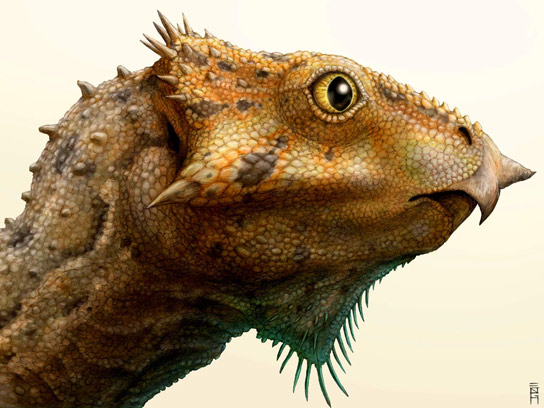
    Aquilops Americanus Oldest Horned North American Dinosaur
    Aquilops americanus is the oldest known North American dinosaur with horns. Credit: Brian Engh / Raymond M. Alf Museum of Paleontology

    A team of paleontologists has discovered the oldest known “horned” dinosaur fossil from North America. Named Aquilops americanus, the species is 40 million years older than the iconic Triceratops.

    A fossil skull small enough to fit in the palm of your hand represents the oldest species of horned dinosaur named from North America. The discovery, announced by a multi-institution team including the Raymond M. Alf Museum of Paleontology at The Webb Schools, is 40 million years older than the iconic Triceratops.

    The new dinosaur is named Aquilops americanus, meaning “American eagle face.” The name refers to the hook-like beak at the front of the skull, used to snip plants during feeding. It lived around 108 million years ago, in what is now southern Montana. Aquilops (pronounced “uh-QUILL-ops”) was about the size of a rabbit, weighing around 3.5 pounds (1.6 kilograms) and measuring around 2 feet (60 centimeters) in total length. It belongs to a group called ceratopsians, better known as horned dinosaurs. Unlike its famous relatives, such as Triceratops, Aquilops lacked horns and a bony neck frill. The animal is nearly 20 million years older than the previous oldest horned dinosaur named from North America.

    “Aquilops is the first fossil to show what the earliest horned dinosaurs in North America looked like,” said paleontologist Andrew Farke, Augustyn Family Curator at the Alf Museum and lead author on the scientific study. Farke continued, “Scattered teeth and bones from around the same time showed us that these animals were here, but not much else was known.”

    Surprisingly, Aquilops turns out to be more closely related to ceratopsians from Asia than to other ceratopsians from North America. This is consistent with evidence from other animals, including carnivorous dinosaurs as well as early mammals, showing an immigration of species from Asia into North America sometime between 115 and 105 million years ago.

    The fossils of Aquilops, including a partial skull and lower jaw, were found on an expedition led by Richard Cifelli, curator of vertebrate paleontology at the Sam Noble Oklahoma Museum of Natural History, Norman, Oklahoma, and the original fossil is housed there. Fieldwork was funded by a National Geographic Society Committee for Research and Exploration grant. Other researchers who co-authored the study included Desmond Maxwell (University of the Pacific) and Mathew Wedel (Western University of Health Sciences).

    Reference: “A Ceratopsian Dinosaur from the Lower Cretaceous of Western North America, and the Biogeography of Neoceratopsia” by Andrew A. Farke, W. Desmond Maxwell, Richard L. Cifelli and Mathew J. Wedel, 10 December 2014, PLOS One.
    DOI: 10.1371/journal.pone.0112055

    Never miss a breakthrough: Join the SciTechDaily newsletter.
    Follow us on Google and Google News.

    Dinosaurs Paleontology The Raymond M. Alf Museum of Paleontology
    Share. Facebook Twitter Pinterest LinkedIn Email Reddit

    Related Articles

    How Tyrannosaurus Rex Ate Triceratops Horridus

    Fossils Reveal Headbutts May Have Been Used as a Dinosaur Courtship Behavior

    Bushy-Tailed Fossilized Theropod Could Mean that Most Dinosaurs Had Feathers

    Cretaceous Period Sankofa Pyrenaica Fossilized Eggs Are Unusually Shaped

    Feathered Yutyrannus Huali Specimen Found in China, Closely Related to Tyrannosaurus Rex

    New Insight on Pterosaur Specimen, Istiodactylus Latidens

    Microraptor Feathers Were Black With Iridescent Sheen

    Jurassic Period Super-Sized Fleas Had Armored Mouthparts to Attack the Thick Hide of Dinosaurs

    Researchers Conclude Torosaurus and Triceratops Are Different Species of Horned Dinosaurs

    1 Comment

    1. Tom Luczycki on December 22, 2014 1:25 pm

      The skull is in the collections of the Sam Noble Museum in Norman OK. This website features their ongoing work on an interactive digital reconstruction of Aquilops. Try it out!

      http://www.snomnh.ou.edu/Aquilops_Dinosaur

      Reply
    Leave A Reply Cancel Reply

    • Facebook
    • Twitter
    • Pinterest
    • YouTube

    Don't Miss a Discovery

    Subscribe for the Latest in Science & Tech!

    Trending News

    Monster Storms on Jupiter Unleash Lightning Beyond Anything on Earth

    Scientists Create “Liquid Gears” That Spin Without Touching

    The Simple Habit That Could Help Prevent Cancer

    Millions Take These IBS Drugs, But a New Study Finds Serious Risks

    Scientists Unlock Hidden Secrets of 2,300-Year-Old Mummies Using Cutting-Edge CT Scanner

    Bread Might Be Making You Gain Weight Even Without Eating More Calories

    Scientists Discover Massive Magma Reservoir Beneath Tuscany

    Europe’s Most Active Volcano Just Got Stranger – Here’s Why Scientists Are Rethinking It

    Follow SciTechDaily
    • Facebook
    • Twitter
    • YouTube
    • Pinterest
    • Newsletter
    • RSS
    SciTech News
    • Biology News
    • Chemistry News
    • Earth News
    • Health News
    • Physics News
    • Science News
    • Space News
    • Technology News
    Recent Posts
    • 25-Year Study Uncovers Hidden Paths and Early Warning Signs of Blood Cancer
    • Not Just Snoring – New Research Reveals Sleep Apnea May Be Damaging Your Muscles
    • Scientists Discover a Surprising Reason Intermittent Fasting Extends Life
    • Scientists Discover a New Meteor Shower From a Mysterious Crumbling Asteroid
    • This Simple Fruit Wash Could Make Produce Safer and Last Days Longer
    Copyright © 1998 - 2026 SciTechDaily. All Rights Reserved.
    • Science News
    • About
    • Contact
    • Editorial Board
    • Privacy Policy
    • Terms of Use

    Type above and press Enter to search. Press Esc to cancel.