
Close Menu
    Facebook X (Twitter) Instagram
    SciTechDaily
    • Biology
    • Chemistry
    • Earth
    • Health
    • Physics
    • Science
    • Space
    • Technology
    Facebook X (Twitter) Pinterest YouTube RSS
    SciTechDaily
    Home»Science»Archaeologists Discover Ancient 3600-Year-Old Royal Purple Dye Workshop on Aegina Island
    Science

    Archaeologists Discover Ancient 3600-Year-Old Royal Purple Dye Workshop on Aegina Island

    By PLOSAugust 19, 2024No Comments3 Mins Read
    Facebook Twitter Pinterest Telegram LinkedIn WhatsApp Email Reddit
    Share
    Facebook Twitter LinkedIn Pinterest Telegram Email Reddit
    Bronze Age Purple Dye Workshop Graphic
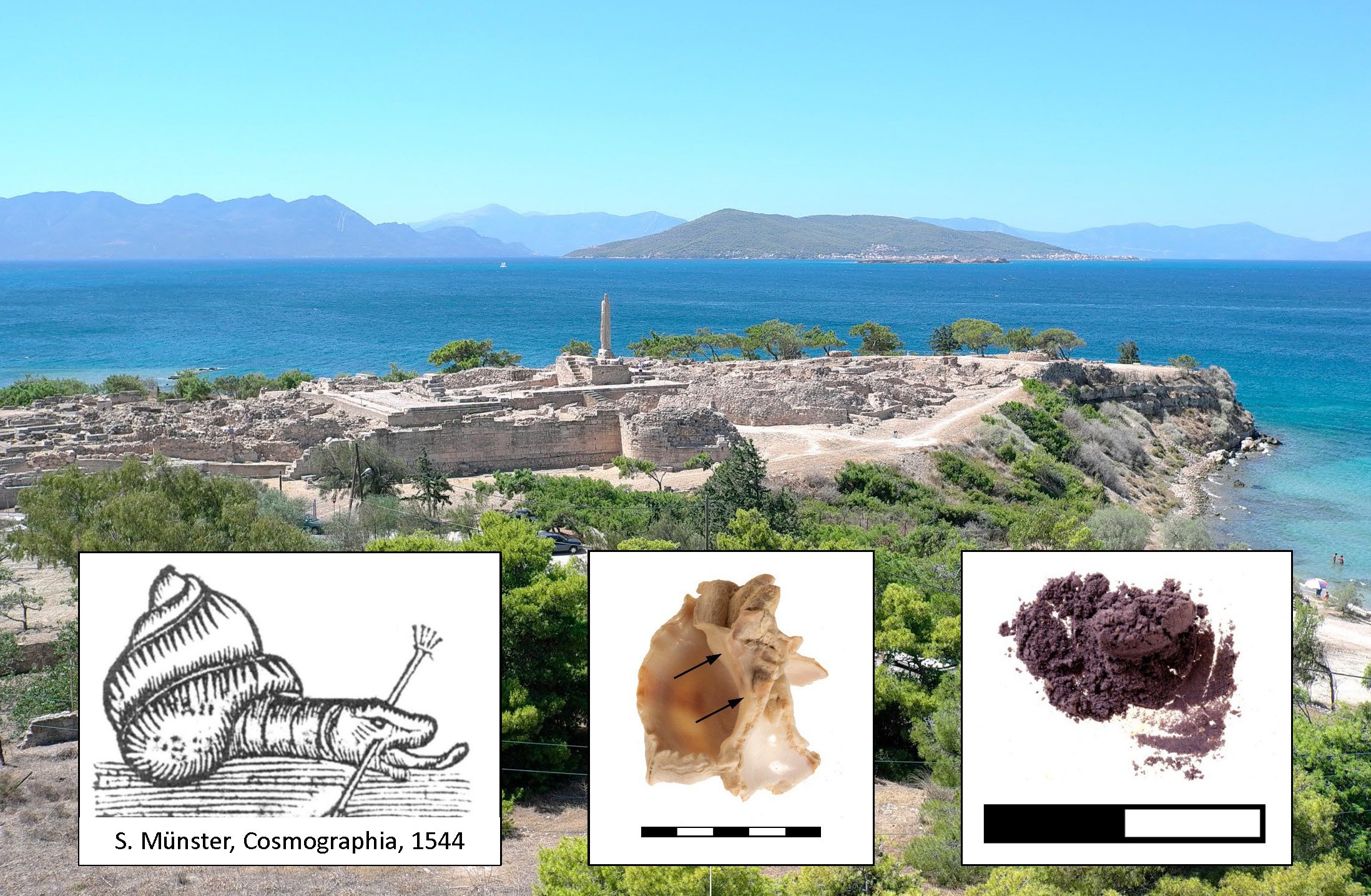
    Aegina Kolonna: view of the site from the Northeast (Aegina Kolonna excavation, Department of Classics, Paris Lodron University of Salzburg). Small pictures from the left: drawing of a purple snail of the 16th c. (in S. Münster, Cosmographia, 1544), Hexaplex trunculus from Late Bronze Age Aegina Kolonna (photo by G. Forstenpointner), purple pigment sample from Aegina Kolonna (photo by L. Berger). Credit: Aegina Kolonna excavation, Department of Classics, Paris Lodron University of Salzburg, CC-BY 4.0

    Ceramics, tools, and snail shells reveal insights into Mycenaean dye production in the 16th century BC.

    A study recently published in the open-access journal PLOS ONE reveals that the Greek island of Aegina hosted a Late Bronze Age purple dye workshop, according to Lydia Berger from Paris Lodron University of Salzburg, Austria, and her colleagues.

    Colored dyes were a significant commodity in the Mediterranean region during the Late Bronze Age, and understanding the production of these dyes was valuable for interpretations of culture and trade at the time. In this study, Berger and colleagues describe the site of a purple dye workshop from the 16th century BC located at Aegina Kolonna in the Saronic Gulf.

    Evidence of Dye Production

    The presence of a dye workshop at this site is inferred from three main lines of evidence: purple pigment preserved on ceramic fragments, which are likely remnants of dye containers; dyeing tools, including grinding stones and a waste pit; and crushed shells of marine snails whose bodies are harvested for these pigments. Analysis of the shells and the chemical composition of the pigments indicate that the workshop predominantly used one species of Mediterranean snail, the banded dye-murex.

    Excavation at this site also uncovered many burnt bones from young mammals, mainly piglets and lambs. The authors hypothesize that these could be the remains of animals ritually sacrificed as spiritual offerings to protect the site of production, a practice known from other cultural sites, although the exact connection between these bones and the dye production is not yet fully clear.

    Insights and Future Research

    This site provides valuable insights into the tools and processes of Mycenaean purple dye production. Further research might reveal more information about the scale of dye production at Kolonna Aegina, the details of the on-site procedures, and the use of this dye in regional trade.

    The authors add: “For the first time, the discovery of remarkable quantities of well-preserved pigment, together with a large number of crushed mollusk shells and a few functional facilities, allow a detailed insight into the production of purple-dye on the Greek island of Aegina around 3600 years ago. Chemical analysis by HPLC, malacological, zoological, and archaeological studies illustrate the technical process and peculiarities of early dye production and prove a workshop within the Late Bronze Age settlement.”

    Reference: “More than just a color: Archaeological, analytical, and procedural aspects of Late Bronze Age purple-dye production at Cape Kolonna, Aegina” by Lydia Berger, Gerhard Forstenpointner, Peter Frühauf and Fabian Kanz, 12 June 2024, PLOS ONE.
    DOI: 10.1371/journal.pone.0304340

    Never miss a breakthrough: Join the SciTechDaily newsletter.
    Follow us on Google and Google News.

    Anthropology Archaeology PLOS
    Share. Facebook Twitter Pinterest LinkedIn Email Reddit

    Related Articles

    Over 57,000 Years Old – Scientists Discover Oldest Known Neanderthal Cave Engravings

    Uncovering the Past of Ancient Puerto Rico: New Study Challenges Simplistic Assumptions

    Uncovering the Secrets of an Ancient Stone Monument: New Findings From an Archaeological Site in Saudi Arabia

    Ancient Roman Gold Coins – Long Thought To Be Fakes – Now Authenticated

    Before Stonehenge Monuments, Hunter-Gatherers Made Use of Open Woodland Habitats

    Archaeologists Discover That Ancient Islamic Tombs Cluster Like Galaxies

    Indiscriminate Killing Revealed in Genetic Analysis of Ancient Massacre

    Deformed Skulls Discovered in an Ancient Cemetery Reveal a Remarkably Diverse Community

    Neandertals Dove Underwater to Collect Clam Shells to Use as Tools

    Leave A Reply Cancel Reply

    • Facebook
    • Twitter
    • Pinterest
    • YouTube

    Don't Miss a Discovery

    Subscribe for the Latest in Science & Tech!

    Trending News

    The Universe Is Expanding Too Fast and Scientists Can’t Explain Why

    “Like Liquid Metal”: Scientists Create Strange Shape-Shifting Material

    Early Warning Signals of Esophageal Cancer May Be Hiding in Plain Sight

    Common Blood Pressure Drug Shows Surprising Power Against Deadly Antibiotic-Resistant Superbug

    Scientists Uncover Dangerous Connection Between Serotonin and Heart Valve Disease

    Scientists Discover a “Protector” Protein That Could Help Reverse Hair Loss

    Bone-Strengthening Discovery Could Reverse Osteoporosis

    Scientists Uncover Hidden Trigger Behind Stem Cell Aging

    Follow SciTechDaily
    • Facebook
    • Twitter
    • YouTube
    • Pinterest
    • Newsletter
    • RSS
    SciTech News
    • Biology News
    • Chemistry News
    • Earth News
    • Health News
    • Physics News
    • Science News
    • Space News
    • Technology News
    Recent Posts
    • Scientists Create Improved Insulin Cells That Reverse Diabetes in Mice
    • Scientists Stunned After Finding Plant Thought Extinct for 60 Years
    • A Common Diabetes Drug May Hold the Key to Stopping HIV From Coming Back
    • Ancient “Syphilis-Like” Disease in Vietnam Challenges Key Scientific Assumptions
    • Drinking Alcohol To Cope in Your 20s Could Damage Your Brain for Life
    Copyright © 1998 - 2026 SciTechDaily. All Rights Reserved.
    • Science News
    • About
    • Contact
    • Editorial Board
    • Privacy Policy
    • Terms of Use

    Type above and press Enter to search. Press Esc to cancel.