
Close Menu
    Facebook X (Twitter) Instagram
    SciTechDaily
    • Biology
    • Chemistry
    • Earth
    • Health
    • Physics
    • Science
    • Space
    • Technology
    Facebook X (Twitter) Pinterest YouTube RSS
    SciTechDaily
    Home»Chemistry»Are There Disinfection Byproducts in That Cup of Tea? Many Unknown DBPs With Uncertain Health Effects
    Chemistry

    Are There Disinfection Byproducts in That Cup of Tea? Many Unknown DBPs With Uncertain Health Effects

    By American Chemical SocietyNovember 5, 2021No Comments3 Mins Read
    Facebook Twitter Pinterest Telegram LinkedIn WhatsApp Email Reddit
    Share
    Facebook Twitter LinkedIn Pinterest Telegram Email Reddit
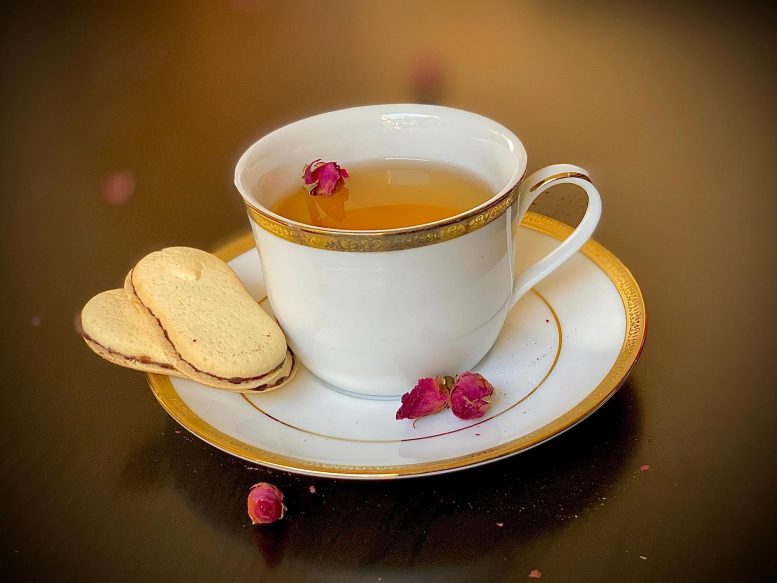
    Tea Cup Cookies
    When tap water containing residual chlorine is boiled for brewing tea, it can react with tea compounds, forming disinfection byproducts (DBPs).

    Tea, the world’s second most consumed beverage, can interact with residual chlorine in tap water to form disinfection byproducts (DBPs).

    Surpassed only by water, tea is the second most consumed beverage worldwide. When boiled tap water is used to brew tea, residual chlorine in the water can react with tea compounds to form disinfection byproducts (DBPs). Now, researchers reporting in Environmental Science & Technology measured 60 DBPs in three types of tea, unexpectedly finding lower levels in brewed tea than in tap water. However, they also detected many unknown DBPs with uncertain health effects.

    Although disinfection is important to ensure drinking water safety, a downside is DBP formation. Tea contains about 500 compounds, including polyphenols, amino acids, caffeine, and others, that can react with chlorine to form DBPs, some of which have been linked in epidemiological studies with cancer and adverse birth outcomes. In addition, DBPs can form from reactions with compounds in the tap water itself. Susan Richardson and colleagues wanted to conduct a comprehensive survey to measure 60 known DBPs in three green and black teas popular in the U.S.

    The researchers brewed the teas and then measured the compounds using gas chromatography-mass spectrometry. Levels of the 60 DBPs were higher in tap water than in the brewed teas, likely because many compounds evaporated or were absorbed by tea leaves. However, the 60 known DBPs comprised only 4% of the total organic halogen (a measure of all halogen-containing DBPs) in tea, indicating that the majority of these compounds in tea are uncharacterized. The team identified 15 of these compounds – which likely form from the reaction of chlorine with natural phenolic and polyphenolic precursors in tea leaves – for the first time in the beverage. Although no “safe” levels have yet been established for most DBPs, for the ones that are regulated, an average person would need to drink 18­–55 cups of tea per day to exceed the limits established by the U.S. Environmental Protection Agency, the researchers say.

    Reference: “Are Disinfection Byproducts (DBPs) Formed in My Cup of Tea? Regulated, Priority, and Unknown DBPs” by Jiafu Li, Md. Tareq Aziz, Caroline O. Granger and Susan D. Richardson, 15 September 2021, Environmental Science & Technology.
    DOI: 10.1021/acs.est.1c03419

    The authors acknowledge funding from the National Science Foundation, the University of South Carolina, and the Chinese Scholarship Council.

    Never miss a breakthrough: Join the SciTechDaily newsletter.
    Follow us on Google and Google News.

    American Chemical Society
    Share. Facebook Twitter Pinterest LinkedIn Email Reddit

    Related Articles

    Mysterious Chemistry Behind a Creepy Photographic Technique Unveiled

    Human Cells Made Magnetic With Engineered Protein Crystals

    Super Durable, Flexible, Water-Repelling Material Inspired by Porcupinefish

    What’s in Dog Food? The Fascinating Chemistry Behind Kibble.

    Sustainable Organic Batteries for Safer, Environmentally Friendly Power Storage

    New Polyurethane Designed to Easily Degrade for Reuse

    Degradable Polyurethane Gives Its Components a Second Life

    Chocolate Interferes With Cannabis Potency Testing

    Perfect Shot of Espresso Every Time With Chemistry

    Leave A Reply Cancel Reply

    • Facebook
    • Twitter
    • Pinterest
    • YouTube

    Don't Miss a Discovery

    Subscribe for the Latest in Science & Tech!

    Trending News

    Popular Sugar-Free Sweetener Linked to Liver Disease, Study Warns

    What Is Hantavirus? The Deadly Disease Raising Alarm Worldwide

    Scientists Just Discovered How the Universe Builds Monster Black Holes

    Scientists Unveil New Treatment Strategy That Could Outsmart Cancer

    A Simple Vitamin May Hold the Key to Treating Rare Genetic Diseases

    Scientists Think the Real Fountain of Youth May Be Hiding in Your Gut

    Ravens Don’t Follow Wolves, They Predict Them

    This Common Knee Surgery May Be Doing More Harm Than Good

    Follow SciTechDaily
    • Facebook
    • Twitter
    • YouTube
    • Pinterest
    • Newsletter
    • RSS
    SciTech News
    • Biology News
    • Chemistry News
    • Earth News
    • Health News
    • Physics News
    • Science News
    • Space News
    • Technology News
    Recent Posts
    • Scientists Build a Living AI Device Using Real Brain Cells
    • Why Are So Many New Fathers Dying? Scientists Say the U.S. Has a Dangerous Blind Spot
    • Scientists Identify Simple Supplement That Greatly Reduces Alzheimer’s Damage
    • You May Have a Dangerous Type of Cholesterol Even if Your Tests Look Normal
    • Study Reveals Dangerous Flaw in AI Symptom Checkers
    Copyright © 1998 - 2026 SciTechDaily. All Rights Reserved.
    • Science News
    • About
    • Contact
    • Editorial Board
    • Privacy Policy
    • Terms of Use

    Type above and press Enter to search. Press Esc to cancel.