
Ancient lava-mantle interactions may explain unusual silica-rich rocks and a critical shift in Earth’s mantle behavior 2.5 billion years ago.
Geologists have developed a new theory about the state of Earth billions of years ago after examining the very old rocks formed in the Earth’s mantle below the continents.
Assistant Professor Emma Tomlinson from Trinity College Dublin and Queensland University of Technology’s Professor Balz Kamber have just published their research in leading international journal, Nature Communications.
Clues Found in Ancient Mantle Rocks
The seven continents on Earth today are each built around a stable interior called a craton, and geologists believe that craton stabilization some 2.5 – 3 billion years ago was critical to the emergence of land masses on Earth.
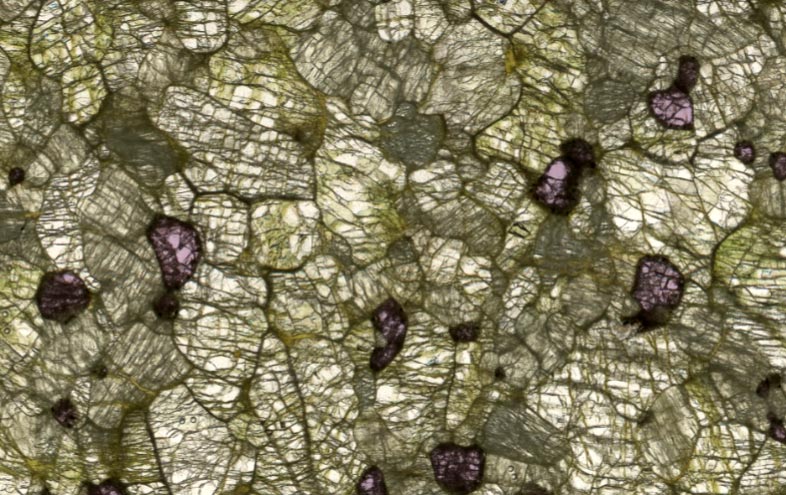
Little is known about how cratons and their supporting mantle keels formed, but important clues can be found in peridotite xenoliths, which are samples of mantle that are brought to the Earth’s surface by erupting volcanoes.
Dr. Tomlinson, from Trinity’s School of Natural Sciences, said:
“Many rocks from the mantle below old continents contain a surprising amount of silica — much more than is found in younger parts of the mantle.”
“There is currently no scientific consensus about the reason for this.”
The new research, which looks at the global data for mantle peridotite, comes up with a new explanation for this observation.
The research used a new thermodynamic model to calculate that the unusual mineralogy developed when very hot molten rock– greater than 1,700 °C (3,100 °F)— interacted with older parts of the mantle and this caused the growth of silica-rich minerals.
A Billion Years of Unusual Lava Flows
“For more than 1 billion years, from 3.8 to 2.5 billion years ago, volcanoes also erupted very unusual lavas of very low viscosity — lava that was very thin, very hot, and often contained variable levels of silica,” Dr. Tomlinson added.
“Our modeling suggests that the unusual lavas were in fact the molten rocks that interacted with the mantle at great depth and this interaction resulted in the variable level of silica.”
Professor Kamber, QUT, said:
“Both the silica-rich rocks in the deep mantle and the low viscosity volcanic rocks stopped being made by the Earth some 2.5 billion years ago. This timing is the boundary between the Archaean and Proterozoic eons — one of the most significant breaks in Earth’s geological timescale.”
What caused this boundary remains unknown, but the research offers a new perspective.
Professor Kamber added:
“This may have been due to a change in how the mantle was flowing. Once the mantle started slowly turning over all the way down to the core (2,900 km), the very high temperatures of the Archaean eon were no longer possible.”
Reference: “Depth-dependent peridotite-melt interaction and the origin of variable silica in the cratonic mantle” by Emma L. Tomlinson and Balz S. Kamber, 17 February 2021, Nature Communications.
DOI: 10.1038/s41467-021-21343-9
Never miss a breakthrough: Join the SciTechDaily newsletter.
Follow us on Google and Google News.
1 Comment
Interesting.
Their data implies a heterogenous heated mantle in the Archaean, with early continent cratons associated with local hot upwellings.
“The second geodynamic constraint is the need for coexisting shallow cooler and deeper hot melting regimes.” “In both explanations, the very hot mantle upwellings, and the associated melt-rock reaction, are the distinguishing feature that significantly shaped the early continents.”
After that period with sparse and localized plate tectonics, the mantle homogenize and the process becomes global.
“The episodic upwelling of heat through a relatively cool background state mantle required by the model has two geodynamic implications.
First, it necessitates the existence of a discrete strong thermal boundary layer well below the lithosphere. There is growing evidence that the base of the mantle transition zone could have been this layer and that many Archaean “plumes” originated from there70. The disappearance of the hypothesised layer would explain why both komatiites and coarse-grained orthopyroxene-rich harzburgites are largely absent after the Archaean. It would also have marked the onset of whole-mantle convection.” [Second implication, see above.]