
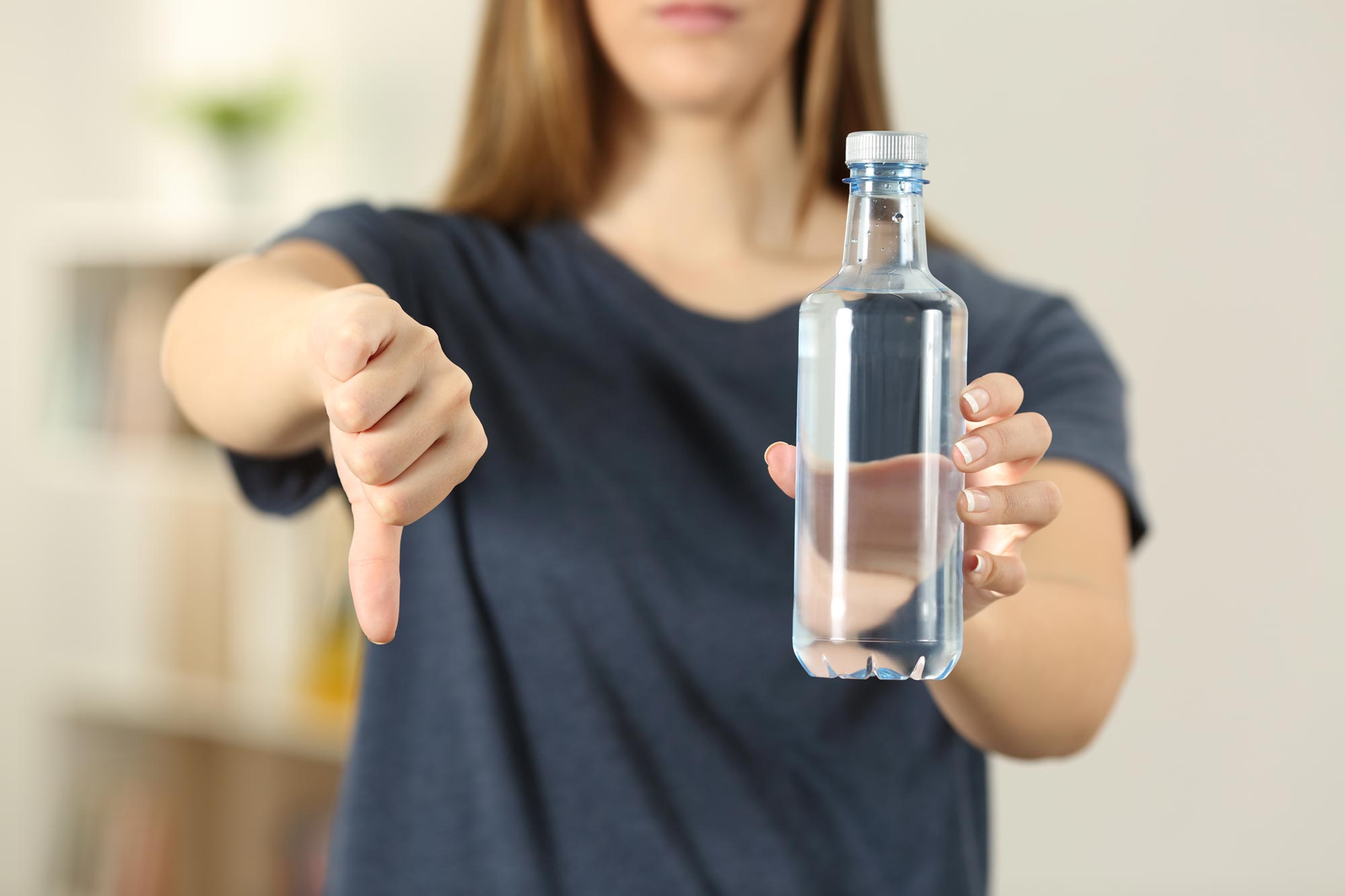
New research reveals that some bottled water may contain far more microscopic plastic particles than tap water, raising questions about everyday exposure.
Some bottled water products may expose consumers to far higher levels of microplastics than tap water, according to new findings from scientists who created an advanced method to detect these extremely small particles.
Microplastics and nanoplastics form as larger plastic materials break down or are worn down through use. These tiny synthetic fragments have spread widely across the environment and are now commonly found in rivers, lakes, and other water sources.
To assess how much of this contamination reaches drinking water, scientists examined samples from four water treatment facilities near Lake Erie along with six brands of bottled water. The analysis showed that bottled water contained roughly three times more nanoplastic particles than treated tap water, said Megan Jamison Hart, lead author of the study and a PhD candidate in environmental sciences at The Ohio State University.
“We can make educated choices to try and reduce our daily exposure to these harmful chemicals,” said Hart. “For the average person who is thirsty and wants a drink, the best way to do that would be drinking it straight out of the tap rather than grabbing pre-bottled water.”

New methods reveal hidden particles
Earlier studies have documented microplastics in drinking water, but far fewer have focused on nanoplastics, largely because their extremely small size makes them difficult to detect, said Hart. In this study, the team combined imaging (scanning electron microscopy) with chemical analysis (optical photothermal infrared spectroscopy), allowing them to identify particles at much smaller scales than before.
The study was recently published in the journal Science of The Total Environment.
Health risks remain uncertain
Scientists are still working to understand how microplastics affect human health, but there is growing concern about long-term impacts. Nanoplastics, in particular, may pose greater risks because their small size makes it easier for them to pass through important biological barriers in the body.
“While we don’t really fully understand the human health risks associated with nanoplastic exposure, it’s still better to try and mitigate that risk because evidence indicates that they do cause problems, even if we’re not fully aware of what those are yet,” said Hart.

Bottled water linked to packaging
The analysis showed that many of the plastic particles found in bottled water likely originated from the packaging itself, which aligned with expectations. However, the source of plastics detected in treated drinking water remains uncertain. More than half of all particles identified in the samples were nanoplastics, highlighting how widespread these contaminants have become, even in water intended for consumption.
These findings reinforce the idea that nanoplastics make up a major share of global microplastic pollution and that their presence has likely been underestimated, said John Lenhart, senior author of the study and a professor of environmental engineering at Ohio State.
“The concentrations we saw were higher than anticipated, which, unlike prior studies, we were able to attribute to the inclusion of the nanoplastics,” said Lenhart. “That emphasis validates a lot of the information we’ve learned.”
Findings could guide water treatment
Including nanoplastics in measurements like these may open the door to new discoveries, such as identifying which water treatment approaches are most effective at removing these contaminants from the environment.
“By understanding the basic composition of the materials in water and the reactions important for controlling that composition, we can make better design decisions for future treatment or for remediation,” said Lenhart. “That’s why analyses like these are so promising.”
Reference: “What’s in your water? A comparative analysis of micro- and nanoplastics in treated drinking water and bottled water” by Megan N. Jamison Hart and John J. Lenhart, 17 December 2025, Science of The Total Environment.
DOI: 10.1016/j.scitotenv.2025.181148
The study was supported by the U.S. National Oceanic and Atmospheric Administration through its Ohio Sea Grant College Program and the National Science Foundation.
Never miss a breakthrough: Join the SciTechDaily newsletter.
Follow us on Google and Google News.
2 Comments
How do we get around this? Humans infact all species need water, correct?
In the ‘old days’ we used glass bottles with metal caps with rubber seals (or waxed or oiled leather seals).