
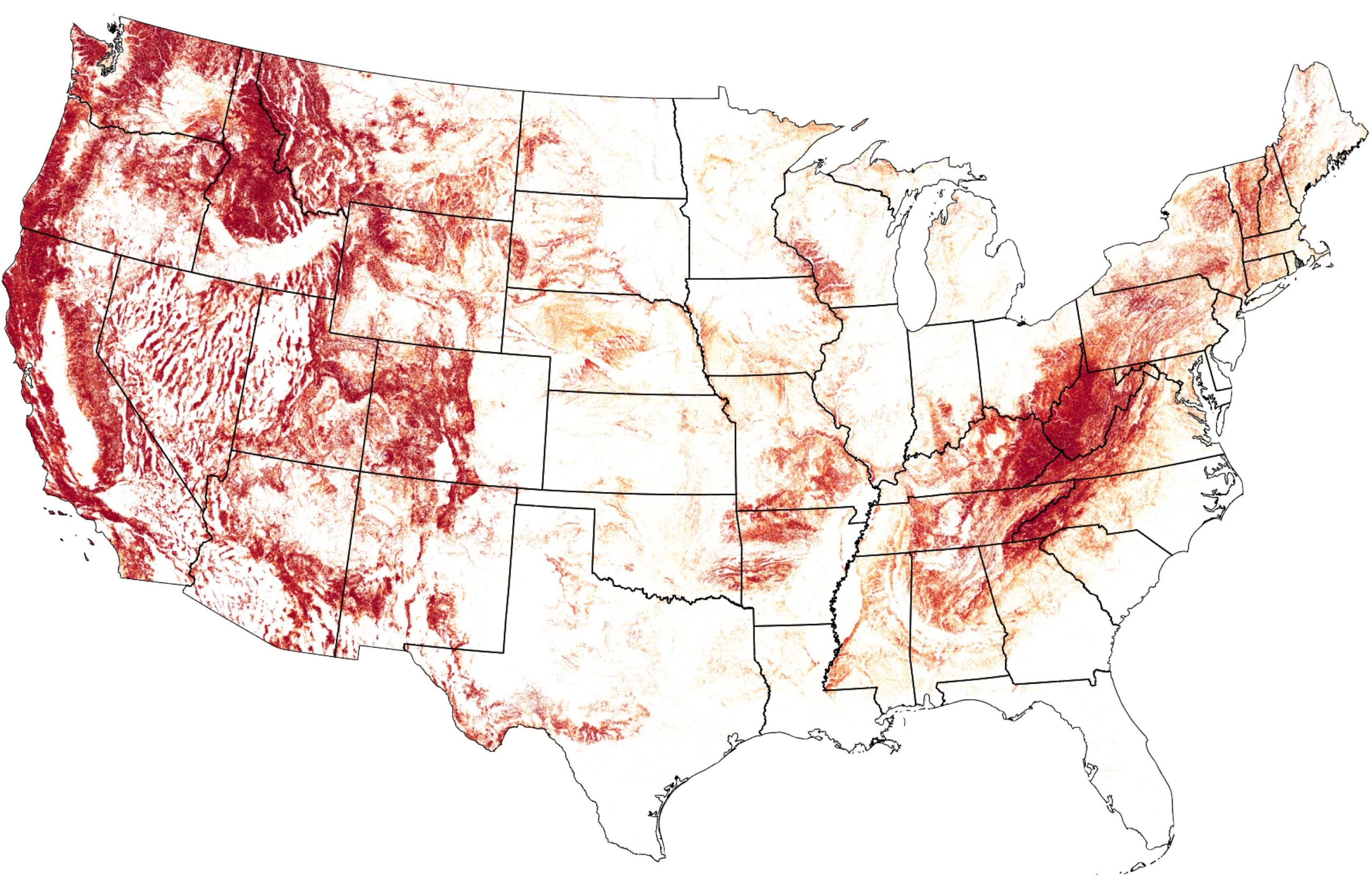
The U.S. Geological Survey has developed a new nationwide landslide susceptibility map, showing that nearly half the country is at risk of landslides.
This map, built using an inventory of nearly 1 million previous landslides and high-resolution elevation data, provides a detailed, county-by-county analysis to aid in risk reduction and land-use planning. It not only identifies hazardous areas but also spots where further mapping is needed to enhance landslide preparedness.
New Landslide Susceptibility Map
The U.S. Geological Survey has released a new nationwide landslide susceptibility map that indicates nearly 44% of the U.S. could potentially experience landslide activity. The new assessment provides a highly detailed, county-by-county picture of where these damaging, disruptive, and potentially deadly geologic hazards are more likely as well as areas where landslide hazards are negligible.
The new map will support risk-reduction and land-use planning efforts by showing where potentially unstable areas are so planners and engineers can better prioritize and mitigate future landslide hazards.

Landslide Susceptibility Across the U.S.
“This new national landslide susceptibility map addresses an important but difficult question: which areas across the entire U.S. are prone to landslides?” said Ben Mirus, USGS research geologist. “We are excited that it is now publicly available to help everyone be more prepared – to be a more hazard-ready nation.”
Previously, detailed landslide maps were only developed for a few areas of the U.S. where the landslide risks were considered high, but this map expands the assessment to include many other hazardous areas around the country where there was a limited understanding of landslide potential.
Mirus and team used an inventory of nearly 1 million previous landslides, high-resolution national elevation data from the USGS 3D Elevation Program, and advanced computing to build their comprehensive landslide susceptibility model. The resulting map of the contiguous U.S., Alaska, Hawaii, and Puerto Rico zeroes in on landslide locations by using much higher resolution data than existing continental and global landslide maps.
Future Applications and Needs
The new map can also be used to identify areas where more landslide mapping is needed and how the improvements can better inform landslide mitigation.
Reference: “Parsimonious High-Resolution Landslide Susceptibility Modeling at Continental Scales” by Benjamin B. Mirus, Gina M. Belair, Nathan J. Wood, Jeanne Jones and Sabrina N. Martinez, 11 September 2024, AGU Advances.
DOI: 10.1029/2024AV001214
Never miss a breakthrough: Join the SciTechDaily newsletter.
Follow us on Google and Google News.
1 Comment
Steep slopes/soils behind/above brother’s & cousin’s houses are likely higher Risk than Soils on gentle to moderate slopes. Can USGS use the detailed Soil Surveys already completed by USDA & the Land Grant Universities???