
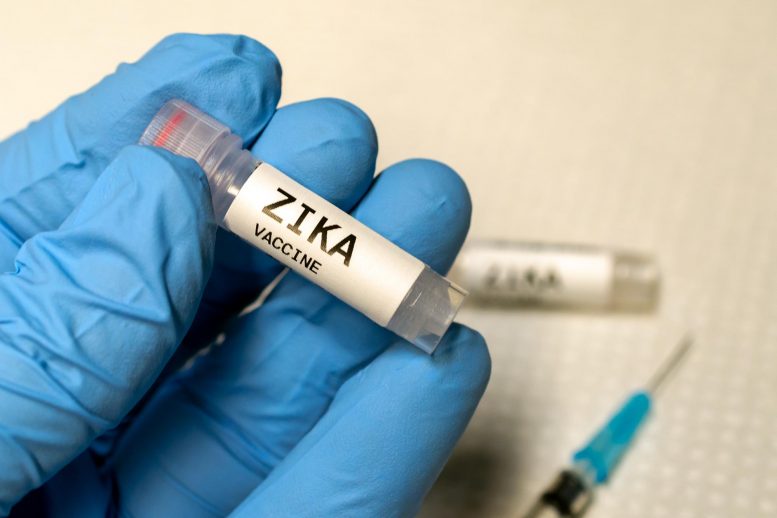
A new study led by scientists at the Walter Reed Army Institute of Research has shown for the first time that a single dose of an experimental Zika vaccine in a dengue-experienced individual can boost pre-existing flavivirus immunity and elicit protective cross-neutralizing antibody responses against both Zika and dengue viruses. The findings were published on February 3, 2020, in Nature Medicine.
Researchers analyzed the antibody responses of a dengue-experienced volunteer who participated in a Phase 1 clinical trial of the WRAIR-developed Zika purified inactivated virus vaccine. They identified a potent cross-reactive antibody called MZ4 that demonstrated a potent ability to neutralize the Zika virus as well as the dengue virus serotype-2 strain. In addition, MZ4 protected against Zika and dengue in a mouse model of infection.
“Rapid-onset countermeasures are needed to protect military personnel, travelers, and residents in areas where emerging infections such as Zika and dengue viruses are already widespread and expanding,” said Dr. Kayvon Modjarrad, who leads the U.S. Army Zika vaccine program, directs the Emerging Infectious Diseases Branch at WRAIR and is one of the lead authors on the paper. “These results demonstrate the potential for MZ4 to be part of the prevention toolbox for these diseases.”
The individual’s immune profile was compared to trial volunteers who had no previous exposure to dengue virus. While the volunteer with prior dengue exposure experienced a sharp increase in antibodies that neutralize Zika and dengue viruses, following just one dose of the ZPIV vaccine, the dengue-naïve trial participants required two vaccinations to reach a similar magnitude of Zika antibody responses. Additionally, no cross-reactive antibody response to dengue virus.
“These new findings indicate that an effective Zika vaccine could both boost dengue virus immune responses and generate potent Zika neutralizing antibodies that might have unique potential as a prevention tool in regions where both dengue and Zika are prevalent,” said Dr. Shelly Krebs, a B cell researcher at WRAIR and senior author of the paper.
Building on these findings, researchers used samples from another Phase 1 study of the ZPIV vaccine currently being conducted in Puerto Rico, where there is a higher risk of exposure to flaviviruses, a family of viruses that includes Zika, dengue, Japanese encephalitis, yellow fever, and West Nile viruses. WRAIR researchers found that vaccination with ZPIV in Puerto Rican individuals with prior flavivirus experience yielded similar cross-neutralizing potency after a single vaccination, highlighting the potential benefit of ZIKV vaccination in flavivirus-endemic areas.
Asymptomatic Zika infections can lead to severe birth defects and neurologic complications. The ZPIV vaccine candidate was developed by WRAIR based on the same inactivated flavivirus vaccine technology the Institute used to create its Japanese encephalitis vaccine, which was licensed in the U.S. in 2009. Three Phase 1 human clinical trials have shown ZPIV to be safe and well-tolerated in healthy adults and that it induced a robust immune response (Modjarrad et al., 2018). WRAIR’s Zika efforts are ongoing, overseen by the Institute’s Emerging Infectious Diseases Branch.
Reference: “Potent Zika and dengue cross-neutralizing antibodies induced by Zika vaccination in a dengue-experienced donor” by Vincent Dussupt, Rajeshwer S. Sankhala, Gregory D. Gromowski, Gina Donofrio, Rafael A. De La Barrera, Rafael A. Larocca, Weam Zaky, Letzibeth Mendez-Rivera, Misook Choe, Edgar Davidson, Michael K. McCracken, James D. Brien, Peter Abbink, Hongjun Bai, Aubrey L. Bryan, Candace Hope Bias, Irina Maljkovic Berry, Nubia Botero, Tanya Cook, Nicole A. Doria-Rose, Ariadna Grinyo i Escuer, Justice Akuoku Frimpong, Aviva Geretz, Mayda Hernandez, Bradley S. Hollidge, Ningbo Jian, Kareem Kabra, David J. Leggat, Jinyan Liu, Amelia K. Pinto, Wiriya Rutvisuttinunt, Ian Setliff, Ursula Tran, Samantha Townsley, Benjamin J. Doranz, Morgane Rolland, Adrian B. McDermott, Ivelin S. Georgiev, Rasmi Thomas, Merlin L. Robb, Kenneth H. Eckels, Elizabeth Barranco, Michael Koren, Darci R. Smith, Richard G. Jarman, Sarah L. George, Kathryn E. Stephenson, Dan H. Barouch, Kayvon Modjarrad, Nelson L. Michael, M. Gordon Joyce and Shelly J. Krebs, 3 February 2020, Nature Medicine.
DOI: 10.1038/s41591-019-0746-2
Modjarrad, Kayvon, et al. “Preliminary aggregate safety and immunogenicity results from three trials of a purified inactivated Zika virus vaccine candidate: phase 1, randomized, double-blind, placebo-controlled clinical trials.” The Lancet 391.10120 (2018): 563-571.
The opinions or assertions contained herein are the private views of the author, and are not to be construed as official, or as reflecting true views of the Department of the Army or the Department of Defense. The investigators have adhered to the policies for protection of human subjects as prescribed in AR 70- 25.
Never miss a breakthrough: Join the SciTechDaily newsletter.
Follow us on Google and Google News.
1 Comment
A friend of mine went to the Islands off Florida for some R&R. Never thought twice about the mosquito bite she got. Turns out she got dengue fever and you do not want it. She sloughed off a great deal of skin and was stuck in a local hospital ward (government healthcare does not usually provide private rooms). The ladies were on the second floor and the men on the ground floor. She has never gone island hoping again. She did make a full recovery.