
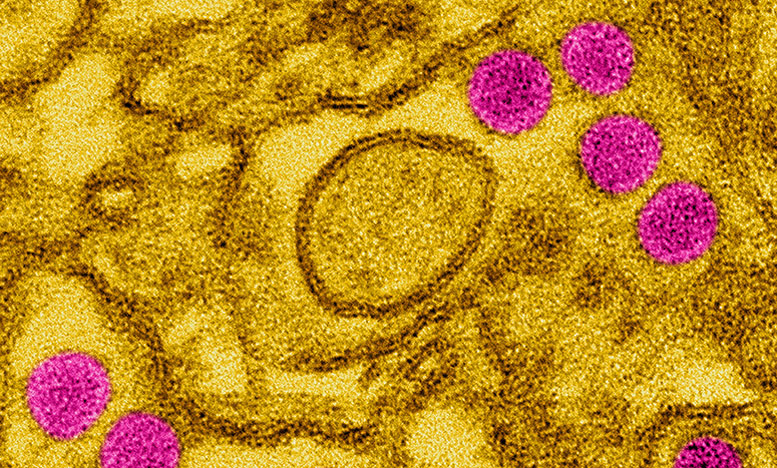
A team of researchers has succeeded in producing large quantities of Zika viruses in the laboratory – a crucial prerequisite for the production of vaccines.
Shortly before the Olympic Games of 2016 in Brazil, all anyone could talk about was the spread of Zika virus. There was even a discussion on postponing the Games for a time. Since the consequences of infection with the virus particularly for pregnant women and their infants have become known, scientists have been working intensively on the development of vaccines against the pathogen. Working in cooperation with a team of researchers from the Universidade Federal do Rio de Janeiro, researchers at the Max Planck Institute for Dynamics of Complex Technical Systems in Magdeburg have now for the first time succeeded in producing large quantities of Zika viruses in the laboratory – a crucial prerequisite for the initiation of immunological studies, the development of diagnostic tools, and the production of vaccines.
Sporadic cases of infection caused by Zika virus were detected in Africa since the 1950s. Thus, up to a few years ago, the virus was only known in expert circles. Over the last decade, however, Zika has spread from Africa via the Pacific islands to Central and South America and South Florida. The pathogen is transmitted by the yellow fever mosquito (Aedes aegypti), which is also found in these locations today. The virus is now found in around 60 countries. While the population of Africa appears to have acquired a kind of basic immunity to the infection over the years, and the illness when contacted tends to be mild, people outside the virus’s original distribution range lack natural immunity.
There is currently no vaccination against Zika virus available. If an effective vaccine is developed one day, it will be necessary to be able to produce it on a large scale in order to supply it to people in the affected regions. To enable this, the viruses must first be propagated in living cells, from which live attenuated or inactivated virus particles can then be obtained for use as a vaccine.
Adaptation to liquid growth medium
To date, the African and Brazilian Zika virus was mostly produced in the kidney cells of African green monkeys (Vero cells) and in cells from Aedes albopictus mosquito larvae. Instead of this, the scientists at the Max Planck Institute in Magdeburg used the BHK-21 (Baby Hamster Kidney) cell line, which has been used successfully in the production of veterinary vaccines for many years. Working in collaboration with the company IDT Biologika in Dessau-Roßlau, the scientists adapted the cells so that they can grow in a serum-free liquid medium in a bioreactor without the use of carriers.
As the adapted BHK-21 cell line proved very suitable for the propagation of Zika virus, the researchers from Magdeburg and the team of Professor Amilcar Tanuri in Rio de Janeiro infected the cells with different Zika virus isolates from South America. They discovered that it was not possible to achieve equally high virus yields from all virus isolates. The highest yield was obtained from a virus isolate from the Brazilian federal state of Pernambuco.
The scientists then noticed that the viruses largely remained in the host cells and were not released from them. Thus, to enable the harvesting of the pathogens, the cells had to be destroyed and the virus particles thereby released.
Flaviviruses, of which the Zika virus is one, only form around ten infectious particles per cell in the currently available cell cultures. In comparison, influenza viruses can produce up to 20,000 virus particles per cell (with 200 infectious virus particles per cell). Thus, to enable the effective production of vaccines against flaviviruses, either more productive cell lines or processes for the production of very high cell concentrations are needed.
The researchers succeeded in achieving the latter in recent months. Using high cell density cultivation, they can now produce cell concentrations that are up to six times higher than using traditional processes.
High cell density allows for efficient propagation
A filter ensures that the cells remain in the reactor, while the medium is replaced. The temperature, oxygen, and pH values in the bioreactor can be controlled to ensure optimal conditions for the production of the viruses. After almost two weeks, the scientists were able to harvest almost 40 million infectious viruses per milliliter – sufficient to meet the needs of a large number of virological studies.
Although BHK-21 cells can be used without any problems in veterinary medicine, further studies are needed before these cells can be used as a substrate for the production of human vaccines. However, thanks to the new insights into virus production obtained through this study, researchers can now carry out further epidemiological and virological studies on Zika virus.
Reference: “Propagation of Brazilian Zika virus strains in static and suspension cultures using Vero and BHK cells” by Alexander Nikolay, Leda R Castilho, Udo Reichl and Yvonne Genzel, 23 March 2017, Vaccine.
DOI: 10.1016/j.vaccine.2017.03.018
Related Zika News from SciTechDaily
Never miss a breakthrough: Join the SciTechDaily newsletter.
Follow us on Google and Google News.