
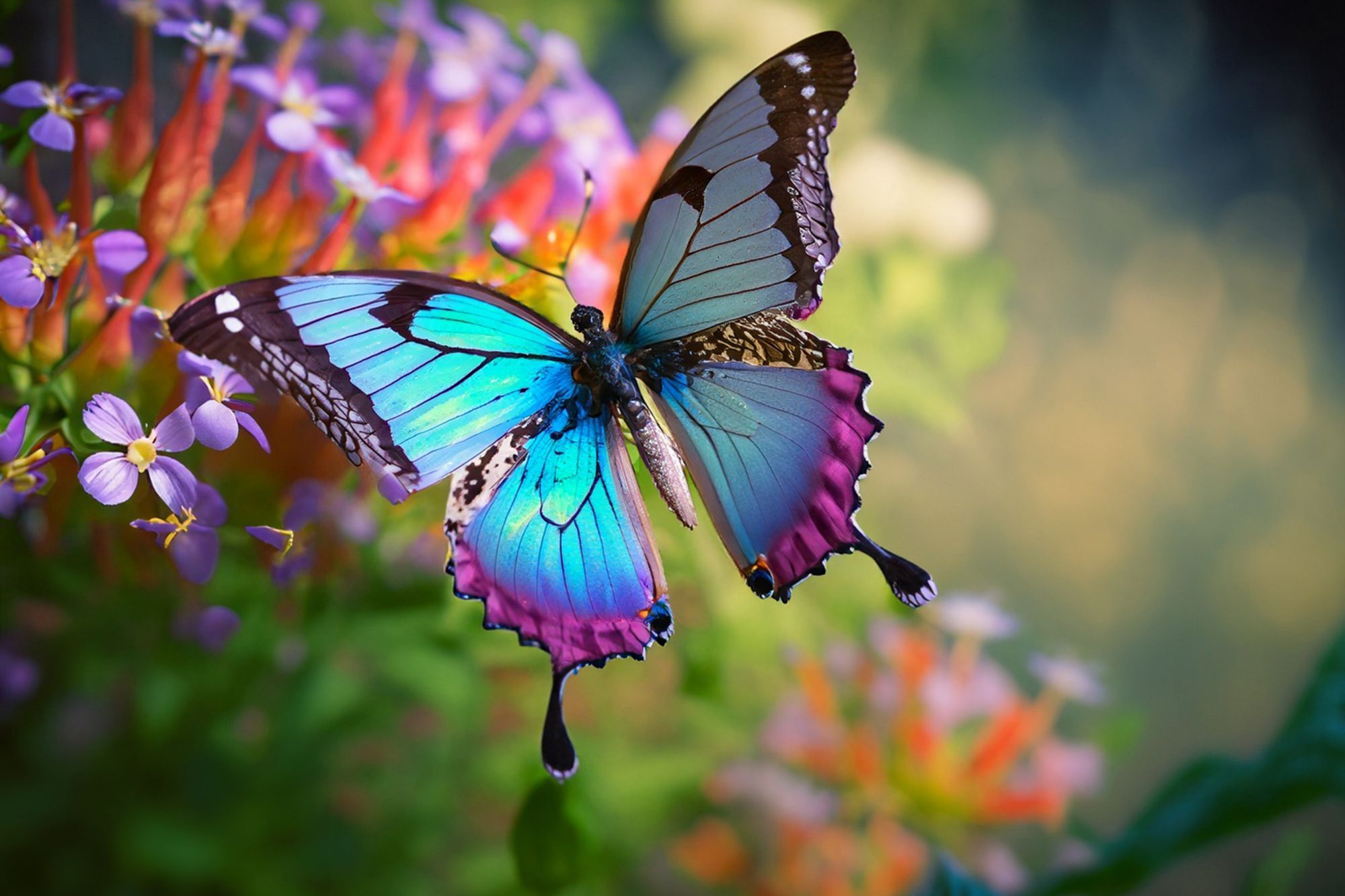
New research uncovers a surprising genetic mechanism that impacts the development of butterfly wing colors
An international team of researchers has revealed an unexpected genetic process that shapes the intricate and colorful patterns on butterfly wings. Published in the Proceedings of the National Academy of Sciences, the study led by Luca Livraghi from George Washington University and the University of Cambridge, identifies an RNA molecule, rather than a protein as previously believed, as crucial in controlling the spread of black pigment on butterfly wings.
Precisely how butterflies are able to generate the vibrant patterns and colors on their wings has fascinated biologists for centuries. The genetic code contained within the cells of developing butterfly wings dictates the specific arrangement of the color on the wing’s scales—the microscopic tiles that form wing patterns—similar to the arrangement of colored pixels to form a digital image.
Cracking this code is fundamental to understanding how our own genes build our anatomy. In the lab, researchers can manipulate that code in butterflies with gene-editing tools and observe the effect on visible traits, such as coloration on a wing.
The Role of Protein-Coding Genes
Scientists have long known that protein-coding genes are crucial to these processes. These types of genes create proteins that can dictate when and where a specific scale should generate a particular pigment. When it comes to black pigments, researchers thought this process would be no different, and initially implicated a protein-coding gene. The new research, however, paints a different picture.
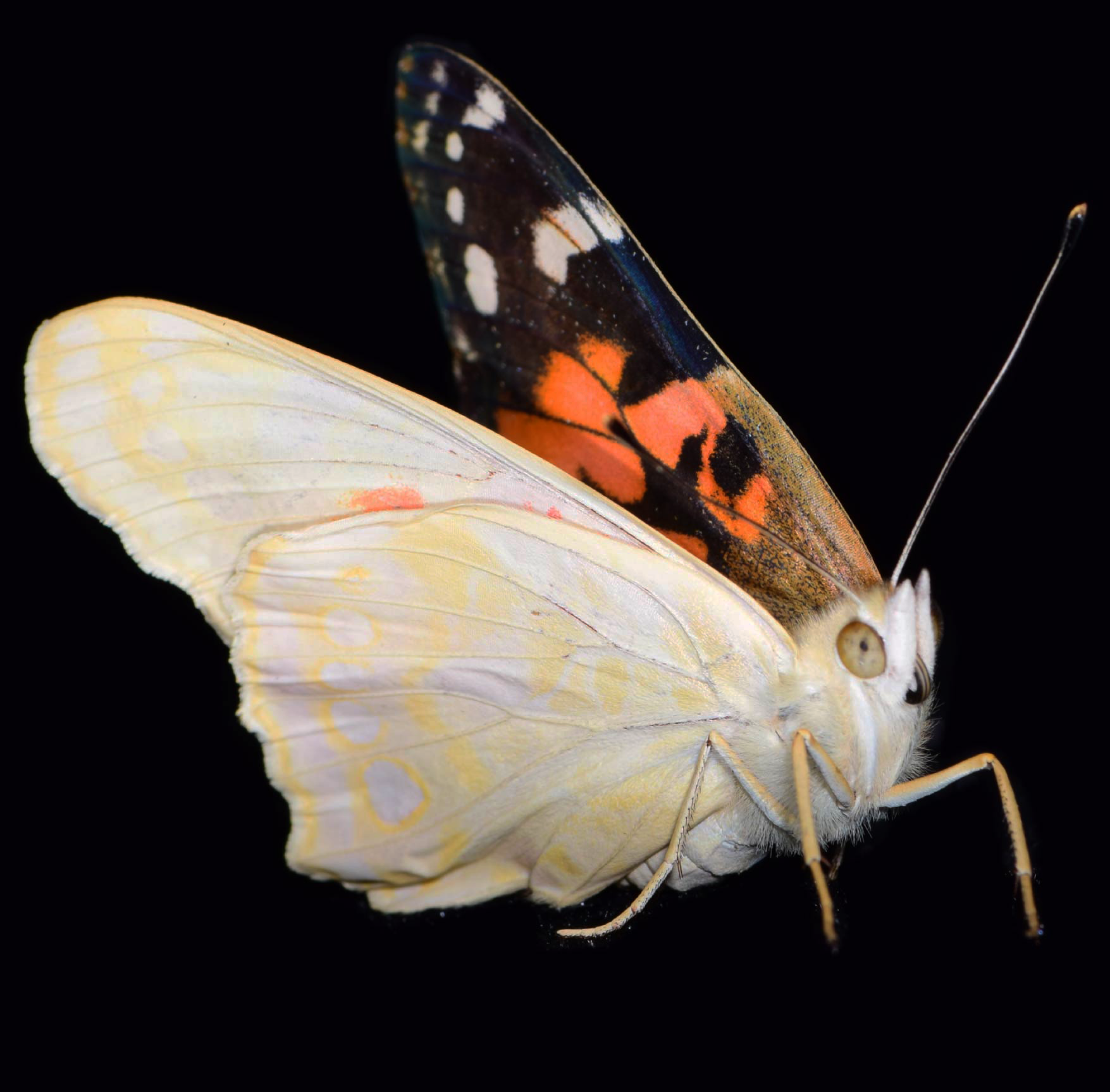
dark pigmentation was lost in one set of wings after gene editing with CRISPR, which disabled a
crucial RNA molecule responsible for regulating wing color. Credit: Luca Livraghi
The team discovered a gene that produces an RNA molecule—not a protein—controls where dark pigments are made during butterfly metamorphosis. Using the genome-editing technique CRISPR, the researchers demonstrated that when you remove the gene that produces the RNA molecule, butterflies completely lose their black pigmented scales, showing a clear link between RNA activity and dark pigment development.
RNA as an Evolutionary Paintbrush
“What we found was astonishing,” said Livraghi, a postdoctoral scientist at GW. “This RNA molecule directly influences where the black pigment appears on the wings, shaping the butterfly’s color patterns in a way we hadn’t anticipated.”
The researchers further explored how the RNA molecule functions during wing development. By examining its activity, they observed a perfect correlation between where the RNA is expressed and where black scales form.
“We were amazed that this gene is turned on where the black scales will eventually develop on the wing, with exquisite precision,” said Arnaud Martin, associate professor of biology at GW. “It is truly an evolutionary paintbrush in this sense, and a creative one, judging by its effects in several species.”

The researchers examined the newly discovered RNA in several other butterflies whose evolutionary history diverged around 80 million years ago. They found that in each of these species, the RNA had evolved to control new placements in the patterns of dark pigments.
“The consistent result obtained from CRISPR mutants in several species really demonstrate that this RNA gene is not a recent invention, but a key ancestral mechanism to control wing pattern diversity,” said Riccardo Papa, professor of biology at the University of Puerto Rico – Río Piedras.
“We and others have now looked at this genetic trait in many different butterfly species, and remarkably we are finding that this same RNA is used again and again, from longwing butterflies, to monarchs and painted lady butterflies,” said Joe Hanly, a postdoctoral scientist and visiting fellow at GW. “It’s clearly a crucial gene for the evolution of wing patterns. I wonder what other, similar phenomena biologists might have been missing because they weren’t paying attention to the dark matter of the genome.”
The findings not only challenge long-standing assumptions about genetic regulation but also open up new avenues for studying how visible traits evolve in animals.
Reference: “A long noncoding RNA at the cortex locus controls adaptive coloration in butterflies” by Luca Livraghi, Joseph J. Hanly, Elizabeth Evans, Charlotte J. Wright, Ling S. Loh, Anyi Mazo-Vargas, Kiana Kamrava, Alexander Carter, Eva S. M. van der Heijden, Robert D. Reed, Riccardo Papa, Chris D. Jiggins and Arnaud Martin, 30 August 2024, Proceedings of the National Academy of Sciences.
DOI: 10.1073/pnas.2403326121
The research was supported by the National Science Foundation and the Biotechnology and Biological Sciences Research Council.
Never miss a breakthrough: Join the SciTechDaily newsletter.
Follow us on Google and Google News.
1 Comment
Hi 👋
Thank you for a very fascinating article about ‘black matter’ and the connection to the beautiful colors of the butterflies. I find it very interesting. The moment I saw your headline ” ….dark matter solves butterfly evolutionary history..” I got excited and my immediate connection was with the dark matter in our universe.
After reading your article, I thought it would be very interesting to think along those same lines of the universe’s dark matter and our astonishingly beautiful, bright, colorful universe. To a much lesser degree, the butterfly’s colors are just as astonishingly beautiful and mysterious as those of our universe.
I know that dark matter and dark energy are the most mysterious elements in our Universe. It is the 95 % invisible element that scientists up till today have no clue what it does or how it’s related to our existence on Earth.
So far there is no proof of any other kind of existence except humankind. (when I say humankind, I mean everything that exists on Earth) The 95% obviously has everything to do with the 5%, which is us, humankind, and everything else that has been discovered and is being discovered as we speak by the amazing James Webb and other telescopes.
So besides that, the 95% dark matter and dark energy is the invisible pillar and glue that holds everything together including everything on Mother Earth. Based on your butterfly black matter effect, without it, there would have been no light and color in our universe whatsoever if you can make sense of the thoughts that are going through my mind after reading your fascinating article and research results.
Thank and regards,
Mo Noor Joseph
South Africa 🇿🇦