

The Expedition 72 crew advanced its life science research and prepared for upcoming spacewalks on Tuesday, as a U.S. resupply spacecraft splashed down in the Gulf of Mexico. The astronauts also maintained exercise equipment and reconfigured a scientific airlock aboard the International Space Station (ISS).
NASA Flight Engineers Don Pettit and Nick Hague conducted separate space biology experiments focused on how microgravity affects the human body. Pettit cleaned a research incubator that previously held biological samples exposed to space-related stressors causing muscle and bone loss. Those samples were returned to Earth aboard the SpaceX Dragon cargo spacecraft for further analysis. Meanwhile, Hague wore a sensor-equipped headband and vest to monitor his heart rate and breathing while cycling on an exercise bike. This data will help researchers better understand how the human body adapts to life in microgravity.
Commander Suni Williams and Flight Engineer Butch Wilmore, both NASA astronauts, joined each other in the Columbus laboratory module and began installing new exercise gear. Combining bicycling, rowing, and resistive capabilities, the small and compact European Enhanced Exploration Exercise Device will be tested for its effectiveness aboard the space station before being used for longer-term missions to the Moon, Mars, and beyond.
Wilmore partnered with Hague near the end of their shift and reconfigured the Nanoracks Bishop airlock. Bishop will be repressurized after being reattached to the Tranquility module following a weekend of transfer activities with the Canadarm2 robotic arm. Bishop had earlier contained the Euro Materials Ageing experiment hardware that was robotically maneuvered to the Bartolomeo research platform attached to the outside of Columbus.
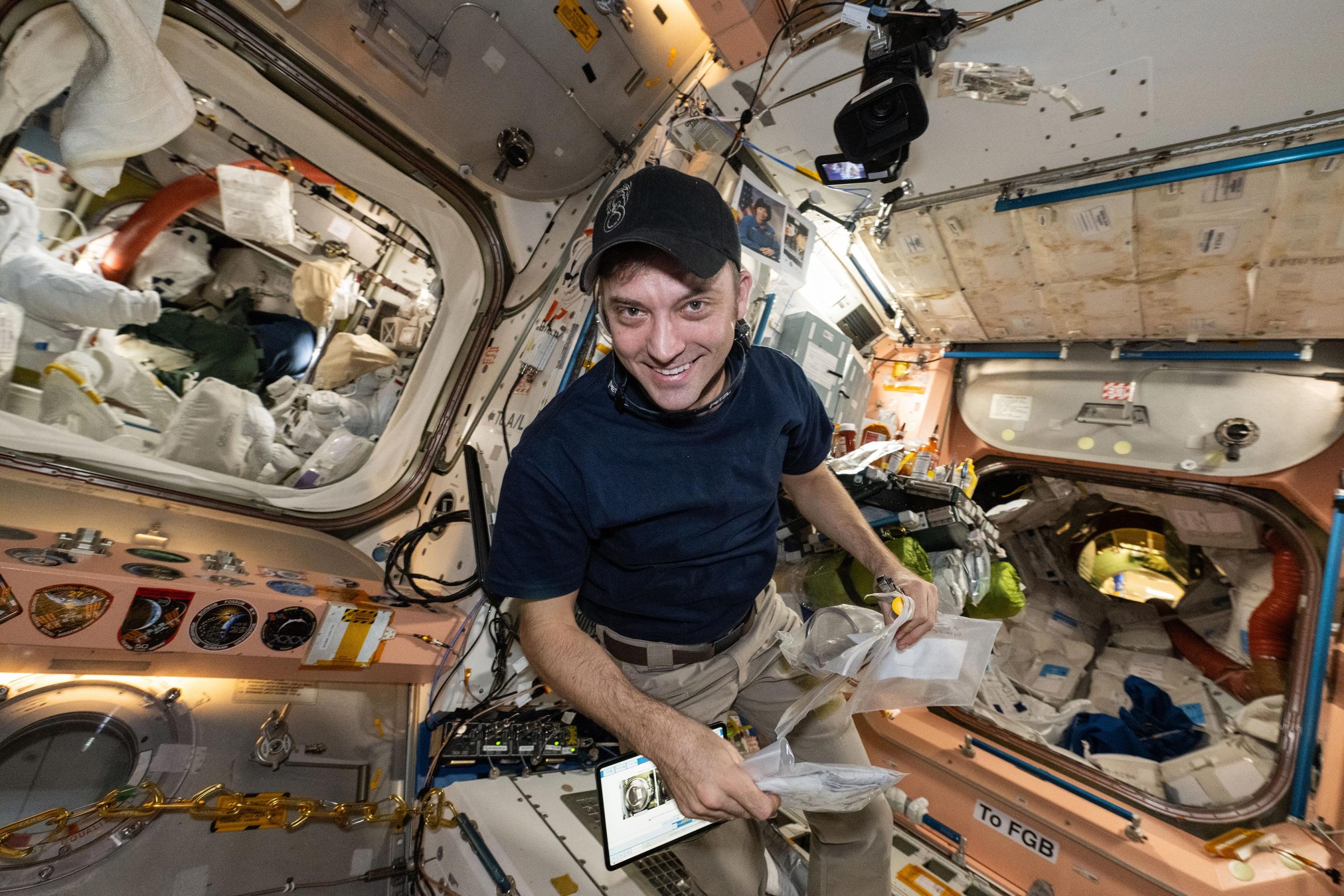
Roscosmos cosmonauts Alexey Ovchinin and Ivan Vagner are nearing a spacewalk that will see the duo remove external science experiments and relocate European robotic arm hardware. The pair organized their spacewalking tools and conducted photographic inspections inside the Poisk airlock where they will exit into the vacuum of space at 10:10 a.m. EST on Thursday. Ovchinin and Vagner will spend about six hours and 40 minutes wearing their Orlan spacesuits while tethered to the outside of the orbital outpost.
Flight Engineer Aleksandr Gorbunov split his day on Earth observations and life support maintenance inside the station’s Roscosmos segment. Gorbunov tested new imaging hardware in the Nauka science module that can view the effects of natural and man-made disasters on Earth in different wavelengths. The first-time space flyer also worked on an orbital plumbing and ventilation system cleaning throughout the day.
Never miss a breakthrough: Join the SciTechDaily newsletter.
Follow us on Google and Google News.