
Close Menu
    Facebook X (Twitter) Instagram
    SciTechDaily
    • Biology
    • Chemistry
    • Earth
    • Health
    • Physics
    • Science
    • Space
    • Technology
    Facebook X (Twitter) Pinterest YouTube RSS
    SciTechDaily
    Home»Space»Astronomers Analysis Reveals Outbound Comets Likely of Alien Origin
    Space

    Astronomers Analysis Reveals Outbound Comets Likely of Alien Origin

    By National Institutes of Natural SciencesJanuary 17, 2020No Comments3 Mins Read
    Facebook Twitter Pinterest Telegram LinkedIn WhatsApp Email Reddit
    Share
    Facebook Twitter LinkedIn Pinterest Telegram Email Reddit
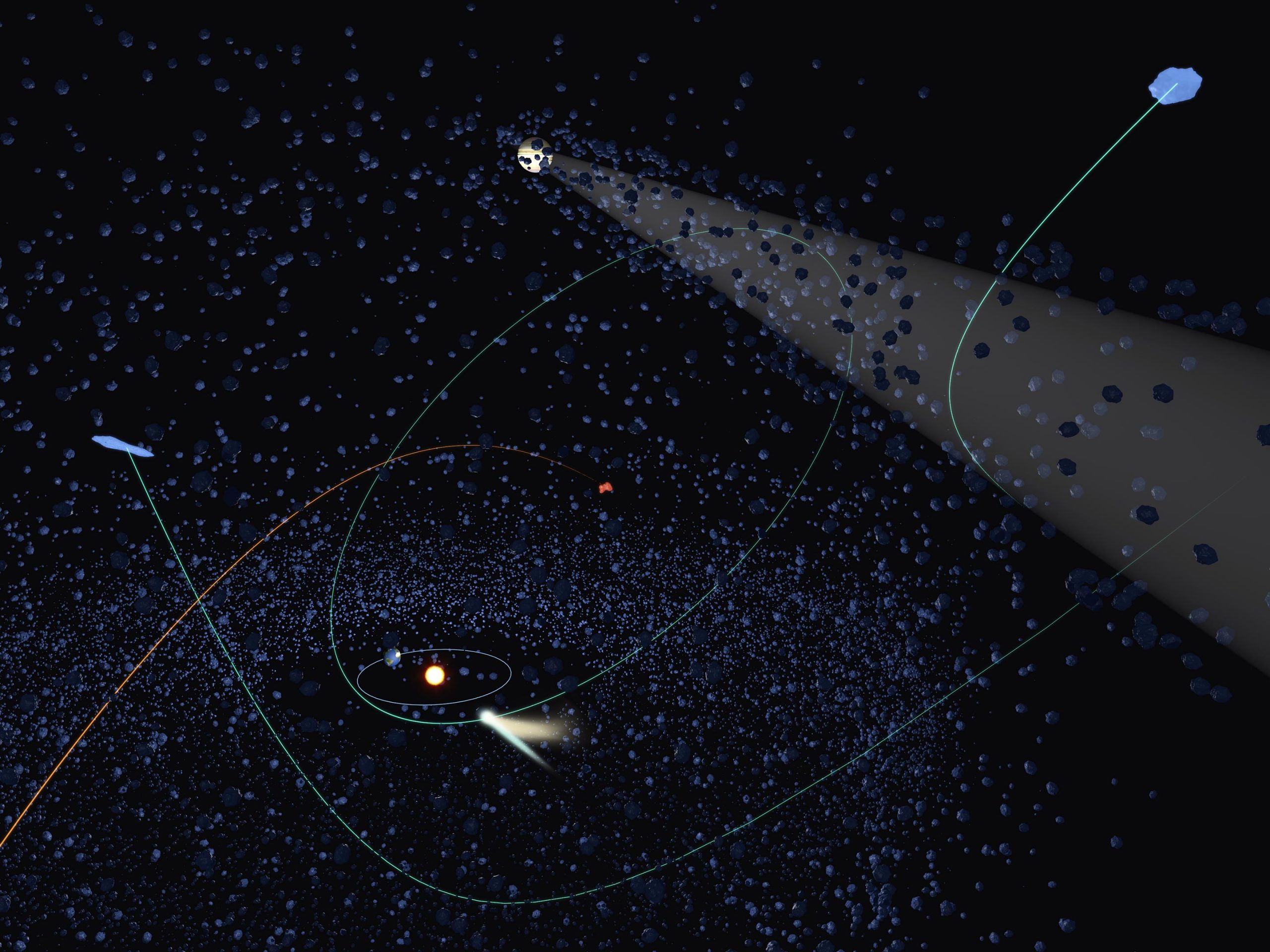
    Conceptual Diagram Comets Interstellar Objects
    Researchers calculated the typical paths of long-orbit comets (blue) perturbed by a passing gas-giant-sized object (white) and objects of interstellar origin (red). Credit: NAOJ

    Astronomers at the National Astronomical Observatory of Japan (NAOJ) have analyzed the paths of two objects heading out of the Solar System forever and determined that they also most likely originated from outside of the Solar System. These results improve our understanding of the outer Solar System and beyond.

    Not all comets follow closed orbits around the Sun. Some fly through the Solar System at high speed before heading out to interstellar space, never to return. Although it is simple to calculate where these comets are going, determining where they came from is more difficult.

    There are two possible scenarios. In the first scenario, a comet is originally in a stable orbit far from the Sun, but gravitational interactions with a passing object pull the comet out of its orbit. The comet then falls into the inner Solar System where it can be observed before being flung out into interstellar space. In the second scenario, a comet originates someplace very far away, perhaps a different planetary system, and as it flies through interstellar space, by random chance it passes through the Solar System once before continuing on its way.

    Arika Higuchi and Eiichiro Kokubo at NAOJ calculated the types of trajectories which would typically be expected in each scenario. The team then compared their calculations to observations of two unusual outbound objects, 1I/’Oumuamua discovered in 2017 and 2I/Borisov discovered in 2019. They found that the interstellar origin scenario provides the better match for the paths of both objects.

    The team also showed that it is possible for gas-giant-sized bodies passing close to the Solar System to destabilize long-orbit comets and set them on paths similar to the paths of these two objects. Survey observations have not uncovered any gas-giant-sized bodies which can be linked to these two outbound objects, but further study, both theoretical and observational, of small interstellar objects is needed to better determine the origins of these objects.

    These results appeared online as Higuchi & Kokubo “Hyperbolic orbits in the Solar system: interstellar origin or perturbed Oort cloud comets?” in the Monthly Notices of the Royal Astronomical Society on November 11, 2019, and will be printed in the February 2020 issue.

    Reference: “Hyperbolic orbits in the Solar system: interstellar origin or perturbed Oort cloud comets?” by Arika Higuchi and Eiichiro Kokubo, 11 November 2019, Monthly Notices of the Royal Astronomical Society.
    DOI: 10.1093/mnras/stz3153

    Never miss a breakthrough: Join the SciTechDaily newsletter.
    Follow us on Google and Google News.

    Astronomy NAOJ National Institutes of Natural Sciences
    Share. Facebook Twitter Pinterest LinkedIn Email Reddit

    Related Articles

    Cosmic Cradles and Graves: Tracing Life and Death of Stars in the Most Distant Galaxy

    Cosmic Shield: How Our Solar System Survived a Supernova

    Mysterious Cosmic Tadpole: A Strange Gas Cloud Dances With a Colossal Black Hole

    Unknown Physics on the Cosmic Scale? 1000 Supernova Explosions Chart the Expansion History of the Universe

    Astronomers Spot Stellar Eggs Near Center of the Milky Way Hatching Into Baby Stars

    Scientists Observe the Atmosphere of Super Earth Exoplanet GJ3470b

    New Insights into How Retrograde Planets May Form and Endure

    HiCIAO Helps Reveal the Structure of Protoplanetary Disks

    ULIRG Arp 220 Developed From a Multiple Merger of Four or More Galaxies

    Leave A Reply Cancel Reply

    • Facebook
    • Twitter
    • Pinterest
    • YouTube

    Don't Miss a Discovery

    Subscribe for the Latest in Science & Tech!

    Trending News

    Millions Take These IBS Drugs, But a New Study Finds Serious Risks

    Scientists Unlock Hidden Secrets of 2,300-Year-Old Mummies Using Cutting-Edge CT Scanner

    Bread Might Be Making You Gain Weight Even Without Eating More Calories

    Scientists Discover Massive Magma Reservoir Beneath Tuscany

    Europe’s Most Active Volcano Just Got Stranger – Here’s Why Scientists Are Rethinking It

    Alzheimer’s Symptoms May Start Outside the Brain, Study Finds

    Millions Take This Popular Supplement – Scientists Discover a Concerning Link to Heart Failure

    The Universe Is Expanding Too Fast and Scientists Can’t Explain Why

    Follow SciTechDaily
    • Facebook
    • Twitter
    • YouTube
    • Pinterest
    • Newsletter
    • RSS
    SciTech News
    • Biology News
    • Chemistry News
    • Earth News
    • Health News
    • Physics News
    • Science News
    • Space News
    • Technology News
    Recent Posts
    • Doctors Surprised by the Power of a Simple Drug Against Colon Cancer
    • Why Popular Diabetes Drugs Like Ozempic Don’t Work for Everyone: The “Genetic Glitch”
    • Scientists Create Improved Insulin Cells That Reverse Diabetes in Mice
    • Scientists Stunned After Finding Plant Thought Extinct for 60 Years
    • A Common Diabetes Drug May Hold the Key to Stopping HIV From Coming Back
    Copyright © 1998 - 2026 SciTechDaily. All Rights Reserved.
    • Science News
    • About
    • Contact
    • Editorial Board
    • Privacy Policy
    • Terms of Use

    Type above and press Enter to search. Press Esc to cancel.