
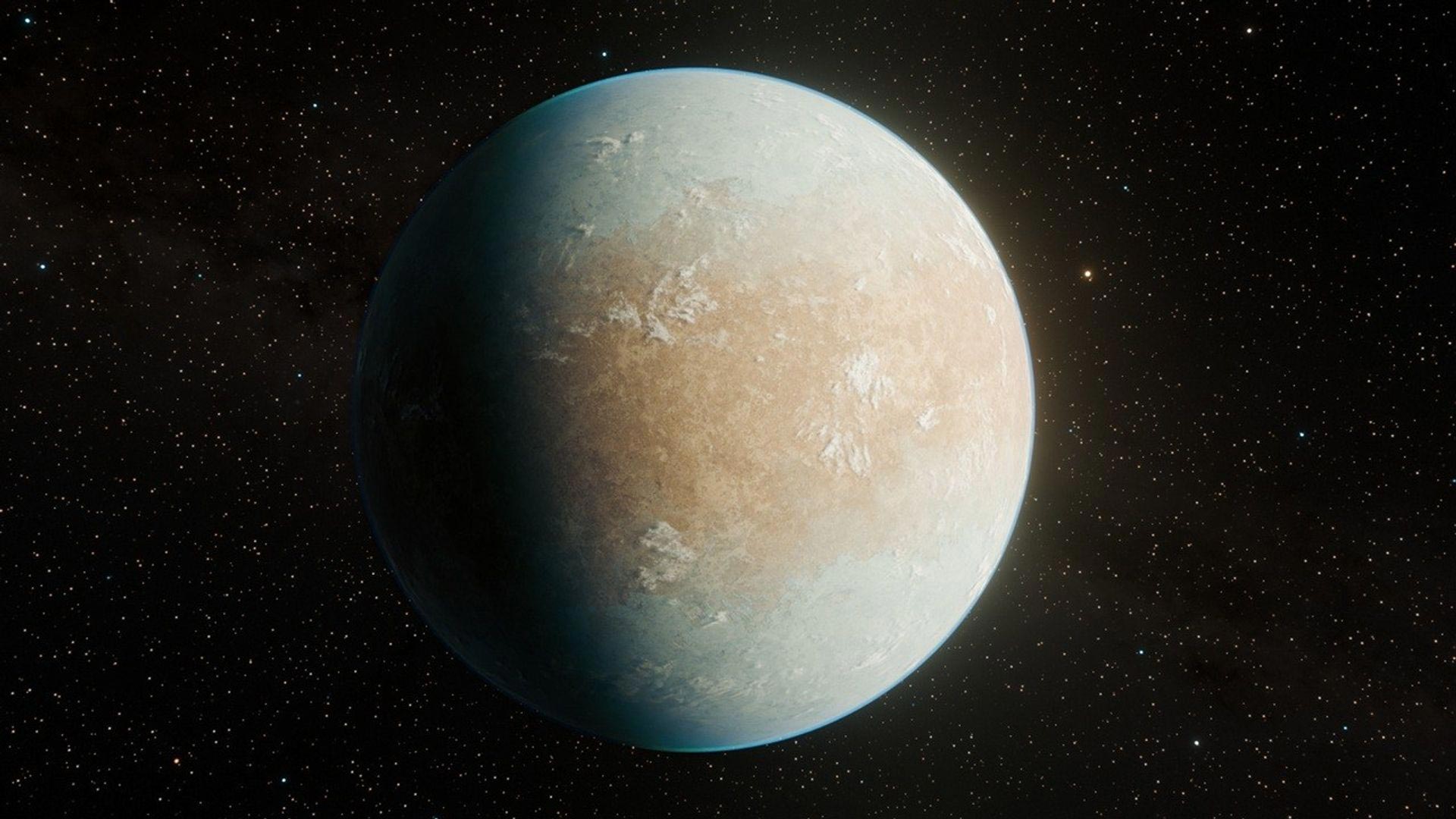
A newly identified Earth-sized exoplanet with a year-long orbit may lie near its star’s habitable zone, but extreme cold could limit its chances of hosting liquid water.
HD 137010 b is a newly identified planet that appears broadly similar to Earth, but with one important caveat. Despite its Earth-like traits, it may be even colder than Mars, a world already locked in deep freeze.
A rare Earth-like orbit emerges
Researchers are still uncovering new discoveries in data collected by NASA’s Kepler Space Telescope, which ended operations in 2018. One recent study highlights a promising find: a rocky planet slightly larger than Earth that circles a Sun-like star roughly 146 light-years from our solar system.
The planet’s year length is expected to closely match Earth’s, at about one orbit per year. Although it is currently classified as a “candidate” awaiting confirmation, HD 137010 b appears to lie near the outer boundary of its star’s “habitable zone,” the range of distances where liquid water could exist on a planet’s surface if atmospheric conditions are right.
Worlds that orbit stars beyond our Sun are called “exoplanets.” If confirmed, HD 137010 b would be especially notable because it may be the first Earth-sized exoplanet in a year-long orbit that passes directly in front of a nearby, Sun-like star, making it unusually well-suited for detailed follow-up observations.
Habitable in theory, frozen in practice
There is a significant drawback to this otherwise intriguing world. The planet would receive less than one-third of the energy that Earth gets from the Sun. While its host star, HD 137010, belongs to the same general class as our Sun, it is both cooler and less luminous.
As a result, the surface temperature of HD 137010 b could remain extremely low, potentially no warmer than minus 90 degrees Fahrenheit (minus 68 degrees Celsius). For context, Mars has an average surface temperature of about minus 85 degrees Fahrenheit (minus 65 degrees Celsius), suggesting that this candidate planet may be even colder than the Red Planet.
An artist’s concept animation of exoplanet candidate HD 137010 b, which gives a view as if flying above this possible rocky planet slightly larger than Earth, thought to orbit a Sun-like star about 146 light-years away. This view also creates an effect similar to a transit, as the planet’s star disappears and then reappears from behind HD 137010 b. Credit: NASA/JPL-Caltech/Keith Miller (Caltech/IPAC)
Planet HD 137010 b also will need follow-up observations to be promoted from “candidate” to “confirmed.” Exoplanet scientists use a variety of techniques to identify planets, and this discovery comes from a single “transit” — only one instance of the planet crossing its star’s face in a kind of miniature eclipse — detected during Kepler’s second mission, known as K2.
Even with just one transit, the study’s authors were able to estimate the candidate planet’s orbital period. They tracked the time it took for the planet’s shadow to move across the star’s face — in this case, 10 hours, while Earth takes about 13 — then compared it to orbital models of the system itself. Still, though the precision of that single detection is much higher than most transits captured by space-based telescopes, astronomers need to see these transits repeat regularly in order to confirm that they are caused by a real planet.
And capturing more transits is going to be tricky. The planet’s orbital distance, so similar to Earth’s, means such transits happen far less often than for planets in tighter orbits around their stars (it’s a big reason why exoplanets with Earth-like orbits are so hard to detect in the first place). With luck, confirmation could come from further observation by the successor to Kepler/K2, NASA’s TESS (the Transiting Exoplanet Survey Satellite), the still-functioning workhorse for planetary detection, or from the European Space Agency’s CHEOPS (CHaracterising ExOPlanets Satellite). Otherwise, gathering further data on planet HD 137010 b might have to wait for the next generation of space telescopes.
Fun Facts
Despite the possibility of a frigid climate, HD 137010 b also could turn out to be a temperate or even a watery world, say the authors of the paper on this exoplanet. It would just need an atmosphere richer in carbon dioxide than our own. The science team, based on modeling of the planet’s possible atmospheres, gives it a 40% chance of falling within the “conservative” habitable zone around the star, and a 51% chance of falling within the broader “optimistic” habitable zone. On the other hand, the authors of the study say the planet has about a 50-50 chance of falling beyond the habitable zone entirely.
Reference: “A Cool Earth-sized Planet Candidate Transiting a Tenth Magnitude K-dwarf From K2” by Alexander Venner, Andrew Vanderburg, Chelsea X. Huang, Shishir Dholakia, Hans Martin Schwengeler, Steve B. Howell, Robert A. Wittenmyer, Martti H. Kristiansen, Mark Omohundro and Ivan A. Terentev, 27 January 2026, The Astrophysical Journal Letters.
DOI: 10.3847/2041-8213/adf06f
Never miss a breakthrough: Join the SciTechDaily newsletter.
Follow us on Google and Google News.