
Close Menu
    Facebook X (Twitter) Instagram
    SciTechDaily
    • Biology
    • Chemistry
    • Earth
    • Health
    • Physics
    • Science
    • Space
    • Technology
    Facebook X (Twitter) Pinterest YouTube RSS
    SciTechDaily
    Home»Space»Astronomers Discover a Bridge of Atomic Hydrogen Gas 2.6 Million Light Years Long
    Space

    Astronomers Discover a Bridge of Atomic Hydrogen Gas 2.6 Million Light Years Long

    By Royal Astronomical SocietyAugust 7, 20141 Comment3 Mins Read
    Facebook Twitter Pinterest Telegram LinkedIn WhatsApp Email Reddit
    Share
    Facebook Twitter LinkedIn Pinterest Telegram Email Reddit
    Astronomers Discover a Bridge of Atomic Hydrogen Gas 2.6 Million Light Years Long
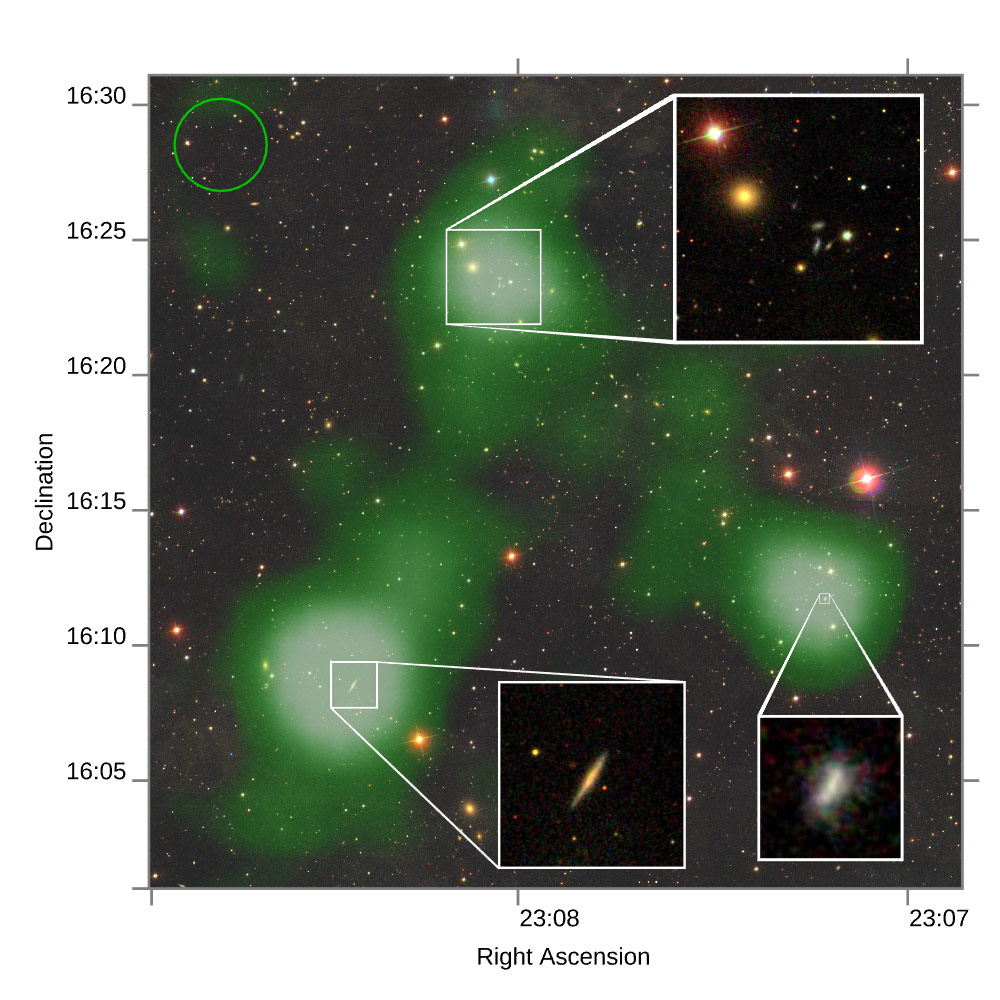
    The bridge of gas (shown in green) stretches from the large galaxy at the bottom left to the group of galaxies at the top. A third nearby galaxy to the right also has a shorter stream of gas attached to it. The three insets show expanded views of the different galaxies and the green circle indicates the Arecibo telescope beam. Credit: Rhys Taylor/Arecibo Galaxy Environment Survey/The Sloan Digital Sky Survey Collaboration.

    Using the William E. Gordon Telescope, astronomers discovered a bridge of atomic hydrogen gas 2.6 million light-years long between galaxies 500 million light-years away.

    Astronomers and students have found a bridge of atomic hydrogen gas 2.6 million light-years long between galaxies 500 million light-years away. They detected the gas using the William E. Gordon Telescope at the Arecibo Observatory, a radio astronomy facility of the US National Science Foundation located in Puerto Rico. The team publish their results in a paper in Monthly Notices of the Royal Astronomical Society.

    The stream of atomic hydrogen gas is the largest known, a million light years longer than a gas tail found in the Virgo Cluster by another Arecibo project a few years ago. Dr. Rhys Taylor, a researcher at the Czech Academy of Sciences and lead author of the paper, said “This was totally unexpected. We frequently see gas streams in galaxy clusters, where there are lots of galaxies close together, but to find something this long and not in a cluster is unprecedented.”

    It is not just the length of the stream that is surprising but also the amount of gas found in it. Roberto Rodriguez, a 2014 graduate from the University of Puerto Rico in Humacao who worked on the project as an undergraduate, explained “We normally find gas inside galaxies, but here half of the gas – 15 billion times the mass of the Sun – is in the bridge. That’s far more than in the Milky Way and Andromeda galaxies combined!”

    The team is still investigating the origin of the stream. One notion surmises that the large galaxy at one end of the stream passed close to the group of smaller galaxies at the other end in the past, and that the gas bridge was drawn out as they moved apart. A second notion suggests that the large galaxy plowed straight through the middle of the group, pushing gas out of it. The team plan to use computer simulations to find out which of these ideas can best match the shape of the bridge that is seen with the Arecibo Telescope.

    The project involved three undergraduate researchers: Roberto Rodriguez and Clarissa Vazquez from UPR Humacao, and Hanna Herbst, now a graduate student at the University of Florida. Dr. Robert Minchin, a staff astronomer at Arecibo Observatory and the principal investigator on the project, said “Student involvement is very important to us. We are proud to be inspiring the next generation of astronomers, and particularly proud of the involvement of Puerto Rican students.”

    The bridge was found in data taken between 2008 and 2011 for the Arecibo Galaxy Environment Survey (AGES), which is using the power of the Arecibo Telescope to survey a large area of sky with a high level of sensitivity.

    Reference: “The Arecibo Galaxy Environment Survey VII : A Dense Filament With Extremely Long HI Streams” by R. Taylor, R. F. Minchin, H. Herbst, J. I. Davies, R. Rodriguez and C. Vazquez, 4 August 2014, MNRAS.
    DOI: 10.1093/mnras/stu1305
    arXiv: 1407.0016


    Never miss a breakthrough: Join the SciTechDaily newsletter.
    Follow us on Google and Google News.

    Astronomy Astrophysics Royal Astronomical Society
    Share. Facebook Twitter Pinterest LinkedIn Email Reddit

    Related Articles

    Martian Meteorite Hunters: Paving the Way for Future Rovers To Search for Meteorites on Mars

    Planetary Shields Will Buckle Under Furious Stellar Winds From Their Dying Stars – Nearly Impossible for Life To Survive

    Lucky Encounter: Solar Orbiter Spacecraft Flies Through the Tail of a Disintegrated Comet

    A Bug’s Life: Mountains on Neutron Stars May Be Only Fractions of Millimeters Tall

    Habitable Planets With Earth-Like Biospheres May Be Much Rarer Than Thought

    Mysterious Hydrogen-Free Supernova Sheds Light on Massive Stars’ Violent Death Throes

    New Research Finds That Supermassive Black Holes Could Form From Dark Matter

    Stunning “Honeycomb Heart” Revealed in Iconic Supernova Explosion Remnant

    Giant Radio Galaxies: Cosmic Beasts and Where to Find Them

    1 Comment

    1. Madanagopal.V.C. on August 9, 2014 12:42 pm

      The precursor of this universe is nothing but Hydrogen Atom which was formed by the nucleosynthesis of quarks trapped by color forces called gluons(three pronged) and electrical forces called electron which is semi solid and semi energy as a cloud, being (two pronged) to become stable proton and electron. Molecular synthesis happened later to Helium and other higher elements in the periodic table bu atomic fusion as in the Sun. Hence the primordial MATTER happens to be only HYDROGEN. This truth is fully borne out in this article by detecting atomic Hydrogen lines of 2.6 million light years long beyond 500 light years around a galaxy. Thank You.

      Reply
    Leave A Reply Cancel Reply

    • Facebook
    • Twitter
    • Pinterest
    • YouTube

    Don't Miss a Discovery

    Subscribe for the Latest in Science & Tech!

    Trending News

    Scientists Discover Mysterious Creature Living in the Great Salt Lake – and It Exists Nowhere Else on Earth

    It’s Alive? Surprising Discovery Changes What We Know About Fog

    A Tiny Bright-Blue Octopus Found in the Galápagos Is Completely New to Science

    Scientists Discover Surprising Anti-Aging Power Hidden in Aged Garlic

    Why More People in Their 30s Are Suddenly Getting Colon Cancer

    Scientists Discover Sperm Seem To Bypass a Fundamental Law of Physics

    Archaeologists Discover Mysterious Artificial Island Older Than Stonehenge in Scotland

    Massive Study Warns Marijuana Use in Teens Is Linked to Serious Mental Illness

    Follow SciTechDaily
    • Facebook
    • Twitter
    • YouTube
    • Pinterest
    • Newsletter
    • RSS
    SciTech News
    • Biology News
    • Chemistry News
    • Earth News
    • Health News
    • Physics News
    • Science News
    • Space News
    • Technology News
    Recent Posts
    • Goodbye CPAP? New Pill Shows Major Promise for Sleep Apnea
    • Largest Known Wild Chimpanzee Community Breaks Apart After Decades of Unity
    • Scientists Turn Mice Transparent to Uncover Obesity’s Secret Effects on Nerves
    • Scientists Discover a Hidden Cause of Cellular Aging That Can Be Reversed
    • World’s Most-Used Weedkiller Found To Disrupt Honeybee Brains
    Copyright © 1998 - 2026 SciTechDaily. All Rights Reserved.
    • Science News
    • About
    • Contact
    • Editorial Board
    • Privacy Policy
    • Terms of Use

    Type above and press Enter to search. Press Esc to cancel.