
Astronomers have discovered that Milky Way makes small wobbling or squishing movements, acting like a huge flag fluttering in the wind.
22 October 2013. Astronomers have discovered that our Galaxy wobbles. An international team of astronomers around Mary Williams from the Leibniz Institute for Astrophysics Potsdam (AIP) detected and examined this phenomenon with the RAdial Velocity Experiment (RAVE), a survey of almost half a million stars around the Sun. In addition to the regular Galactic rotation, the scientists found the Milky Way moving perpendicular to the Galactic plane.
It is common knowledge that our Galaxy is permanently in motion. Being a barred spiral galaxy it rotates around the Galactic center. It has now been discovered that our Galaxy, the Milky Way, also makes small wobbling or squishing movements. It acts like a Galactic mosh pit or a huge flag fluttering in the wind, north to south, from the Galactic plane with forces coming from multiple directions, creating a chaotic wave pattern. The source of the forces is still not understood however: possible causes include spiral arms stirring things up or ripples caused by the passage of a smaller galaxy through our own.
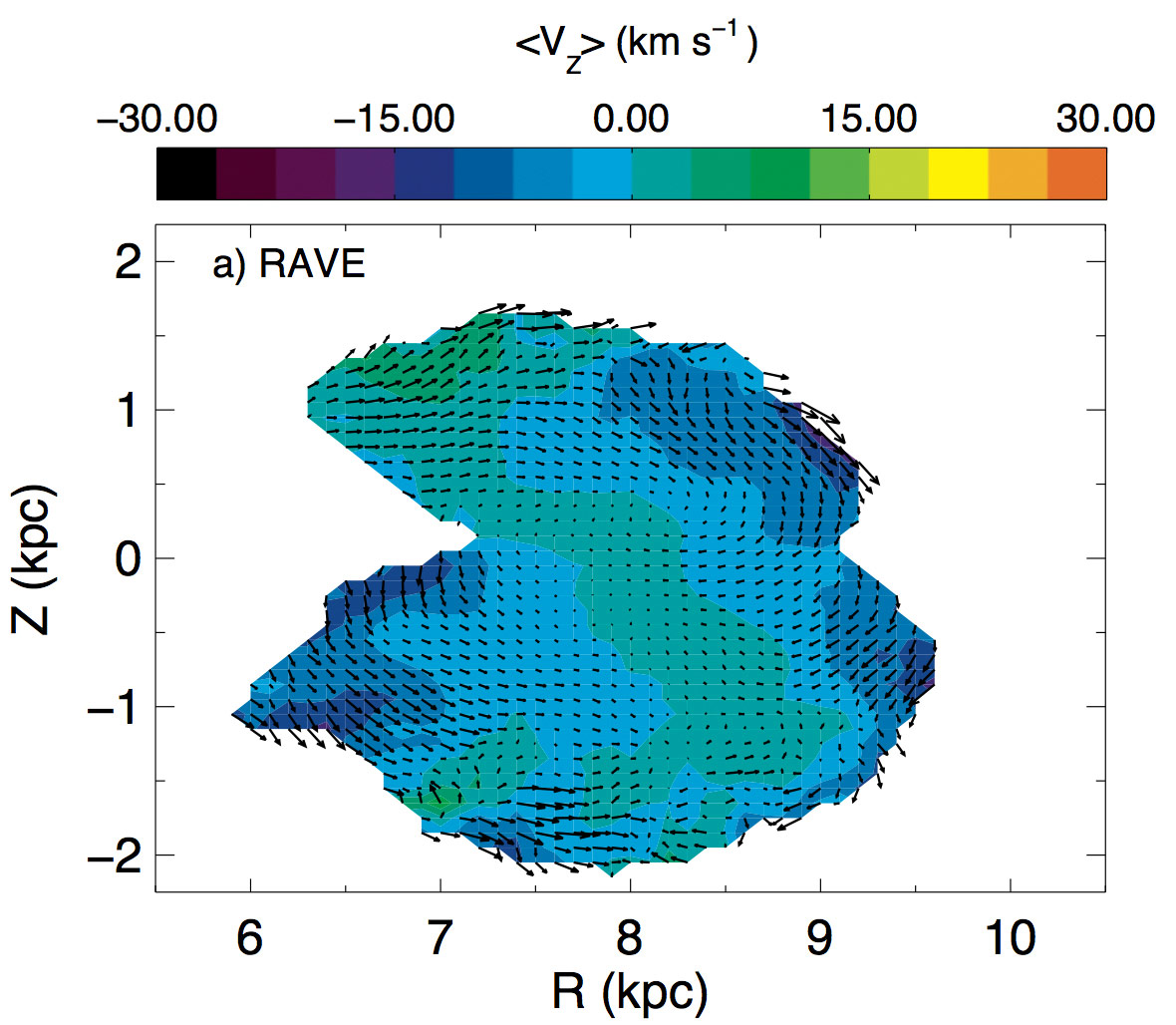
In this study, RAVE stars were used to examine the kinematics (velocities) of stars in a large, 3D region around the Sun – the region surveys 6500 light years above and below the Sun’s position as well as inwards and outwards from the Galactic center, reaching a quarter of the way to the center. Using a special class of stars, red clump stars, which all have about the same brightness, mean distances to the stars could be determined. This was important as then the velocities measured with RAVE, combined with other survey data, could be used to determine the full 3D velocities (up-down, in-out, and rotational). The RAVE red clump giants gave an unprecedented number of stars with which it is possible to study 3D velocities in a large region around the Sun.
The 3D movement patterns obtained showed highly complex structures. The aim was then to untangle these structures, concentrating on differences between the north and south of the Galactic plane. From these velocities it was seen that our Galaxy has a lot more going on than previously thought. The velocities going upwards and downwards show that there is a wave-like behavior, with stars sloshing in and out. The novel element in our approach was a true 3D observation, showing how complex the velocity landscape of the Galaxy really is. Modellers now have the challenge of understanding this behavior, be it from ripples from an eaten galaxy or the wake from spiral arms. These new findings will make it possible to make 3D models of our Galaxy much more precise.
Reference: “The wobbly Galaxy: kinematics north and south with RAVE red-clump giants” by M. E. K. Williams, M. Steinmetz, J. Binney, A. Siebert, H. Enke, B. Famaey, I. Minchev, R. S. de Jong, C. Boeche, K. C. Freeman, O. Bienaymé, J. Bland-Hawthorn, B. K. Gibson, G. F. Gilmore, E. K. Grebel, A. Helmi, G. Kordopatis, U. Munari, J. F. Navarro, Q. A. Parker, W. Reid, G. M. Seabroke, S. Sharma, A. Siviero, F. G. Watson, R. F. G. Wyse and T. Zwitter, 3 October 2013, Monthly Notices of the Royal Astronomical Society.
DOI: 10.1093/mnras/stt1522
arXiv:1302.2468
Never miss a breakthrough: Join the SciTechDaily newsletter.
Follow us on Google and Google News.
4 Comments
i think its more or less the same forces that act upon a bathtub full of water when you suddenly jerk back and it makes waves bounce back and forth, there was one force acting upon the matter, (in this case possibly the big bang or something that could give it momentum) and the tub keeping all the water together (gravity). Or if you think of it another way, a water droplet dripped into space.
“The world is a marvelous system of wiggles.” – Alan Watts
From the largest to the smallest: scientists have discovered the problem in attaining fusion–there is a instability (think of a an increasing spiral) in sustaining the implosion. Now we see why it exists.
Perhaps we are a fractal after all?
Much like water droplets dancing chaotically on the hood of your car at 45 mph, each star a droplet beaded up on your waxed hood. So, the interstellar masses pulsate, undulate, whirl and pull on eachother with their gravity wells. Weaving a massive galactic wave of liquid motion as they dance across the stage that is reality.