
Close Menu
    Facebook X (Twitter) Instagram
    SciTechDaily
    • Biology
    • Chemistry
    • Earth
    • Health
    • Physics
    • Science
    • Space
    • Technology
    Facebook X (Twitter) Pinterest YouTube RSS
    SciTechDaily
    Home»Space»Astronomers Find Universe’s “Missing” Matter
    Space

    Astronomers Find Universe’s “Missing” Matter

    By European Space AgencyJune 30, 20252 Comments6 Mins Read
    Facebook Twitter Pinterest Telegram LinkedIn WhatsApp Email Reddit
    Share
    Facebook Twitter LinkedIn Pinterest Telegram Email Reddit
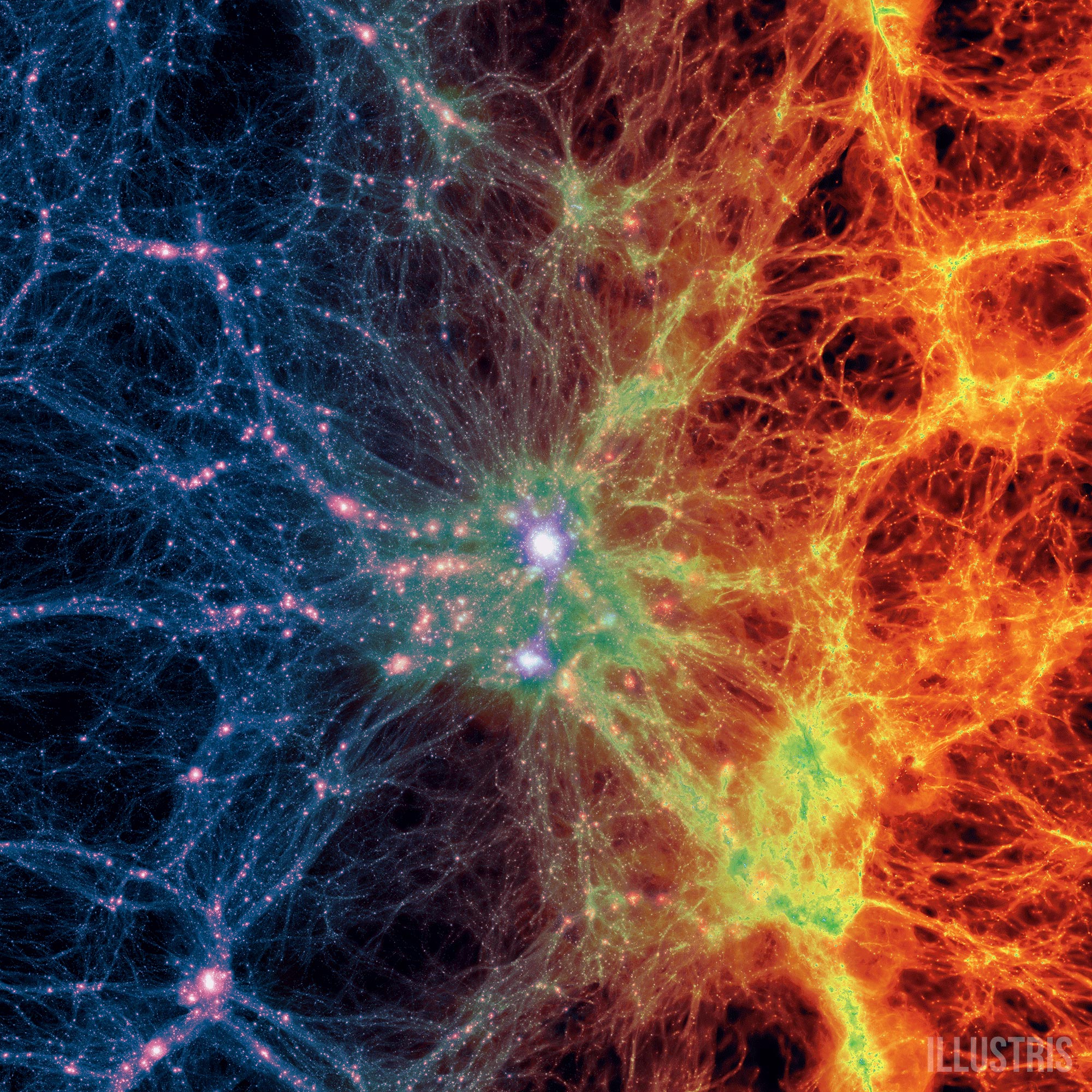
    Simulation of the Cosmic Web
    A simulation of the ‘cosmic web’, the vast network of threads and filaments that extends throughout the Universe. Stars, galaxies, and galaxy clusters spring to life in the densest knots of this web, and remain connected by vast threads that stretch out for many millions of light-years. These threads are invisible to the eye, but can be uncovered by telescopes such as ESA’s XMM-Newton. Credit: Illustris Collaboration / Illustris Simulation

    A vast filament of gas stretching across the cosmos may help solve the mystery of the Universe’s missing matter.

    Astronomers have identified a massive filament of hot gas connecting four galaxy clusters. With a mass roughly ten times greater than that of the Milky Way, this structure could contain some of the Universe’s long-missing matter, helping to resolve a decades-old cosmic mystery.

    The discovery was made using data from the European Space Agency’s XMM-Newton and Japan’s Suzaku X-ray space telescopes.

    More than one-third of the ‘normal’ matter in the nearby Universe—the kind that forms stars, planets, galaxies, and life—has yet to be observed directly. Despite being essential to our current models of the cosmos, this matter has remained hidden.

    The leading explanation is that it resides in diffuse, thread-like structures of gas called filaments, which span the densest regions of space. Although filaments have been detected before, their faint emissions make it difficult to separate their light from nearby sources like galaxies and black holes.

    Breakdown of Ordinary Matter and Hot Intergalactic Gas Content
    The filament is made up of hot intergalactic gas (shown in mottled black-yellow), a type of ‘ordinary matter’ that has proven really difficult for astronomers to find. Credit: ESA

    Now, new research is among the first to overcome that challenge, successfully detecting and precisely characterizing a single hot gas filament connecting four galaxy clusters in the nearby Universe.

    “For the first time, our results closely match what we see in our leading model of the cosmos – something that’s not happened before,” says lead researcher Konstantinos Migkas of Leiden Observatory in the Netherlands. “It seems that the simulations were right all along.”

    Euclid Flagship Mock Galaxy Catalogue
    Euclid flagship mock galaxy catalogue. Credit: J. Carretero (PIC), P. Tallada (PIC), S. Serrano (ICE) and the Euclid Consortium Cosmological Simulations SWG

    XMM-Newton on the case

    With a temperature exceeding 10 million degrees, the filament holds about ten times the mass of the Milky Way and links four galaxy clusters—two at each end. These clusters belong to the Shapley Supercluster, a vast assembly of over 8,000 galaxies and one of the most massive structures in the nearby Universe.

    The filament extends diagonally through the supercluster for 23 million light-years, a distance equal to crossing the Milky Way from end to end approximately 230 times.

    Konstantinos and colleagues characterized the filament by combining X-ray observations from XMM-Newton and Suzaku, and digging into optical data from several others.

    Labeled X Ray Map of Hot Gas Filament
    The image shows a cluster of bright, colorful spots against a black background. The spots are primarily purple with areas of intense brightness in the center, transitioning from yellow to green and blue. These spots are connected by a faint purple structure, forming an irregular extended shape with hazy blobs at either end. Credit: ESA/XMM-Newton and ISAS/JAXA

    The two X-ray telescopes were ideal partners. Suzaku mapped the filament’s faint X-ray light over a wide region of space, while XMM-Newton pinpointed very precisely contaminating sources of X-rays – namely, supermassive black holes – lying within the filament.

    “Thanks to XMM-Newton we could identify and remove these cosmic contaminants, so we knew we were looking at the gas in the filament and nothing else,” adds co-author Florian Pacaud of the University of Bonn, Germany. “Our approach was really successful, and reveals that the filament is exactly as we’d expect from our best large-scale simulations of the Universe.”

    Not truly missing

    As well as revealing a huge and previously unseen thread of matter running through the nearby cosmos, the finding shows how some of the densest and most extreme structures in the Universe – galaxy clusters – are connected over colossal distances.

    It also sheds light on the very nature of the ‘cosmic web’, the vast, invisible cobweb of filaments that underpins the structure of everything we see around us.

    “This research is a great example of collaboration between telescopes, and creates a new benchmark for how to spot the light coming from the faint filaments of the cosmic web,” adds Norbert Schartel, ESA XMM-Newton Project Scientist.

    X Ray Image of Hot Gas Filament Linking Four Galaxy Clusters
    This image shows the new filament, which connects four galaxy clusters: two on one end, two on the other. These clusters are visible as bright spots at the bottom and top of the filament (four white dots encircled by color). A mottled band of purple stretches between these bright dots, standing out brightly against the black surrounding sky; this is the filament of X-ray-emitting hot gas that had not been seen before, and contains a chunk of ‘missing’ matter. The purple band comprises data from Suzaku. The astronomers were able to identify and remove any possible ‘contaminating’ sources of X-rays from the filament using XMM-Newton, leaving behind a pure thread of ‘missing’ matter. These sources can be seen here as bright dots studded through – and removed from – the filament’s emission. Credit: ESA/XMM-Newton and ISAS/JAXA

    “More fundamentally, it reinforces our standard model of the cosmos and validates decades of simulations: it seems that the ‘missing’ matter may truly be lurking in hard-to-see threads woven across the Universe.”

    Piecing together an accurate picture of the cosmic web is the domain of ESA’s Euclid mission. Launched in 2023, Euclid is exploring this web’s structure and history. The mission is also digging deep into the nature of dark matter and energy – neither of which have ever been observed, despite accounting for a whopping 95% of the Universe – and working with other dark Universe detectives to solve some of the biggest and longest-standing cosmic mysteries.

    Reference: “Detection of pure warm-hot intergalactic medium emission from a 7.2 Mpc long filament in the Shapley supercluster using X-ray spectroscopy” by K. Migkas, F. Pacaud, T. Tuominen and N. Aghanim, 19 June 2025, Astronomy & Astrophysics.
    DOI: 10.1051/0004-6361/202554944

    Never miss a breakthrough: Join the SciTechDaily newsletter.
    Follow us on Google and Google News.

    Astrophysics Dark Matter European Space Agency Galaxy Popular XMM-Newton
    Share. Facebook Twitter Pinterest LinkedIn Email Reddit

    Related Articles

    Hubble’s Newest Discovery Isn’t a Star, It’s a Window Into the Dark Universe

    Scientists Watch Black Hole Create Near Light Speed Winds in Hours

    This Red Dwarf Just Launched a Planet-Killing Blast Into Space

    Sleeping Black Hole Erupts in Real Time – Blasting Out Record-Breaking X-Rays

    Astronomers Use Galaxy Clusters to Shed Light on the Universe’s Dark Side

    XMM-Newton Sets New Record for Cosmic X-Ray Sightings

    Detailed Map Reveals New Information about the Age, Contents and Origins of the Universe

    Astrophysicists Zero In on How the Universe Responds to Gravity

    Researchers Discover First Intermediate-Mass Black Hole

    2 Comments

    1. Stephen Duplantier on July 1, 2025 5:14 am

      It’s called plasma. Welcome to real cosmology .

      Reply
    2. Don Bailey on July 1, 2025 8:44 pm

      What elements are in the gas or plasma? Hydrogen? Helium?

      Reply
    Leave A Reply Cancel Reply

    • Facebook
    • Twitter
    • Pinterest
    • YouTube

    Don't Miss a Discovery

    Subscribe for the Latest in Science & Tech!

    Trending News

    Breakthrough Bowel Cancer Trial Leaves Patients Cancer-Free for Nearly 3 Years

    Natural Compound Shows Powerful Potential Against Rheumatoid Arthritis

    100,000-Year-Old Neanderthal Fossils in Poland Reveal Unexpected Genetic Connections

    Simple “Gut Reset” May Prevent Weight Gain After Ozempic or Wegovy

    2.8 Days to Disaster: Scientists Warn Low Earth Orbit Could Suddenly Collapse

    Common Food Compound Shows Surprising Power Against Superbugs

    5 Simple Ways To Remember More and Forget Less

    The Atomic Gap That Could Cost the Semiconductor Industry Billions

    Follow SciTechDaily
    • Facebook
    • Twitter
    • YouTube
    • Pinterest
    • Newsletter
    • RSS
    SciTech News
    • Biology News
    • Chemistry News
    • Earth News
    • Health News
    • Physics News
    • Science News
    • Space News
    • Technology News
    Recent Posts
    • ADHD Isn’t Just a Deficit: Study Reveals Powerful Hidden Strengths
    • Scientists Uncover “Astonishing” Hidden Property of Light
    • Scientists Discover Stem Cells That Could Regrow Teeth and Bone
    • Scientists Discover Natural Molecule That Stops Alzheimer’s Protein Clumps From Forming
    • Early Cannabis Use May Stall Key Brain Skills in Teens
    Copyright © 1998 - 2026 SciTechDaily. All Rights Reserved.
    • Science News
    • About
    • Contact
    • Editorial Board
    • Privacy Policy
    • Terms of Use

    Type above and press Enter to search. Press Esc to cancel.