
Close Menu
    Facebook X (Twitter) Instagram
    SciTechDaily
    • Biology
    • Chemistry
    • Earth
    • Health
    • Physics
    • Science
    • Space
    • Technology
    Facebook X (Twitter) Pinterest YouTube RSS
    SciTechDaily
    Home»Space»Astronomers Measure Temperature Shift in Brown Dwarfs for the First Time
    Space

    Astronomers Measure Temperature Shift in Brown Dwarfs for the First Time

    By Jonathan Gagné, Carnegie Institution for ScienceFebruary 27, 2018No Comments3 Mins Read
    Facebook Twitter Pinterest Telegram LinkedIn WhatsApp Email Reddit
    Share
    Facebook Twitter LinkedIn Pinterest Telegram Email Reddit
    Astronomers Measure Temperature Shift in Cooling Brown Dwarfs for the First Time
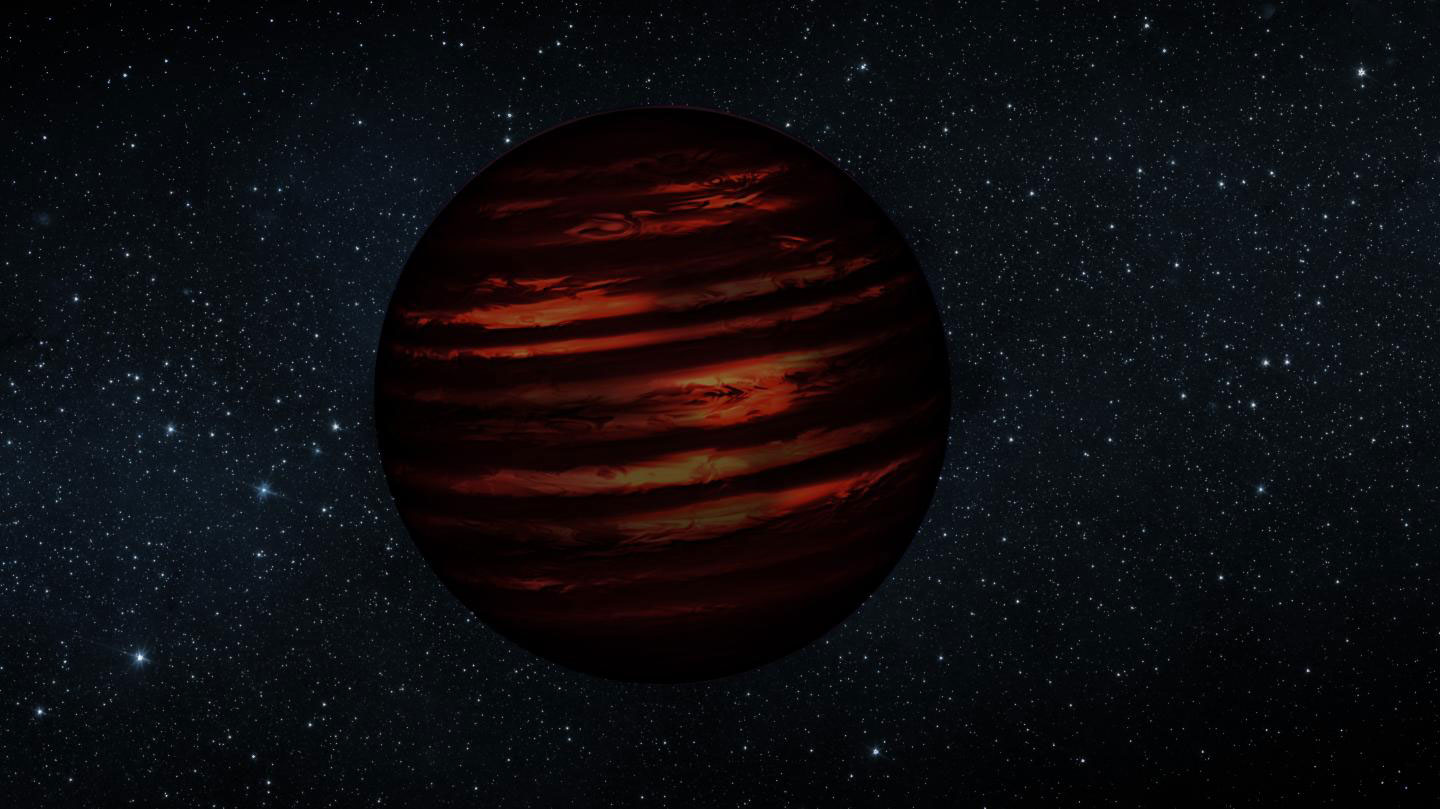
    An artist’s conception of a brown dwarf. Credit: Image is courtesy of NASA/JPL, slightly modified by Jonathan Gagné

    Brown dwarfs, the larger cousins of giant planets, undergo atmospheric changes from cloudy to cloudless as they age and cool. A team of astronomers led by Carnegie’s Jonathan Gagné measured for the first time the temperature at which this shift happens in young brown dwarfs. Their findings, published by The Astrophysical Journal Letters, may help them better understand how gas giant planets like our own Solar System’s Jupiter evolved.

    Brown dwarfs are too small to sustain the hydrogen fusion process that fuels stars and allows them to remain hot and bright for a long time. After formation, brown dwarfs slowly cool down and contract over time—at some point shifting from heavily cloud covered to having completely clear skies.

    Because they are freely floating in space, the atmospheric properties of brown dwarfs are much easier to study than the atmospheres of exoplanets, where the light of a central star can be completely overwhelming.

    In this paper, Gagné and his colleagues—Katelyn Allers of Bucknell University; Christopher Theissen of University of California San Diego; Jacqueline Faherty and Daniella Bardalez Gagliuffi of the American Museum of Natural History, and Etienne Artigau of Institute for Research on Exoplanets, Université de Montréal—focused on an unusually red brown dwarf called 2MASS J13243553+6358281, which they were able to determine is one of the nearest known planetary mass objects to our Solar System.


    An introduction to brown dwarfs.

    The redness of this object had previously been suggested to indicate that it was actually a binary system, but the research team’s findings indicate that it is a single free floating planetary mass object.

    They confirmed that it is part of a group of roughly 80 stars of similar ages and compositions drifting together through space, called the AB Doradus moving group, which revealed that it is about 150 million years old.

    By knowing the object’s age and measuring its luminosity and distance, the team could determine its likely radius, mass, and, most importantly its temperature.

    They could then compare its temperature to that of another previously studied brown dwarf in the same moving group—one that was still cloudy while 2MASS J1324+6358 was already cloudless. This allowed them to figure out the temperature at which the cloudy to cloudless transition happens.

    “We were able to constrain the point in the cool-down process at which brown dwarfs like J1324transition from cloudy to cloud-free,” explained Gagné

    The shift occurs about 1,150 degrees kelvin, or 1,600 degrees Fahrenheit, for planetary-mass objects that are 150 million years old like 2MASS J1324+6358 and other members of the AB Doradus moving group.

    “Because brown dwarfs like this one are so analogous to gas giant planets, this information could help us understand some of the evolutionary processes that occurred right here in our own Solar System’s history,” Gagné added.

    Reference: “2MASS J13243553+6358281 is an Early T-Type Planetary-Mass Object in the AB Doradus Moving Group” by Jonathan Gagné, Katelyn N. Allers, Christopher A. Theissen, Jacqueline K. Faherty, Daniella Bardalez Gagliuffi and Étienne Artigau, 16 February 2018, The Astrophysical Journal.
    DOI: 10.3847/2041-8213/aaacfd

    Never miss a breakthrough: Join the SciTechDaily newsletter.
    Follow us on Google and Google News.

    Astronomy Brown Dwarf Carnegie Institution for Science European Planetary Science Congress (EPSC)
    Share. Facebook Twitter Pinterest LinkedIn Email Reddit

    Related Articles

    Indications of Water Clouds in a Brown Dwarf 7 Light-Years from Earth

    Trajectory Models of Refractory Particles Help Solve Two Solar System Puzzles

    Diogenites Provide Clues of the Earliest Days of Our Solar System

    Chondrites, Not Comets, are the Likely Source of Volatile Elements on Earth

    New Planet Weighing Technique Measures Non-Transiting Planet’s Mass

    WISE Observations Provide Crucial Information on Brown Dwarfs

    Ultra-Cool Brown Dwarf Is 35 Times More Massive Than Jupiter

    Astronomers Discover Radio Emissions From a Brown Dwarf

    The Most Distant Cluster of Red Galaxies Ever Observed

    Leave A Reply Cancel Reply

    • Facebook
    • Twitter
    • Pinterest
    • YouTube

    Don't Miss a Discovery

    Subscribe for the Latest in Science & Tech!

    Trending News

    New Research Shows Vitamin B12 May Hold the Key to Healthy Aging

    These Simple Daily Habits Can Quickly Improve Blood Pressure and Heart Risk Factors

    A Common Nutrient May Play a Surprising Role in Anxiety

    Doing This After 9 p.m. Could Double Your Risk of Gut Issues

    Scientists Discover How Coffee Impacts Memory, Mood, and Gut Health

    Why Did the Neanderthals Disappear? Scientists Reveal Humans Had a Hidden Advantage

    Physicists Propose Strange Experiment Where Time Goes Quantum

    Magnesium Magic: New Drug Melts Fat Even on a High-Fat, High-Sugar Diet

    Follow SciTechDaily
    • Facebook
    • Twitter
    • YouTube
    • Pinterest
    • Newsletter
    • RSS
    SciTech News
    • Biology News
    • Chemistry News
    • Earth News
    • Health News
    • Physics News
    • Science News
    • Space News
    • Technology News
    Recent Posts
    • This New Memory Technology Could Make Devices Last Months on One Charge
    • Scientists Turn Cancer’s Own Bacteria Against It in Breakthrough Therapy
    • Cannabis Can Make You Remember Things That Never Happened
    • Doctors Are Surprised by What This Vaccine Is Doing to the Heart
    • Quantum Breakthrough Turns Simple Forces Into Powerful New Interactions
    Copyright © 1998 - 2026 SciTechDaily. All Rights Reserved.
    • Science News
    • About
    • Contact
    • Editorial Board
    • Privacy Policy
    • Terms of Use

    Type above and press Enter to search. Press Esc to cancel.