
Close Menu
    Facebook X (Twitter) Instagram
    SciTechDaily
    • Biology
    • Chemistry
    • Earth
    • Health
    • Physics
    • Science
    • Space
    • Technology
    Facebook X (Twitter) Pinterest YouTube RSS
    SciTechDaily
    Home»Space»Astronomers Puzzled by Giant Planet at Large Distance From Sun-Like Star
    Space

    Astronomers Puzzled by Giant Planet at Large Distance From Sun-Like Star

    By Netherlands Research School for AstronomyApril 22, 2021No Comments3 Mins Read
    Facebook Twitter Pinterest Telegram LinkedIn WhatsApp Email Reddit
    Share
    Facebook Twitter LinkedIn Pinterest Telegram Email Reddit
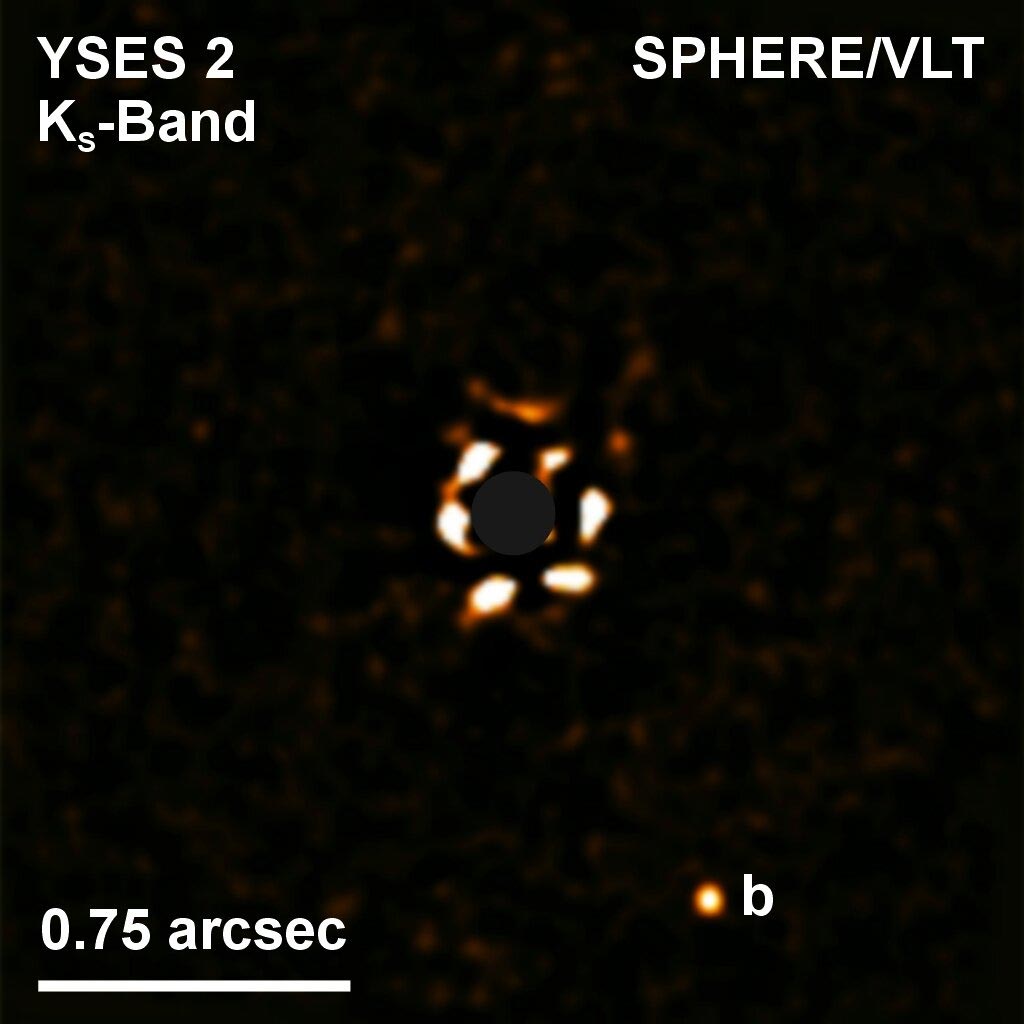
    Exoplanet YSES 2b
    A direct image of the exoplanet YSES 2b (bottom right) and its star (center). The star is blocked by a so-called coronagraph. Credit: ESO/SPHERE/VLT/Bohn et al.

    Dutch astronomers imaged YSES 2b, a gas giant six times Jupiter’s mass, orbiting far from its star, defying known planet formation models. 

    A team of astronomers led by Dutch scientists has directly imaged a giant planet orbiting at a large distance around a sun-like star. Why this planet is so massive and how it got to be there is a mystery. The researchers will publish their findings in the journal Astronomy & Astrophysics.

    The planet in question is YSES 2b, located 360 light-years from Earth in the direction of the southern constellation of Musca (Latin for The Fly). The gaseous planet is six times heavier than Jupiter, the largest planet in our solar system. The newly discovered planet orbits 110 times more distant from its star than the Earth does from the sun (or 20 times the distance between the sun and Jupiter). The accompanying star is only 14 million years old and resembles our sun in its childhood.

    Puzzling Origins and Missing Companions

    The large distance from the planet to the star presents a puzzle to astronomers because it does not seem to fit either of the two most well-known models for the formation of large gaseous planets. If the planet had grown in its current location far from the star by means of core accretion, it would be too heavy because there is not enough material to make a huge planet at this large distance from the star. If the planet was created by so-called gravitational instability in the planetary disk, it appears to be not heavy enough. A third possibility is that the planet formed close to the star by core accretion and then migrated outwards. Such a migration, however, would require the gravitational influence of a second planet, which the researchers have not yet found.

    The astronomers will continue to investigate the surroundings of this unusual planet and its star in the near future and hope to learn more about the system, and they will continue to search for other gaseous planets around young, sun-like stars. Current telescopes are not yet large enough to carry out direct imaging of Earth-like planets around sun-like stars.

    Lead researcher Alexander Bohn (Leiden University): “By investigating more Jupiter-like exoplanets in the near future, we will learn more about the formation processes of gas giants around sun-like stars.”

    The planet YSES 2b was discovered with the Young Suns Exoplanet Survey (YSES). This survey already provided the first direct image of a multi-planet system around a sun-like star in 2020. The researchers made their observations in 2018 and 2020 using the Very Large Telescope of the European Southern Observatory (ESO) in Chile. They used the telescope’s SPHERE instrument for this. This instrument was co-developed by the Netherlands and can capture direct and indirect light from exoplanets.

    Reference: “Discovery of a directly imaged planet to the young solar analog YSES 2” by Alexander J. Bohn, Christian Ginski, Matthew A. Kenworthy, Eric E. Mamajek, Mark J. Pecaut, Markus Mugrauer, Nikolaus Vogt, Christian Adam, Tiffany Meshkat, Maddalena Reggiani and Frans Snik, 19 April 2021, Astronomy & Astrophysics.
    DOI: 10.1051/0004-6361/202140508

    Never miss a breakthrough: Join the SciTechDaily newsletter.
    Follow us on Google and Google News.

    Astronomy Astrophysics Exoplanet Popular
    Share. Facebook Twitter Pinterest LinkedIn Email Reddit

    Related Articles

    Webb Detects a Possible Ingredient of Life on Distant Exoplanet – Scientists Urge Caution

    Astronomers Stunned: Hidden Star Found Inside “Impossible” Dust Zone

    First of Its Kind: Webb Telescope Spots a Planet Losing Its Atmosphere

    Why This New “Super-Earth” Has Scientists So Excited About Alien Life

    Astronomers Stunned by Bizarre Three-Planet System That Rewrites the Rules of Space

    NASA’s Webb Just Found a Hidden Moon Factory Beyond Our Solar System

    Webb Spots Cosmic Light Show on Rogue Planet

    Astronomers Capture First-Ever Photo of a Baby Planet Being Born in Darkness

    Webb Telescope Spots a “Blob” Near a Star, but Is It a Planet?

    Leave A Reply Cancel Reply

    • Facebook
    • Twitter
    • Pinterest
    • YouTube

    Don't Miss a Discovery

    Subscribe for the Latest in Science & Tech!

    Trending News

    Monster Storms on Jupiter Unleash Lightning Beyond Anything on Earth

    Scientists Create “Liquid Gears” That Spin Without Touching

    The Simple Habit That Could Help Prevent Cancer

    Millions Take These IBS Drugs, But a New Study Finds Serious Risks

    Scientists Unlock Hidden Secrets of 2,300-Year-Old Mummies Using Cutting-Edge CT Scanner

    Bread Might Be Making You Gain Weight Even Without Eating More Calories

    Scientists Discover Massive Magma Reservoir Beneath Tuscany

    Europe’s Most Active Volcano Just Got Stranger – Here’s Why Scientists Are Rethinking It

    Follow SciTechDaily
    • Facebook
    • Twitter
    • YouTube
    • Pinterest
    • Newsletter
    • RSS
    SciTech News
    • Biology News
    • Chemistry News
    • Earth News
    • Health News
    • Physics News
    • Science News
    • Space News
    • Technology News
    Recent Posts
    • New Brain Discovery Challenges Long-Held Theory of Teenage Brain Development
    • Sharks Are Overheating as Warming Oceans Push Them to the Edge
    • Scientists Discover Plants “Scream” – We Just Couldn’t Hear Them Until Now
    • 25-Year Study Uncovers Hidden Paths and Early Warning Signs of Blood Cancer
    • Not Just Snoring – New Research Reveals Sleep Apnea May Be Damaging Your Muscles
    Copyright © 1998 - 2026 SciTechDaily. All Rights Reserved.
    • Science News
    • About
    • Contact
    • Editorial Board
    • Privacy Policy
    • Terms of Use

    Type above and press Enter to search. Press Esc to cancel.