
Close Menu
    Facebook X (Twitter) Instagram
    SciTechDaily
    • Biology
    • Chemistry
    • Earth
    • Health
    • Physics
    • Science
    • Space
    • Technology
    Facebook X (Twitter) Pinterest YouTube RSS
    SciTechDaily
    Home»Science»Astronomers Reveal Evidence for Higher Black Hole Spin in Radio-Loud Quasars
    Science

    Astronomers Reveal Evidence for Higher Black Hole Spin in Radio-Loud Quasars

    By NAOJJanuary 12, 2018No Comments3 Mins Read
    Facebook Twitter Pinterest Telegram LinkedIn WhatsApp Email Reddit
    Share
    Facebook Twitter LinkedIn Pinterest Telegram Email Reddit
    Evidence for Higher Black Hole Spin in Radio-Loud Quasars Revealed
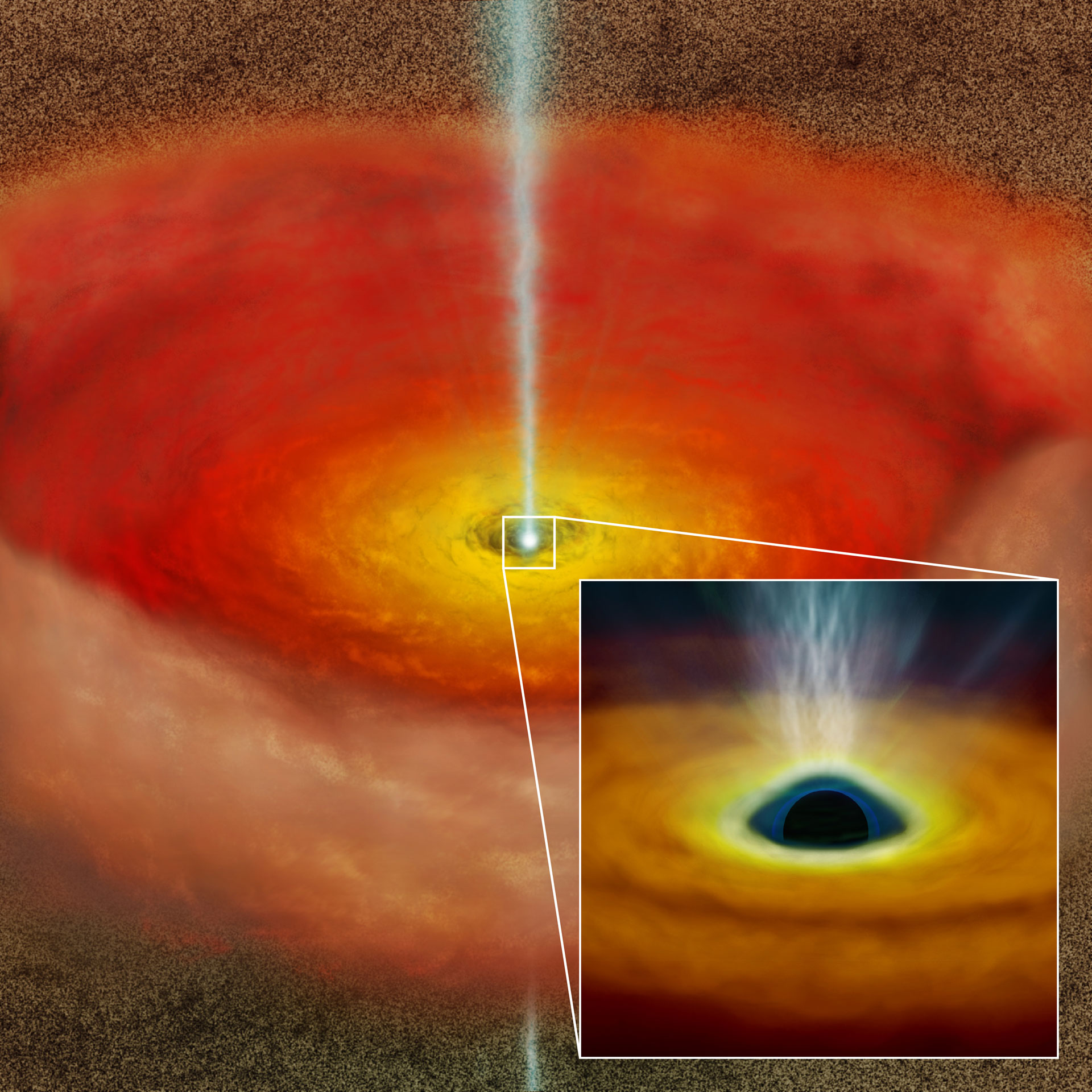
    Figure: Artist’s conception of the accretion disk around a spinning super-massive black hole. The rotation of the black hole may cause the high-speed jet which makes the object radio-loud.

    Statistical analysis of supermassive black holes suggests that the spin of the black hole may play a role in the generation of powerful high-speed jets blasting radio waves and other radiation across the Universe.

    Black holes absorb light and all other forms of radiation, making them impossible to detect directly. But the effects of black holes, in particular accretion disks where matter is shredded and superheated as it spirals down into the black hole, can release enormous amounts of energy. The accretion disks around supermassive black holes (black holes with masses millions of times that of the Sun) are some of the brightest objects in the Universe. These objects are called “quasi-stellar radio sources” or “quasars,” but actually this is a misnomer; only about 10% of quasars emit strong radio waves. We now know that “radio loud” quasars occur when a fraction of the matter in the accretion disk avoids the final fate of falling into the black hole and comes blasting back out into space in high-speed jets emitted from the poles of the black hole. But we still don’t understand why jets form sometimes and not other times.

    A team led by Dr. Andreas Schulze at the National Astronomical Observatory of Japan investigated the possibility that the spin of the supermassive black hole might play a role in determining if the high-speed jets form. Because black holes cannot be observed directly, Schulze’s team instead measured emissions from oxygen ions [O III] around the black hole and accretion disk to determine the radiative efficiency; i.e. how much energy matter releases as it falls into the black hole. From the radiative efficiency they were able to calculate the spin of the black hole at the center.

    By analyzing nearly 8000 quasars from the Sloan Digital Sky Survey, Schulze’s team found that on average the O III oxygen emissions are 1.5 times stronger in radio loud quasars than in radio quiet quasars. This implies that spin is an important factor in the generation of jets.

    Schulze cautions, “Our approach, like others, relies on a number of key assumptions. Our results certainly don’t mean that spin must be the only factor for differentiation between radio-loud and radio-quiet quasars. The results do suggest, however, that we shouldn’t count spin out of the game. It might be determining the loudness of these distant accreting monsters.”

    Reference: “Evidence for Higher Black Hole Spin in Radio-loud Quasars” by Andreas Schulze, Chris Done, Youjun Lu, Fupeng Zhang and Yoshiyuki Inoue, 24 October 2017, The Astrophysical Journal.
    DOI: 10.3847/1538-4357/aa9181

    Never miss a breakthrough: Join the SciTechDaily newsletter.
    Follow us on Google and Google News.

    Astronomy Astrophysics Black Hole NAOJ Quasars
    Share. Facebook Twitter Pinterest LinkedIn Email Reddit

    Related Articles

    Hubble Reveals That Markarian 231 is Powered by a Double Black Hole

    Hubble Reveals the Mysterious Early Formative Years of Quasars

    Rare Quasar Quartet Reveals Massive Structure in Distant Universe

    Astronomers Discover Ultraluminous Quasar with a 12 Billion Solar Mass Black Hole

    Yale Astronomers Identify the First “Changing Look” Quasar

    NASA Supercomputer Simulation Shows Neutron Stars Ripping Each Other Apart to Form a Black Hole

    Subaru Telescope Reveals Active Supermassive Black Holes in Merging Galaxies

    Astronomers Discover a New Type of Quasar

    Scientists Discover the Most Powerful Quasar Outflow Ever

    Leave A Reply Cancel Reply

    • Facebook
    • Twitter
    • Pinterest
    • YouTube

    Don't Miss a Discovery

    Subscribe for the Latest in Science & Tech!

    Trending News

    What Causes Chronic Pain? Scientists Identify Key Culprit in the Brain

    Semaglutide Shows Surprising Mental Health Benefits in Massive 100,000-Person Study

    This Liquid Snapped Instead of Flowing and Scientists Were Shocked

    Breakthrough Alzheimer’s Drug Rewires the Brain Instead of Just Clearing Plaques

    Scientists Discover Hidden “Footprint of Death” That Could Transform How We Fight Disease

    A Simple Nose Swab Could Detect Alzheimer’s Years Before Symptoms Appear

    Scientists Just Rewrote the Timeline of Complex Life on Earth

    Teenager’s Fossil Find Leads to Discovery of Shark Teeth in 5 Million-Year-Old Whale Skull

    Follow SciTechDaily
    • Facebook
    • Twitter
    • YouTube
    • Pinterest
    • Newsletter
    • RSS
    SciTech News
    • Biology News
    • Chemistry News
    • Earth News
    • Health News
    • Physics News
    • Science News
    • Space News
    • Technology News
    Recent Posts
    • Scientists Engineer “Tumor-Eating” Bacteria That Devour Cancer From Within
    • Even “Failed” Diets May Deliver Long-Term Health Gains, Study Finds
    • Childhood Junk Food May Rewire the Brain for Life
    • NIH Scientists Discover Powerful New Opioid That Relieves Pain Without Dangerous Side Effects
    • Breakthrough Study Reveals Why Damaged Nerves Struggle To Heal
    Copyright © 1998 - 2026 SciTechDaily. All Rights Reserved.
    • Science News
    • About
    • Contact
    • Editorial Board
    • Privacy Policy
    • Terms of Use

    Type above and press Enter to search. Press Esc to cancel.