
Close Menu
    Facebook X (Twitter) Instagram
    SciTechDaily
    • Biology
    • Chemistry
    • Earth
    • Health
    • Physics
    • Science
    • Space
    • Technology
    Facebook X (Twitter) Pinterest YouTube RSS
    SciTechDaily
    Home»Space»Astronomers See an Enormous Shockwave – 60x Bigger Than the Entire Milky Way Galaxy
    Space

    Astronomers See an Enormous Shockwave – 60x Bigger Than the Entire Milky Way Galaxy

    By Andy Tomaswick, Universe TodayMarch 5, 20225 Comments3 Mins Read
    Facebook Twitter Pinterest Telegram LinkedIn WhatsApp Email Reddit
    Share
    Facebook Twitter LinkedIn Pinterest Telegram Email Reddit
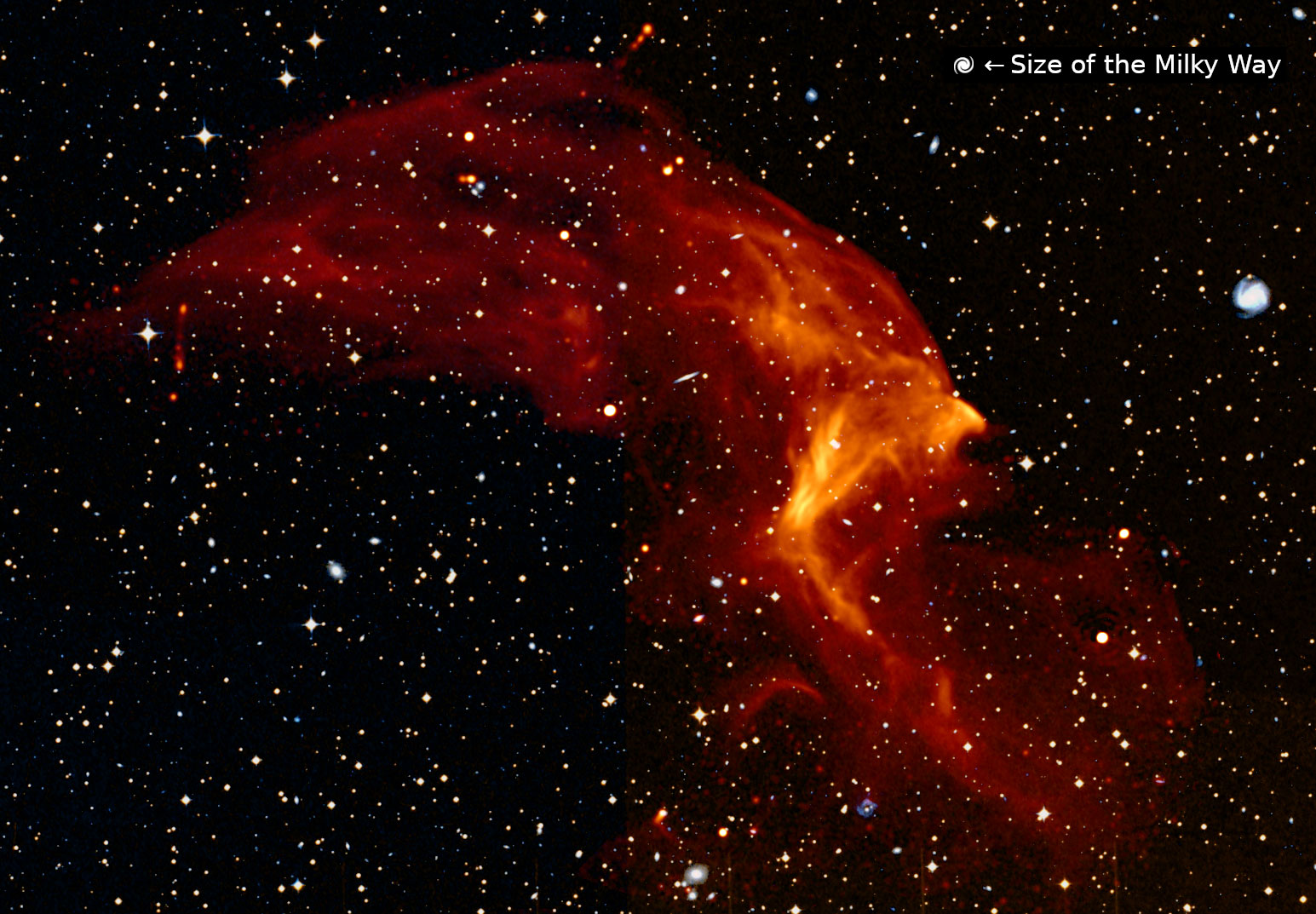
    Milky Way Shockwave Complex Filamentary Structure
    Image of the larger shockwave front, and an image of the Milky Way for scale. Credit: Francesco de Gasperin, SARAO

    A galaxy cluster merger 1 billion years ago created a shockwave 60 times larger than the Milky Way, offering insights into complex galactic physics.

    Astronomers have a thing for big explosions and collisions, and it always seems like they are trying to one-up themselves in finding a bigger, brighter one.  There’s a new entrant to that category – an event so big it created a burst of particles over 1 billion years ago that is still visible today and is 60 times bigger than the entire Milky Way.

    That shockwave was created by the merger of two galaxy clusters to create a supercluster known as Abell 3667.  This was one of the most energetic events in the universe since the Big Bang, according to calculations by Professor Francesco de Gasperin and his time from the University of Hamburg and INAF.  When it happened over 1 billion years ago, it shot out a wave of electrons, similar to how a particle accelerator would.  All these years later, those particles are still traveling at Mach 2.5 (1500 km/s), and when they pass through magnetic fields, they emit radio waves.

    Galaxy Cluster Abell 3667
    Picture of galaxy cluster Abell 3667, where the white color in the center is a concatenation of 550 distinct galaxies, but the red structures represent the shockwaves formed during the creation of this supercluster. Credit: Francesco de Gasperin, SARAO

    Those radio waves are what Dr. de Gasperin and his colleagues observed using a new telescope array in South Africa known as MeerKAT. Radio signals alone weren’t enough to characterize the shockwave itself, though – the XMM-Newton X-ray observatory also spent some time focused on Abell 3667.

    The results of all those observations is a better understanding of the physics of the merger of these galaxy clusters, which were “much more complex than we initially thought,” said Dr. de Gasperin. The shockwaves themselves look like “filaments that trace the location of giant magnetic field lines.” What is clear from the pictures is that, even when scientists are simply looking for big collisions, the resulting radio images might be awe-inspiring in themselves.

    Adapted from an article originally published on Universe Today.

    For more on this discovery, see A Massive Cosmic Shock Wave That Extends for 6.5 Million Light Years.

    [Editor’s Note: An earlier version said the merger of the two galaxy clusters happened 200 million years ago. 1 billion years ago is correct.]

    Never miss a breakthrough: Join the SciTechDaily newsletter.
    Follow us on Google and Google News.

    Astronomy Astrophysics South African Radio Astronomy Observatory
    Share. Facebook Twitter Pinterest LinkedIn Email Reddit

    Related Articles

    Fast and Furious: A Massive Cosmic Shock Wave That Extends for 6.5 Million Light Years

    Star Formation History of the Universe Revealed by Distant Milky Way-Like Galaxies

    Image Shows a Staggeringly Powerful Event Occurred Near Center of the Milky Way

    NASA’s Kepler Mission Discovers 11 New Extrasolar Systems with 26 Exoplanets

    Lasers Mimic Supernova to Explain Cosmic Magnetic Fields

    Baryon Oscillation Spectroscopic Survey Measures the Universe’s Expansion and Dark Energy

    SN Primo Is Farthest Type Ia Supernova Discovered

    Scientists Convene to Take a Picture of the Supermassive Black Hole at the Center of the Milky Way

    Hubble Observes Rare Blue Stars in Andromeda’s Core

    5 Comments

    1. Nick on March 6, 2022 2:07 pm

      What does it have to do with WD 40. Why show this spraying in the gas tank. Thats false and fake stupid example. Called false advertising. Should be stopped now.

      Reply
    2. Nich on March 6, 2022 2:09 pm

      False advertising, showing WD40. Spraying in gas tank. Has nothing to do with the ploy. Fake gimmic.

      Reply
    3. M. Billington on March 6, 2022 2:10 pm

      I think there’s an error with the units where the speed of the particles is described:
      “those particles are still traveling at Mach 2.5 (1500 km / s)”

      I imagine Mach 2.5 might be 1500 m/s, not km/s, otherwise a fighter jet could cross the distance between Munich and Berlin 3 times over in one second!

      Reply
    4. Bill on March 7, 2022 5:14 am

      Their we 2 references to how long ago this happened in the article. First, it was said that it happened over a1 billion years ago. Then it say 200 million years ago. Thats quite a spread.

      Reply
      • Mike O'Neill on March 7, 2022 6:43 am

        200 million years ago was a mistake, so the first number was correct (1 billion years ago). The article has been fixed.

        Reply
    Leave A Reply Cancel Reply

    • Facebook
    • Twitter
    • Pinterest
    • YouTube

    Don't Miss a Discovery

    Subscribe for the Latest in Science & Tech!

    Trending News

    Why Popular Diabetes Drugs Like Ozempic Don’t Work for Everyone: The “Genetic Glitch”

    Scientists Stunned After Finding Plant Thought Extinct for 60 Years

    Scientists Discover Tiny New Spider That Hunts Prey 6x Its Size

    Natural Component From Licorice Shows Promise for Treating Inflammatory Bowel Disease

    Scientists Warn: Popular Sweetener Linked to Dangerous Metabolic Effects

    Monster Storms on Jupiter Unleash Lightning Beyond Anything on Earth

    Scientists Create “Liquid Gears” That Spin Without Touching

    The Simple Habit That Could Help Prevent Cancer

    Follow SciTechDaily
    • Facebook
    • Twitter
    • YouTube
    • Pinterest
    • Newsletter
    • RSS
    SciTech News
    • Biology News
    • Chemistry News
    • Earth News
    • Health News
    • Physics News
    • Science News
    • Space News
    • Technology News
    Recent Posts
    • 100,000-Year-Old Neanderthal Fossils in Poland Reveal Unexpected Genetic Connections
    • Unexpected Hormone Discovery Could Change How We Treat Arthritis
    • Scientists Supercharge “Natural Killer” Cells To Break Through Cancer’s Defenses
    • Simple “Gut Reset” May Prevent Weight Gain After Ozempic or Wegovy
    • 2.8 Days to Disaster: Scientists Warn Low Earth Orbit Could Suddenly Collapse
    Copyright © 1998 - 2026 SciTechDaily. All Rights Reserved.
    • Science News
    • About
    • Contact
    • Editorial Board
    • Privacy Policy
    • Terms of Use

    Type above and press Enter to search. Press Esc to cancel.