
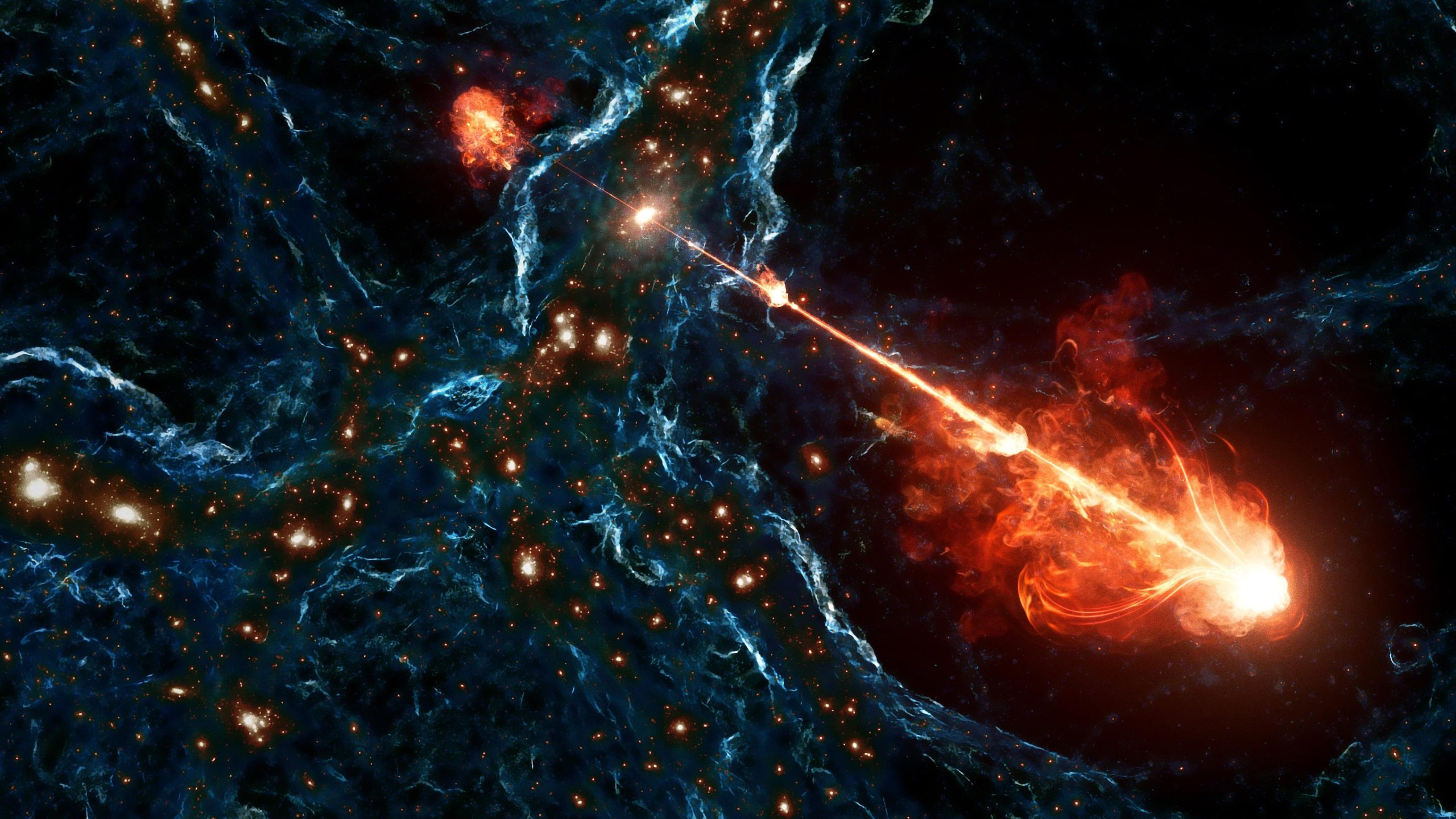
Astronomers have discovered colossal black hole jets, named Porphyrion, stretching 23 million light years across, far surpassing our Milky Way in size.
This astounding discovery, made using radio telescopes like ASKAP and LOFAR, reveals how supermassive black holes launch jets that travel nearly at the speed of light, despite cosmic obstacles. The peculiar straightness and sustained power of Porphyrion, surviving for about 2 billion years, challenge current understanding of black hole dynamics and the environmental factors influencing them.
Discovery of Gigantic Black Hole Jets
The largest known black hole jets, 23 million light-years across, have been discovered in the distant universe. This pair of particle beams launched by a supermassive black hole is over a hundred times larger than our galaxy, the Milky Way.
In 2022, we announced the discovery of one of the largest black hole jets in the night sky, launched from a (relatively) nearby galaxy called NGC2663. Using CSIRO’s Australian Square Kilometre Array Pathfinder (ASKAP) in Western Australia, we confirmed that NGC2663’s jet is one of the largest in the sky. In other words, it appears to be the largest when viewed from Earth.
Introducing Porphyrion: A Colossal Phenomenon
The new jet, announced in the journal Nature, has been dubbed “Porphyrion” (a giant in Greek mythology) by its discoverers at the California Institute of Technology in the United States. It dwarfs NGC2663’s jet in actual size and is over 20 times larger – a true colossus.
Porphyrion can tell us more about the great ecosystem of matter flowing inside and outside of galaxies. But this jet also has us scratching our heads: how can something 23 million light years across be almost perfectly straight?
Unveiling Invisible Cosmic Forces
Porphyrion was discovered by astronomers using the International LOFAR Telescope, a network of radio sensors centered in the Netherlands, and stretching from Sweden to Bulgaria, and from Ireland to Latvia. Radio telescopes like ASKAP and LOFAR can see light that is invisible to our eyes: radio waves.
What launches the jet in the first place? At the center of the jet, researchers see a galaxy, and at the center of the galaxy, they find evidence of a supermassive black hole.
As matter is pulled toward the black hole, various fates await. Some matter is eaten entirely. Some orbits around the black hole, forming a disk. And some of it becomes twisted and tangled in intense magnetic fields, until it is released into two opposing jets, blasting at almost the speed of light.
We’ve seen black hole jets before, even ones that stretch many millions of light years. What’s striking about Porphyrion is that it looks almost perfectly straight. There are plenty of curvy, angled jets out there, including one seen by ASKAP that was dubbed “The Dancing Ghosts.”

The Mystery of Porphyrion’s Straightness
Many processes can add a kink to a jet: an obstacle such as a dense cloud, a change in the orientation of the black hole, strong magnetic fields, and intergalactic “wind” as the host galaxy falls into a larger cosmic structure.
Porphyrion, by contrast, seems to have been happily powering its way through the cosmos for about 2 billion years, unperturbed.
This is puzzling for two reasons. First, it isn’t from around here. Its light has traveled for about 7 billion years to arrive on Earth. We’re seeing Porphyrion as it was about 6 billion years after the Big Bang.
As with all astronomical objects, we’re seeing it in the past, when the universe was more dense (remember: the universe is expanding). But a busy environment is the enemy of a straight jet.
Second, a jet that maintains consistent power for 2 billion years requires a steady stream of food. But that implies a rich local environment, full of goodies (interstellar gas) ready to eat. This presents a paradox, because – again – a busy environment is the enemy of a straight jet.
As the researchers conclude, “how jets can retain such long-lived coherence is unknown at present.” Maybe Porphyrion got lucky, threading its jet through a quiet alley of intergalactic space.
Maybe there’s something about this jet that helps it maintain its focus. We don’t know. But we can think of ways to find out. Observers will explore the environment of this jet with further observations across the spectrum.
Radio astronomers are using telescopes like ASKAP and LOFAR to find more jets, so we can distinguish the typical from the flukey. Meanwhile, astrophysicists are using supercomputer simulations of jets to figure out what launches them, what can bend them, and under what conditions.
The Cosmic Cycle: From Galaxies to Black Holes
Objects like Porphyrion aren’t mere cosmic oddities. They are integral to the ecosystem of matter that shapes our cosmic environment. Intergalactic matter feeds into galaxies, galaxies make stars, some galaxies even make black holes, black holes create a jet, the jet affects the intergalactic matter, and around we go.
We’re slowly untangling the clues to our place in the cosmos.
For more on this discovery, see 140 Milky Ways Spanned by Record-Breaking Black Hole Jets.
Written by Luke Barnes, Lecturer in Physics, Western Sydney University.
Adapted from an article originally published in The Conversation.
Reference: “Black hole jets on the scale of the cosmic web” by Martijn S. S. L. Oei, Martin J. Hardcastle, Roland Timmerman, Aivin R. D. J. G. I. B. Gast, Andrea Botteon, Antonio C. Rodriguez, Daniel Stern, Gabriela Calistro Rivera, Reinout J. van Weeren, Huub J. A. Röttgering, Huib T. Intema, Francesco de Gasperin and S. G. Djorgovski, 18 September 2024, Nature.
DOI: 10.1038/s41586-024-07879-y
Never miss a breakthrough: Join the SciTechDaily newsletter.
Follow us on Google and Google News.
1 Comment
So how does the expansion of the universe affect the frequency of radiation in the jet?