
Close Menu
    Facebook X (Twitter) Instagram
    SciTechDaily
    • Biology
    • Chemistry
    • Earth
    • Health
    • Physics
    • Science
    • Space
    • Technology
    Facebook X (Twitter) Pinterest YouTube RSS
    SciTechDaily
    Home»Space»Astrophysicist Investigates: Possibility of Life Below the Surface of Mars
    Space

    Astrophysicist Investigates: Possibility of Life Below the Surface of Mars

    By NYU Abu DhabiJuly 28, 2020No Comments3 Mins Read
    Facebook Twitter Pinterest Telegram LinkedIn WhatsApp Email Reddit
    Share
    Facebook Twitter LinkedIn Pinterest Telegram Email Reddit
    ExoMars Rover Astrobiology
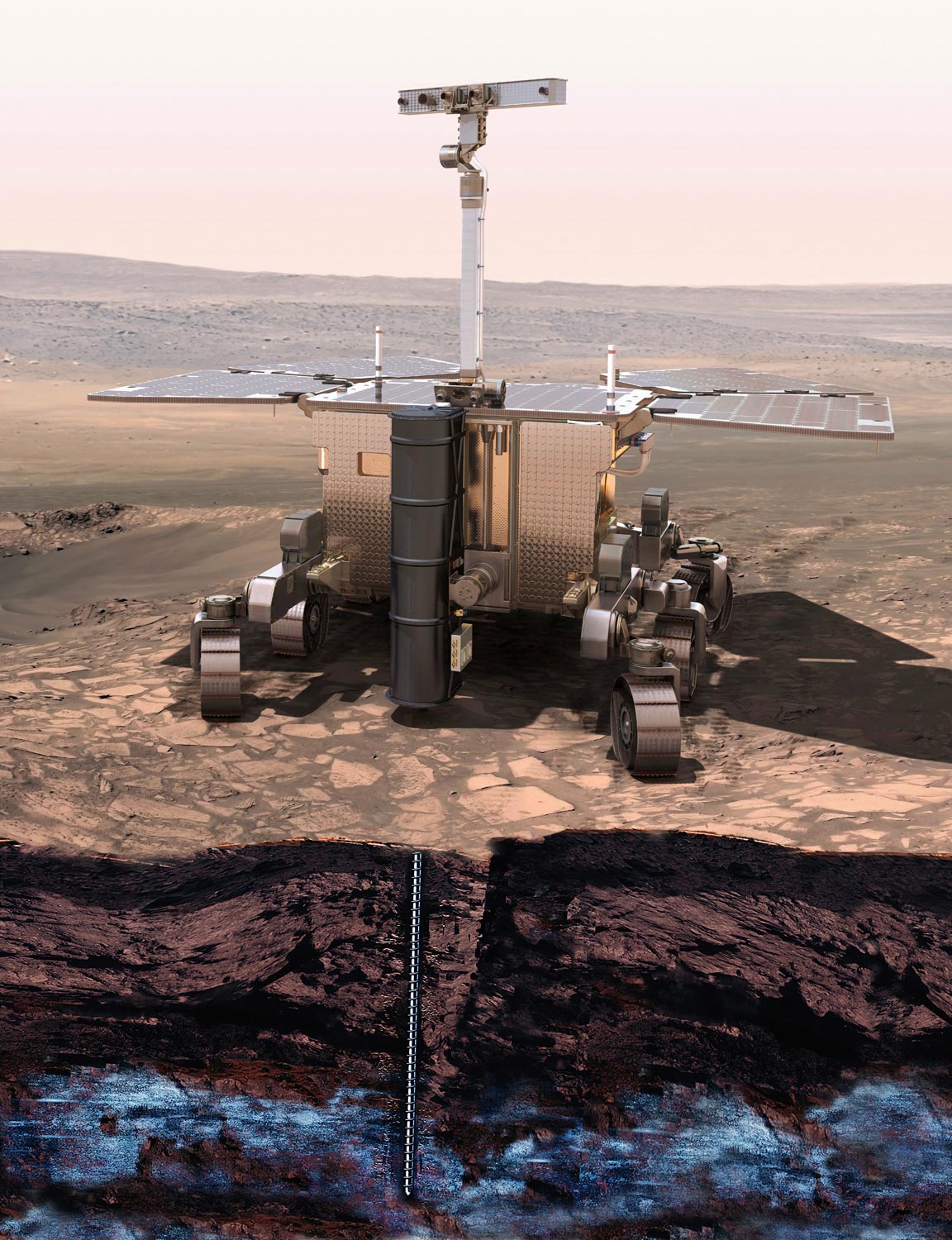
    The Rosalind Franklin rover by European Space Agency and Roscosmos will drill 2 meters below the surface of Mars to search for signs of life. Credit: ESA
    • A rover expected to explore below the surface of Mars in 2022 has the potential to provide more insights
    • The findings published in Scientific Reports, Springer Nature suggests the presence of traces of water on Mars, raising the question of the possibility of a life-supporting environment

    Although no life has been detected on the Martian surface, a new study from astrophysicist and research scientist at the Center for Space Science at NYU Abu Dhabi, Dimitra Atri finds that conditions below the surface could potentially support it. The subsurface – which is less harsh and has traces of water – has never been explored. According to Atri, the steady bombardment of penetrating Galactic Cosmic Rays (GCRs) might provide the energy needed to catalyze organic activity there.

    Atri’s findings are reported in the study Investigating the biological potential of galactic cosmic ray-induced radiation-driven chemical disequilibrium in the Martian subsurface environment in the journal Scientific Reports, Springer Nature.
    Habitable Zone Below the Surface of Mars
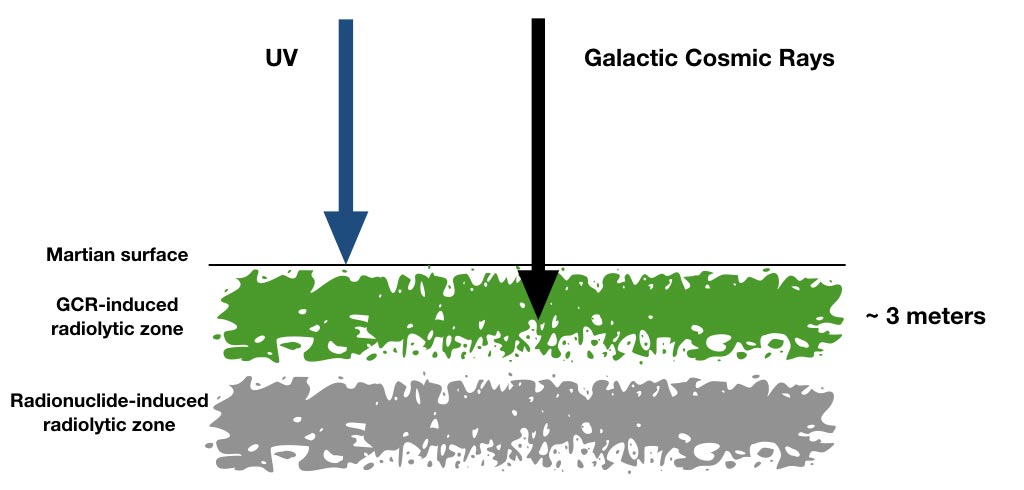
    The proposed radiation-induced habitable zone below the surface of Mars. Credit: NYU Abu Dhabi

    There is growing evidence suggesting the presence of an aqueous environment on ancient Mars, raising the question of the possibility of a life-supporting environment. The erosion of the Martian atmosphere resulted in drastic changes in its climate, surface water disappeared, shrinking habitable spaces on the planet, with only a limited amount of water remaining near the surface in the form of brines and water-ice deposits. Life, if it ever existed, would have had to adapt to harsh modern conditions, which include low temperatures and surface pressure, and high radiation dose.

    The subsurface of Mars has traces of water in the form of water-ice and brines, and undergoes radiation-driven redox chemistry. Using a combination of numerical models, space mission data, and studies of deep-cave ecosystems on Earth for his research, Atri proposes mechanisms through which life, if it ever existed on Mars, could survive and be detected with the upcoming ExoMars mission (2022) by the European Space Agency and Roscosmos. He hypothesizes that galactic cosmic radiation, which can penetrate several meters below the surface, will induce chemical reactions that can be used for metabolic energy by extant life, and host organisms using mechanisms seen in similar chemical and radiation environments on Earth.

    “It is exciting to contemplate that life could survive in such a harsh environment, as few as two meters below the surface of Mars,” said Atri. “When the Rosalind Franklin rover on board the ExoMars mission (ESA and Roscosmos), equipped with a subsurface drill, is launched in 2022, it will be well-suited to detect extant microbial life and hopefully provide some important insights.”

    Reference: “Investigating the biological potential of galactic cosmic ray-induced radiation-driven chemical disequilibrium in the Martian subsurface environment” by Dimitra Atri, 28 July 2020, Scientific Reports.
    DOI: 10.1038/s41598-020-68715-7

    Never miss a breakthrough: Join the SciTechDaily newsletter.
    Follow us on Google and Google News.

    Astrobiology Astrophysics Mars NYU Abu Dhabi Popular
    Share. Facebook Twitter Pinterest LinkedIn Email Reddit

    Related Articles

    Isotope Analysis Reveals a Fundamental Reason Why Mars Has No Liquid Water on Its Surface Today

    Acidic Fluids: Finding Evidence of Life on Mars Just Got Harder

    MAVEN Reveals That Solar Wind Has Transformed Martian Atmosphere

    Scientists Discover Evidence of Methane in Martian Meteorites

    Astronomers Discover Complex Organic Molecules in Infant Star System

    Martian Meteorite Reveals the Possibility of Life on Mars

    Early Chemistry of a Star’s Protoplanetary Disc Shapes Life-Friendly Atmospheres

    Searching for Life on Earth-Like Planets May Be a Mistake, Need to Consider Superhabitable Planets

    Astronomers Obtain Precise Measurements of the Two Kepler-16 Stars

    Leave A Reply Cancel Reply

    • Facebook
    • Twitter
    • Pinterest
    • YouTube

    Don't Miss a Discovery

    Subscribe for the Latest in Science & Tech!

    Trending News

    Monster Storms on Jupiter Unleash Lightning Beyond Anything on Earth

    Scientists Create “Liquid Gears” That Spin Without Touching

    The Simple Habit That Could Help Prevent Cancer

    Millions Take These IBS Drugs, But a New Study Finds Serious Risks

    Scientists Unlock Hidden Secrets of 2,300-Year-Old Mummies Using Cutting-Edge CT Scanner

    Bread Might Be Making You Gain Weight Even Without Eating More Calories

    Scientists Discover Massive Magma Reservoir Beneath Tuscany

    Europe’s Most Active Volcano Just Got Stranger – Here’s Why Scientists Are Rethinking It

    Follow SciTechDaily
    • Facebook
    • Twitter
    • YouTube
    • Pinterest
    • Newsletter
    • RSS
    SciTech News
    • Biology News
    • Chemistry News
    • Earth News
    • Health News
    • Physics News
    • Science News
    • Space News
    • Technology News
    Recent Posts
    • Scientists Discover a New Meteor Shower From a Mysterious Crumbling Asteroid
    • This Simple Fruit Wash Could Make Produce Safer and Last Days Longer
    • These Tiny Robots 50x Smaller Than a Hair Can Hunt and Move Bacteria
    • Simple Blood Test May Predict Alzheimer’s Years Before Brain Scans Show Signs
    • Scientists Say Adding This Unusual Seafood to Your Diet Could Reverse Signs of Aging
    Copyright © 1998 - 2026 SciTechDaily. All Rights Reserved.
    • Science News
    • About
    • Contact
    • Editorial Board
    • Privacy Policy
    • Terms of Use

    Type above and press Enter to search. Press Esc to cancel.