

Unusual structures of unknown origin discovered in desert rocks have been documented in a new study.
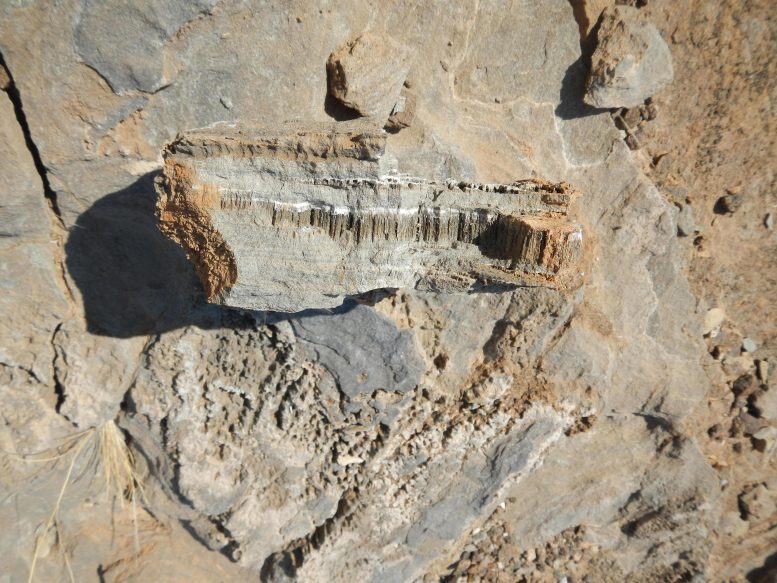
In the desert regions of Namibia, Oman, and Saudi Arabia, researchers have discovered unusual structures that are likely the result of activity by an unknown microbiological life form. Tiny burrows, or small tubes running vertically through rock in a parallel arrangement, were found in marble and limestone across these areas.
“We were surprised because these tubes are clearly not the result of a geological process,” said Professor Cees Passchier from Johannes Gutenberg University Mainz (JGU), who first noticed the phenomenon during geological fieldwork in Namibia. Later analysis of rock samples revealed traces of biological material, suggesting that microorganisms had tunneled through the rock.
“We don’t currently know whether this is a life form that has become extinct or is still alive somewhere,” Passchier added.
Puzzling discovery in Namibia
Geologist Cees Passchier has conducted research in Namibia for 25 years. His work focuses on reconstructing the geological history of Precambrian terranes.
“We look at the structure of the rocks to find out how continents came together to form the supercontinent Gondwana 500 to 600 million years ago,” Passchier explained. During that era, carbonate sediments formed in ancient oceans and later transformed into marble through pressure and heat.
“We noticed strange structures in this marble that were not the result of geological events.”
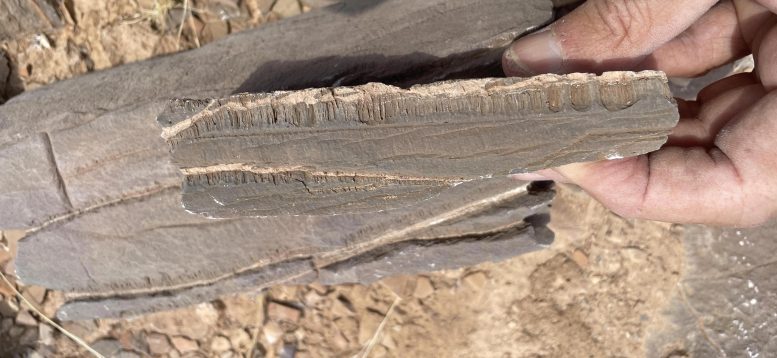
Instead of smooth surfaces shaped by erosion, the team observed tubes about half a millimeter wide and up to three centimeters long. These tubes were arranged in parallel and formed bands as long as ten meters. Some of the edges also had calcrete crusts.
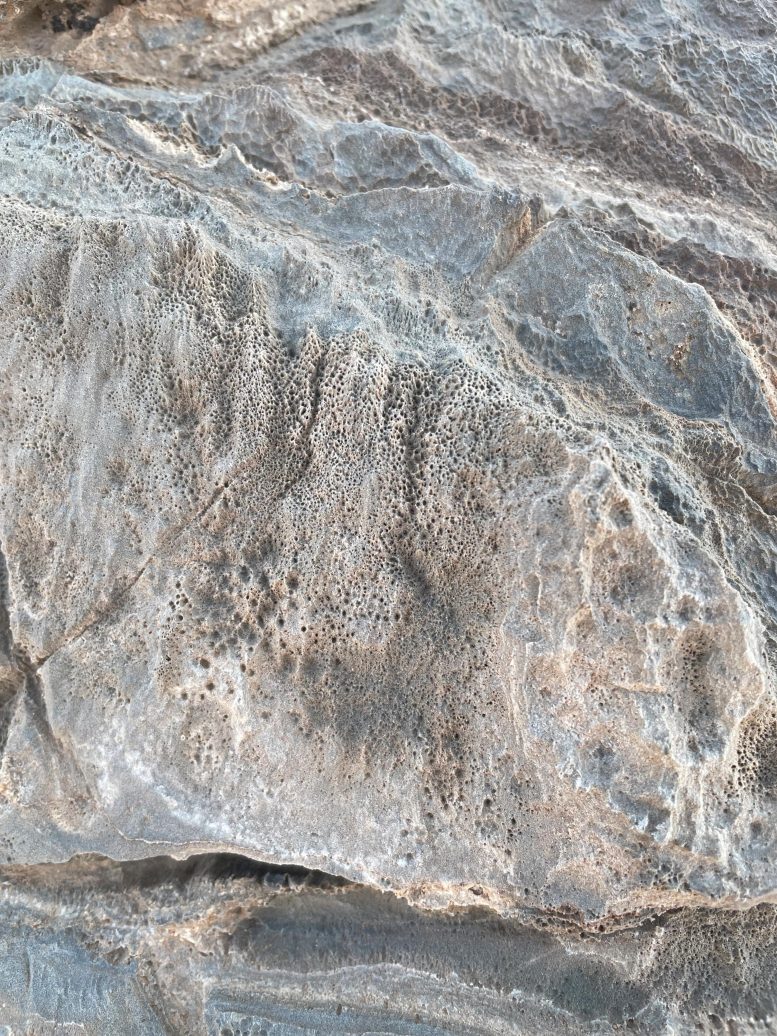
These structures were first observed in the Namibian desert about 15 years ago. Since then, Professor Passchier, along with colleagues from the Institute of Geosciences at Mainz University and Dr. Trudy Wassenaar, head of the consulting firm Molecular Microbiology and Genomics Consultants, has continued to investigate. “We think that it must have been a microorganism that formed these tubes.”
The tubes were not empty but filled with a fine powder of pure calcium carbonate. Researchers believe the microorganisms may have tunneled through the rock to access nutrients in the calcium carbonate, which is the main component of marble. The fine powder was left behind in the tubes. Similar structures were later found during Passchier’s fieldwork in Oman and Saudi Arabia – in limestone in Oman and in marble in Saudi Arabia.
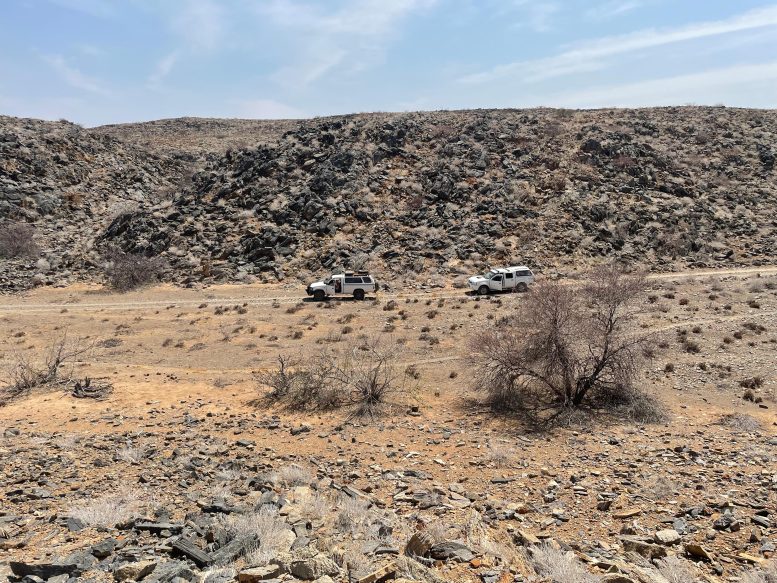
“In any case, these are old structures, perhaps one or two million years old,” said Passchier. “We assume that they were formed in a slightly more humid climate, not in the dry desert climate that prevails today.” However, the organism that caused these structures remains a mystery.
Endolithic microorganisms use rock as a basis for life
Microorganisms such as bacteria, fungi, or lichen are found even in inhospitable or remote corners of the Earth. So-called endolithic microorganisms are not uncommon in desert areas as they can obtain their energy and nutrients from the rocks they live in.
“What is so exciting about our discovery is that we do not know which endolithic microorganism this is. Is it a known form of life or a completely unknown organism?” According to Cees Passchier, it must be an organism that can survive without light because the tubes have formed deep inside the rock. The researchers found biological material, but no DNA or proteins that could provide further insights.
Passchier hopes that specialists on endolithic organisms will look into this phenomenon in the future. “This form of life, of which we do not know whether it still exists, could be important for the global carbon cycle. It is therefore essential that the scientific community becomes aware of it.” The release of carbon through the biological activity of microorganisms could also play a major role in the Earth’s CO2 balance.
Reference: “Subfossil Fracture-Related Euendolithic Micro-burrows in Marble and Limestone” by Cees W. Passchier, Trudy M. Wassenaar, Nora Groschopf, Anne Jantschke and Regina Mertz-Kraus, 27 February 2025, Geomicrobiology Journal.
DOI: 10.1080/01490451.2025.2467417
Never miss a breakthrough: Join the SciTechDaily newsletter.
Follow us on Google and Google News.
7 Comments
Sure resembles a form of micro-karsting, possibly with a microbial component.
It was made for me!
Planck’s constant contradicts Heisenberg’s equation and is a hybrid between the classical and Quantum theories. Speed of photon is not what is taken in mc^2
Planck’s length1.616×10^-35 is not able to explain the wave Nature of energy hence birth of half spin in particle physics. Planck could go still further than 10^-35 to explain Neutrino and Heisenberg. Speed of light is not constant as known today.
I bet you’re a riot at parties
I came here to read this article, but, evidently I need to oder Disney and see a Urologist….
The original paper makes fascinating reading but despite intense study the source of these burrows remains a mystery.
Maybe they were purposefully bored? One practical use would be to prevent shrinkage or expansion so it wouldn’t crack.
Or, to hold thin tapers or hold oil and stick wicks into them.
With no ossifications, petrified bodies nor DNA evidence how can we say it was lifeforms?
And when that rock started out, it was probably sandstone or limestone. Maybe calcium.
But those would be some scary worms I wouldn’t want to meet.