
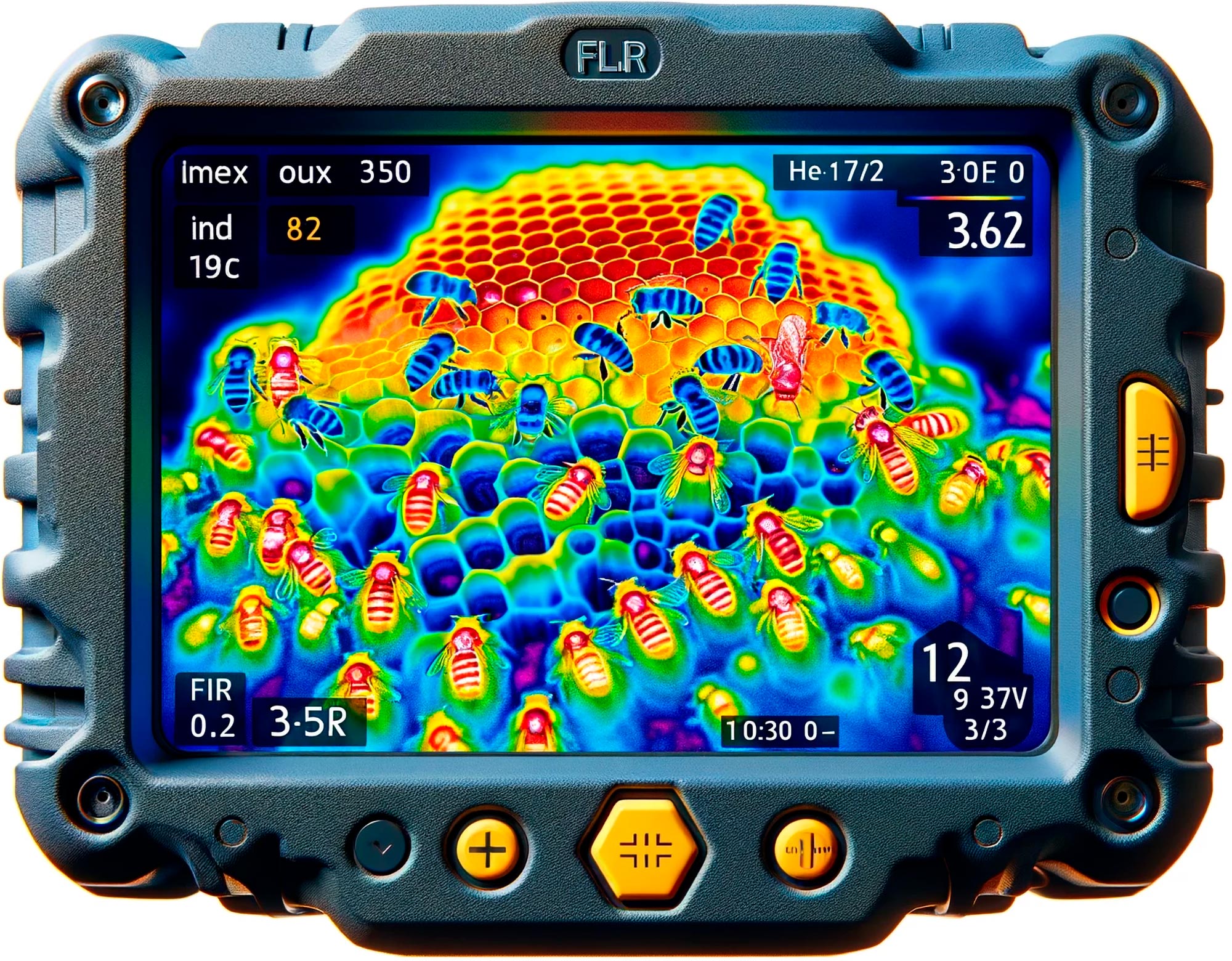
Honeybees do not naturally insulate their colonies against the cold, according to new research by the University of Leeds.
The results of the study carried out by Derek Mitchell, a PhD student at the University of Leeds’ School of Mechanical Engineering, suggest that the creatures are potentially being subjected to thermally induced stress which may mean that beekeepers have to change their practices.
Challenging Traditional Beekeeping Theories
He is calling for further debate on the ethical treatment of insects, saying his research appears to contradict the widely accepted theory that the bees’ reaction to cold temperatures is to form layers of insulation – an idea that has led to them being housed in hives that are extremely poorly insulated compared to their natural habitat.
The study, which is published in the Journal of the Royal Society Interface, looks at honeybee “clusters” — where the insects huddle together, forming dense disks between the combs, to try to keep some of them above 18°C when the outside temperature drops. For almost 120 years, the outer layer of honeybees in the winter cluster – known as the mantle — has been said to insulate the cluster core – the honeybees at the center.
“My findings are controversial because it has become a tenet of beekeeping — that the mantle insulates the honeybees.”
Derek Mitchell, PhD student in the School of Mechanical Engineering
Adopting the same techniques used for measuring heat loss from buildings, Mr. Mitchell analyzed this theory. However, his findings indicate that far from acting as insulation, the mantle instead acts like a heat sink – dissipating the heat away from the center. The paper states: “The cluster mantle does not meet any the four insulation criteria identified and meets all three heat sink criteria.”
The research shows that once the outside temperature falls, the heat needed to sustain 18°C+ inside the hive goes up. If the bees cannot produce that much heat, the temperature near the hive wall drops, and the honeybees near it become chilled and they move closer to bees that can still efficiently produce heat. They get closer together and their combined thermal conductivity increases, which further increases the heat loss.
Mr. Mitchell said: “My findings are controversial because it has become a tenet of beekeeping — that the mantle insulates the honeybees.
“This new research indicates that rather than being benign, clustering is a survival behavior in response to an existential threat — resulting in increased stress due to cold and exertion. Some honeybees may even eat their own young to survive.”
He added: “In anthropomorphic terms, clustering is not a “wrapping of a thick blanket” to keep warm — but more like a desperate struggle to crowd closer to the “fire” or otherwise die.”
Raising Awareness
He said: “I want to share my research, to raise awareness of the welfare issues and to help educate beekeepers about the complex interaction of the colony enclosure and thermofluids — heat, radiation, water vapor, air — with honeybee behavior and physiology.”
Harvey M. Thompson, Professor of Computational Fluid Dynamics at the University of Leeds, who supervised the new research, said: “It’s great to see how mechanical engineering can be applied to such a variety of fields and how these findings can potentially be used to help beekeepers in the future.”
Mr. Mitchell’s research came about when his wife took up beekeeping and he noticed that people still used hives designed in the 1930s and 1940s.
He said: “The hives beekeepers used were at odds with what I knew about heat transfer and what beekeepers had told me about honeybees. I thought I could build better hives, so started out trying to find the requirements of the honeybees and found out that nobody knew in terms that made engineering sense.”
Heat Loss
After studying mechanical engineering as a student apprentice, he returned to the subject as a PhD student. Using engineering techniques more commonly used to solve industrial problems, his previous research suggested that most manufactured hives have seven times more heat loss than natural nests.
Mr. Mitchell, who also has a Physics BSc, Microelectronics MSc and worked in spacecraft ground control software, said he believed misconceptions around clustering had, in part, arisen because the creatures’ overwintering behavior was dominated by observations in thin (19mm) wooden hives, with very different thermal properties to their natural habitat of thick-walled (150mm) tree hollows.
He said those long-held beliefs have encouraged enforced clustering, by beekeepers’ dominant use of what he labels “inadequately insulated hives” and, in North America, refrigeration. This is often seen as a benign or even a necessary process, with beekeeping and academic research considering these conditions of extreme heat loss as natural and normal.
He is calling for changes in practice to be urgently considered, researched, and promoted, as well as further debate on the ethical treatment of honeybees and insects.
Reference: “Honeybee cluster—not insulation but stressful heat sink” by Derek Mitchell, 21 November 2023, Journal of the Royal Society Interface.
DOI: 10.1098/rsif.2023.0488
Never miss a breakthrough: Join the SciTechDaily newsletter.
Follow us on Google and Google News.
3 Comments
Another scientist comparing the insulation value of a dry 19mm thick wood box to a living and water saturated 150mm thick tree. Yes, 19mm is less than 150mm but the insulation of dry lumber (about R-1) per inch, drops to near zero when that wood is past the fiber saturation point and all the resin canals or pores are filled with water.
An insulated ceiling (and walls) varnished with adequate propolis allows bees to control where and when they either require moisture or desire to remove some within the hive.
Sure, honey bees do live in tree hollows, but they also choose to set up home in all sorts of places – caves, chimneys, and yes, empty bee hives! Many swarms choose to live in a thin-walled wooden box left out by a beekeeper. What’s more, many of these ‘poor creatures’ in wooden hives produce loads of honey and stay put, rather than leave at the first opportunity to find a nice tree hollow. The beekeeper can’t force them to stay in the box – they can fly off whenever they want.