
Close Menu
    Facebook X (Twitter) Instagram
    SciTechDaily
    • Biology
    • Chemistry
    • Earth
    • Health
    • Physics
    • Science
    • Space
    • Technology
    Facebook X (Twitter) Pinterest YouTube RSS
    SciTechDaily
    Home»Health»Best Materials for Homemade Coronavirus Face Masks – Performance Close to N95
    Health

    Best Materials for Homemade Coronavirus Face Masks – Performance Close to N95

    By American Chemical SocietyApril 24, 20203 Comments3 Mins Read
    Facebook Twitter Pinterest Telegram LinkedIn WhatsApp Email Reddit
    Share
    Facebook Twitter LinkedIn Pinterest Telegram Email Reddit
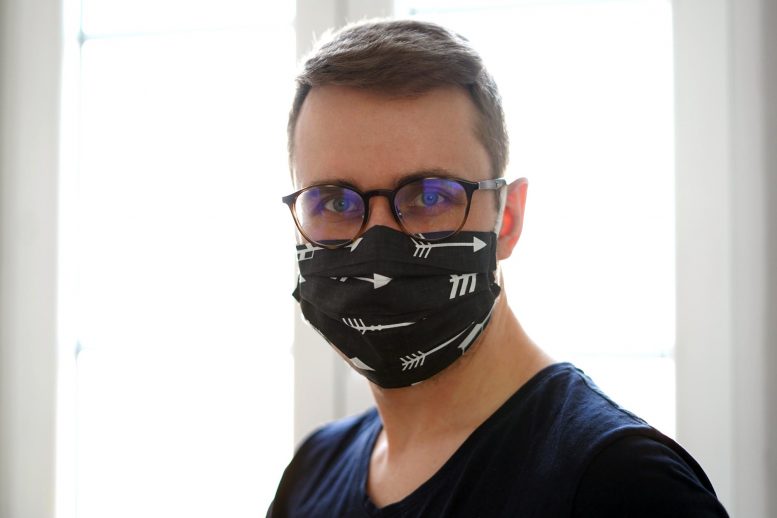
    Homemade Coronavirus Face Mask
    A combination of cotton with natural silk or chiffon can effectively filter out aerosol particles in homemade masks — if the fit is good.

    In the wake of the COVID-19 pandemic, the U.S. Centers for Disease Control and Prevention recommends that people wear masks in public. Because N95 and surgical masks are scarce and should be reserved for health care workers, many people are making their own coverings. Now, researchers report in ACS Nano that a combination of cotton with natural silk or chiffon can effectively filter out aerosol particles — if the fit is good.

    SARS-CoV-2, the new coronavirus that causes COVID-19, is thought to spread mainly through respiratory droplets when an infected person coughs, sneezes, speaks, or breathes. These droplets form in a wide range of sizes, but the tiniest ones, called aerosols, can easily slip through the openings between certain cloth fibers, leading some people to question whether cloth masks can actually help prevent disease. Therefore, Supratik Guha at the University of Chicago and colleagues wanted to study the ability of common fabrics, alone or in combination, to filter out aerosols similar in size to respiratory droplets.

    The researchers used an aerosol mixing chamber to produce particles ranging from 10 nm to 6 μm in diameter. A fan blew the aerosol across various cloth samples at an airflow rate corresponding to a person’s respiration at rest, and the team measured the number and size of particles in the air before and after passing through the fabric.

    One layer of a tightly woven cotton sheet combined with two layers of polyester-spandex chiffon — a sheer fabric often used in evening gowns — filtered out the most aerosol particles (80-99%, depending on particle size), with performance close to that of an N95 mask material. Substituting the chiffon with natural silk or flannel, or simply using a cotton quilt with cotton-polyester batting, produced similar results.

    The researchers point out that tightly woven fabrics, such as cotton, can act as a mechanical barrier to particles, whereas fabrics that hold a static charge, like certain types of chiffon and natural silk, serve as an electrostatic barrier. However, a 1% gap reduced the filtering efficiency of all masks by half or more, emphasizing the importance of a properly fitted mask.

    Reference: “Aerosol Filtration Efficiency of Common Fabrics Used in Respiratory Cloth Masks” by Abhiteja Konda, Abhinav Prakash, Gregory A. Moss, Michael Schmoldt, Gregory D. Grant and Supratik Guha, 24 April 2020, ACS Nano.
    DOI: 10.1021/acsnano.0c03252

    The authors acknowledge use of the U.S. Department of Energy’s Center for Nanoscale Materials user facility at Argonne National Laboratory and funding from the U.S. Department of Defense’s Vannevar Bush Fellowship.

    Never miss a breakthrough: Join the SciTechDaily newsletter.
    Follow us on Google and Google News.

    American Chemical Society COVID-19 Popular Public Health
    Share. Facebook Twitter Pinterest LinkedIn Email Reddit

    Related Articles

    Increased Infectivity Drives COVID Evolution – Mutations That Allow the Virus To Escape Vaccines Become Dominant

    Synthetic Peptide Mimics: Possible New Antivirals Against COVID-19 and Herpes

    Ending the COVID-19 Pandemic: Progress Toward One Drug To Treat All Coronaviruses

    The Latest in the Scientific Race to Develop an Effective COVID-19 Vaccine

    Not Sure if You’ve Already Had Coronavirus? This Test Might Tell You (Video)

    Researchers Develop a Replaceable, More Efficient Filter for N95 Masks

    How Effective Are Cloth Masks Against Coronavirus? [Video]

    New COVID-19 Test Accurately Detects Viral DNA in Minutes

    Where Are We on a Coronavirus Vaccine: And What’s Next? [Video]

    3 Comments

    1. Katharine Birkett on April 27, 2020 4:54 pm

      Glad to see the importance of fit highlighted. I’ve been concerned about this “missing link” in mask design as well. My mask design seals, and I’d love to see it tested. I’ve fitted nurses and myself and my hard-to-fit husband. The mask is seamless and pinless. Extended sizes soon being released. https://www.youtube.com/watch?v=CF9PCfF0HME&t=954s

      Reply
    2. Katharine Birkett on April 27, 2020 5:50 pm

      You may be interested in this effort as well, if you haven’t seen it:
      https://makermask.org/masks/fit/

      Reply
    3. Katharine Birkett on May 5, 2020 8:52 am

      To fit everyone, a range of sizes is needed, up to Men’s Extra Extra Long.

      I’ve released a free pattern with all sizes, a PDF tutorial, and a companion video.

      https://drive.google.com/open?id=1VlfAijzllWGdgnAp9Q3T7lMh2022tvSF
      https://www.youtube.com/watch?v=Z08YRpoz03E
      https://drive.google.com/open?id=1OytyYbsEl4jImLEBwx-sF0RZDGuyJBc6
      https://www.youtube.com/watch?v=CF9PCfF0HME

      Reply
    Leave A Reply Cancel Reply

    • Facebook
    • Twitter
    • Pinterest
    • YouTube

    Don't Miss a Discovery

    Subscribe for the Latest in Science & Tech!

    Trending News

    Scientists Just Discovered a Hidden Freshwater World Beneath the Great Salt Lake

    Why Your Daily Shower Could Be Worsening the Water Crisis

    Scientists Discover New “Magic Mushroom” Species That Rewrites Evolutionary History

    Mystery Deepens: Astrophysicists Say Dark Matter May Not Be One Thing

    Your BMI Might Be Wrong: Study Finds Millions Are Misclassified

    A Simple Blood Test Could Predict Dementia Risk 25 Years Early

    3.5-Billion-Year-Old Rocks Rewrite the Story of Plate Tectonics

    Why Aging Lungs Turn Mild Infections Into Life-Threatening Illness

    Follow SciTechDaily
    • Facebook
    • Twitter
    • YouTube
    • Pinterest
    • Newsletter
    • RSS
    SciTech News
    • Biology News
    • Chemistry News
    • Earth News
    • Health News
    • Physics News
    • Science News
    • Space News
    • Technology News
    Recent Posts
    • This Alga Rewrites the Rules of Photosynthesis To Survive in the Dark
    • Are Humans Naturally Violent? Scientists Challenge Long-Held Assumptions
    • Scientists Say This Popular Food Could Help Your Body Get Rid of Microplastics
    • Scientists Build Five-in-One “Super Molecule” for Next-Gen Electronics
    • Physicists Discover Magnetic Mechanism That Challenges a 300-Year-Old Law of Friction
    Copyright © 1998 - 2026 SciTechDaily. All Rights Reserved.
    • Science News
    • About
    • Contact
    • Editorial Board
    • Privacy Policy
    • Terms of Use

    Type above and press Enter to search. Press Esc to cancel.