

University of Wyoming researchers have developed a new method to control magnetic states in 2D materials, promising revolutionary advancements in computing technology and energy efficiency.
Imagine a future where computers can learn and make decisions in ways that mimic human thinking, but at a speed and efficiency that are orders of magnitude greater than the current capability of computers.
Breakthrough in Magnetic Control
A research team at the University of Wyoming created an innovative method to control tiny magnetic states within ultrathin, two-dimensional (2D) van der Waals magnets — a process akin to how flipping a light switch controls a bulb.
“Our discovery could lead to advanced memory devices that store more data and consume less power or enable the development of entirely new types of computers that can quickly solve problems that are currently intractable,” says Jifa Tian, an assistant professor in the UW Department of Physics and Astronomy and interim director of UW’s Center for Quantum Information Science and Engineering.
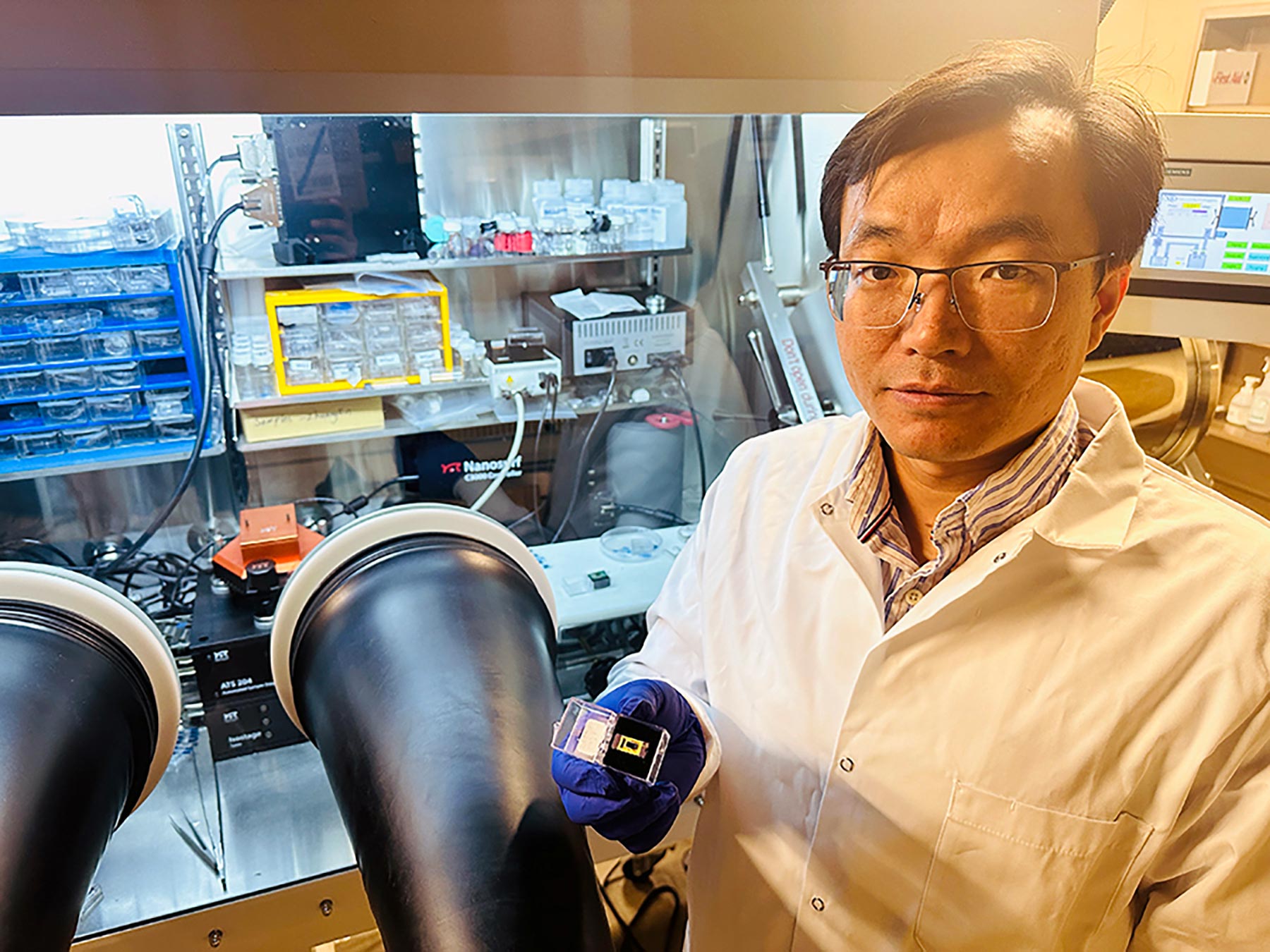
Tian was corresponding author of a paper, titled “Tunneling current-controlled spin states in few-layer van der Waals magnets,” which was published on May 1 in Nature Communications, an open access, multidisciplinary journal dedicated to publishing high-quality research in all areas of the biological, health, physical, chemical, Earth, social, mathematical, applied and engineering sciences.
Understanding van der Waals Materials
Van der Waals materials are made up of strongly bonded 2D layers that are bound in the third dimension through weaker van der Waals forces. For example, graphite is a van der Waals material that is broadly used in industry in electrodes, lubricants, fibers, heat exchangers, and batteries. The nature of the van der Waals forces between layers allows researchers to use Scotch tape to peel the layers into atomic thickness.
The team developed a device known as a magnetic tunnel junction, which uses chromium triiodide — a 2D insulating magnet only a few atoms thick — sandwiched between two layers of graphene. By sending a tiny electric current —called a tunneling current — through this sandwich, the direction of the magnet’s orientation of the magnetic domains (around 100 nanometers in size) can be dictated within the individual chromium triiodide layers, Tian says.
Advancements in Magnetic Spin Control
Specifically, “this tunneling current not only can control the switching direction between two stable spin states, but also induces and manipulates switching between metastable spin states, called stochastic switching,” says ZhuangEn Fu, a graduate student in Tian’s research lab and now a postdoctoral fellow at the University of Maryland.
“This breakthrough is not just intriguing; it’s highly practical. It consumes three orders of magnitude smaller energy than traditional methods, akin to swapping an old lightbulb for an LED, marking it a potential game-changer for future technology,” Tian says. “Our research could lead to the development of novel computing devices that are faster, smaller, and more energy-efficient and powerful than ever before. Our research marks a significant advancement in magnetism at the 2D limit and sets the stage for new, powerful computing platforms, such as probabilistic computers.”
Development of Probabilistic Computers
Traditional computers use bits to store information as 0’s and 1’s. This binary code is the foundation of all classic computing processes. Quantum computers use quantum bits that can represent both “0” and “1” at the same time, increasing processing power exponentially.
“In our work, we’ve developed what you might think of as a probabilistic bit, which can switch between ‘0’ and ‘1’ (two spin states) based on the tunneling current controlled probabilities,” Tian says. “These bits are based on the unique properties of ultrathin 2D magnets and can be linked together in a way that is similar to neurons in the brain to form a new kind of computer, known as a probabilistic computer.
Revolutionizing Computing With New Technologies
“What makes these new computers potentially revolutionary is their ability to handle tasks that are incredibly challenging for traditional and even quantum computers, such as certain types of complex machine learning tasks and data processing problems,” Tian continues. “They are naturally tolerant to errors, simple in design and take up less space, which could lead to more efficient and powerful computing technologies.”
Reference: “Tunneling current-controlled spin states in few-layer van der Waals magnets” by ZhuangEn Fu, Piumi I. Samarawickrama, John Ackerman, Yanglin Zhu, Zhiqiang Mao, Kenji Watanabe, Takashi Taniguchi, Wenyong Wang, Yuri Dahnovsky, Mingzhong Wu, TeYu Chien, Jinke Tang, Allan H. MacDonald, Hua Chen and Jifa Tian, 1 May 2024, Nature Communications.
DOI: 10.1038/s41467-024-47820-5
Hua Chen, an associate professor of physics at Colorado State University, and Allan MacDonald, a professor of physics at the University of Texas-Austin, collaborated to develop a theoretical model that elucidates how tunneling currents influence spin states in the 2D magnetic tunnel junctions. Other contributors were from Penn State University, Northeastern University and the National Institute for Materials Science in Namiki, Tsukuba, Japan.
The study was funded through grants from the U.S. Department of Energy; Wyoming NASA EPSCoR (Established Program to Stimulate Competitive Research); the National Science Foundation; and the World Premier International Research Center Initiative and the Ministry of Education, Culture, Sports, Science and Technology, both in Japan.
Never miss a breakthrough: Join the SciTechDaily newsletter.
Follow us on Google and Google News.