
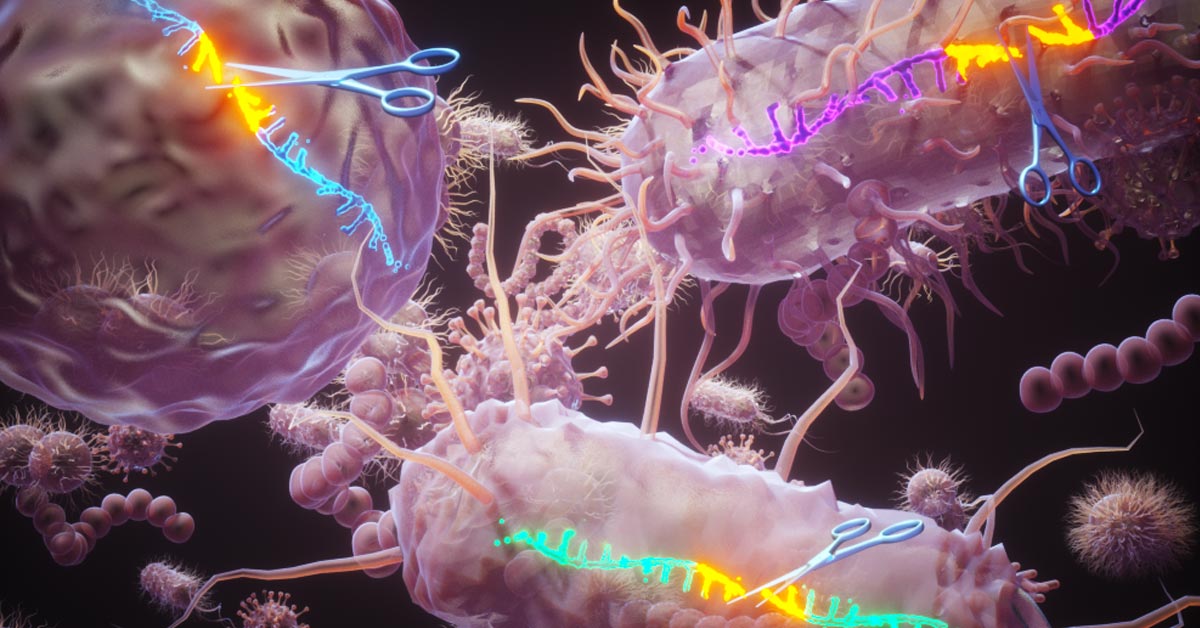
An INRS research team has identified a new family of enzymes that can make precise cuts in single-stranded DNA.
A few years ago, the introduction of CRISPR technology marked a significant breakthrough in the scientific community. Derived from a component of the bacterial immune system, CRISPR enables precise cuts in double-stranded DNA, allowing scientists to modify specific genes in plants, animals, and humans. This precision has made CRISPR a leading tool in the development of treatments for both inherited and acquired diseases.
More recently, Professor Frédéric Veyrier and his team at the Institut national de la recherche scientifique (INRS) have developed a new genetic tool based on a family of enzymes known as Ssn. Unlike CRISPR, this tool targets and cuts only single-stranded DNA, offering a new level of specificity in genetic editing.
The results of their work were recently published in the journal Nature Communications. This major breakthrough sheds light on a crucial genetic mechanism that could revolutionize a multitude of biotechnology applications.
A form of DNA with a key role
Single-stranded DNA is less common than double-stranded DNA. It is often found in some viruses and plays a key role in certain biological processes, such as cell replication or repair. Single-stranded DNA is also used in many technologies (sequencing, gene editing, molecular diagnostics, nanotechnology).
To date, no endonuclease – enzyme that cuts DNA – has been described as exclusively targeting a single-stranded DNA sequence, which has constituted a barrier to the development of technologies based on this type of DNA.
Now, for the first time in a laboratory, Professor Veyrier’s team has identified a family of enzymes capable of cutting a specific sequence in single-stranded DNA: the family of Ssn endonucleases.
To achieve this, the research team at INRS’s Armand-Frappier Santé Biotechnologie Research Centre first characterized a new family of endonucleases part of the GIY-YIG superfamily called Ssn. More specifically, researchers focused on one of these enzymes in the bacterium Neisseria meningitidis, also known as the meningococcus. The enzyme targeted in the study is crucial to the exchange and alteration of genetic material, which influences evolution.
“In studying it, we found that it recognizes a specific sequence that is found in many instances in its genome and plays a key role in the natural transformation of the bacterium. This interaction directly influences the dynamics of the bacterial genome,” explains Professor Veyrier, a specialist in genomic bacteriology and evolution.
In addition to this fundamental discovery, INRS’s research scientists identified thousands of other similar enzymes. “We demonstrated that they are able to recognize and specifically cut their own single-stranded DNA sequence. Thousands of enzymes therefore have this property with their own specificity,” adds Alex Rivera-Millot, a postdoctoral fellow on Professor Veyrier’s team and co-first author of the study.
An undeniable asset for health research
These results, which represent a new tool for DNA recognition and exchange, are significant. They pave the way to many novel applications in biology and medicine. On the one hand, understanding this mechanism could help better control the bacteria in question and the associated infections.
On the other, the discovery of enzymes specific to single-stranded DNA makes it possible to develop more precise and efficient genetic manipulation tools. This could namely improve methods of gene editing, DNA detection, and molecular diagnosis. These enzymes could also be used to detect and manipulate DNA in various medical and industrial applications, such as pathogen detection or genetic manipulation for medical and therapeutic purposes.
All of these avenues hold significant promise for addressing many health issues. Currently, there is a patent pending for the results of this work.
Reference: “Discovery of the widespread site-specific single-stranded nuclease family Ssn” by Martin Chenal, Alex Rivera-Millot, Luke B. Harrison, Ahmed S. Khairalla, Cecilia Nieves, Ève Bernet, Mansoore Esmaili, Manel Belkhir, Jonathan Perreault and Frédéric J. Veyrier, 10 March 2025, Nature Communications.
DOI: 10.1038/s41467-025-57514-1
This work was funded by the Natural Sciences and Engineering Research Council of Canada (NSERC), the Canadian Institutes of Health Research (CIHR) and the Fonds de recherche du Québec – Santé (FRQS).
Never miss a breakthrough: Join the SciTechDaily newsletter.
Follow us on Google and Google News.
5 Comments
Some very clever people ( scientist’s) out there !
Transhumanism in the name of health science, which it is not. HACKING THE GENETIC CODE for financial benefit with no regard to permanently altering, harming the Human Genome. Where’s the worn adage “to cure cancer” the justification for every bizarre experiment.
Truly we are living in the last days of time. There is an angel who has an appointment and that appointment is to announce,
“TIME SHALL BE NO MORE”
God is real and He is in charge of Hus creation. You are rushing full speed ahed to the return of Jesus.
How effective gene editing on thalassemia
This story is from 2019.