

Some birds with large ranges or big brains may be more vulnerable to climate change than expected due to their specialization in narrow climate niches, according to a new UT Austin study.
Biologists have long sought to understand why certain plants and animals can adapt to a wide range of climates, while others remain limited to specific environmental conditions. Gaining insight into this could help conservationists and policymakers better assess which species are most at risk from climate change.
A recent study published in Nature Communications by researchers from The University of Texas at Austin sheds new light on this issue. By analyzing global distribution maps and environmental data for approximately 1,500 bird species, the researchers uncovered some unexpected findings. Notably, they discovered that even species with large geographic ranges may be confined to relatively narrow climate zones. This means these species could be more sensitive to climate change than previously assumed.
A case in point is the Arctic. Although it spans a significant portion of the Earth’s surface, its climate is remarkably uniform.
“Because that region is so big, species that occupy it tend to have large populations and large geographic range sizes—two characteristics that are often associated with lower extinction risks,” said Carlos Botero, an associate professor of integrative biology and senior author of the new study. “The problem here is that because many of those species are adapted to a very narrow range of climates, those seemingly large populations can be quite susceptible to collapse when climate patterns begin to change.”
Comparing Climate Niches Between Species
For example, the breeding range for the Bohemian waxwing, a bird well known to North American and European birders, extends over a large swath of the Arctic, while the chestnut-crowned laughingthrush inhabits a much smaller arc in Asia centered on Nepal and Bhutan. Yet the waxwing inhabits a much smaller and more extreme range of climate conditions than the laughingthrush, suggesting the waxwing may be at greater risk from climate change than previously thought.
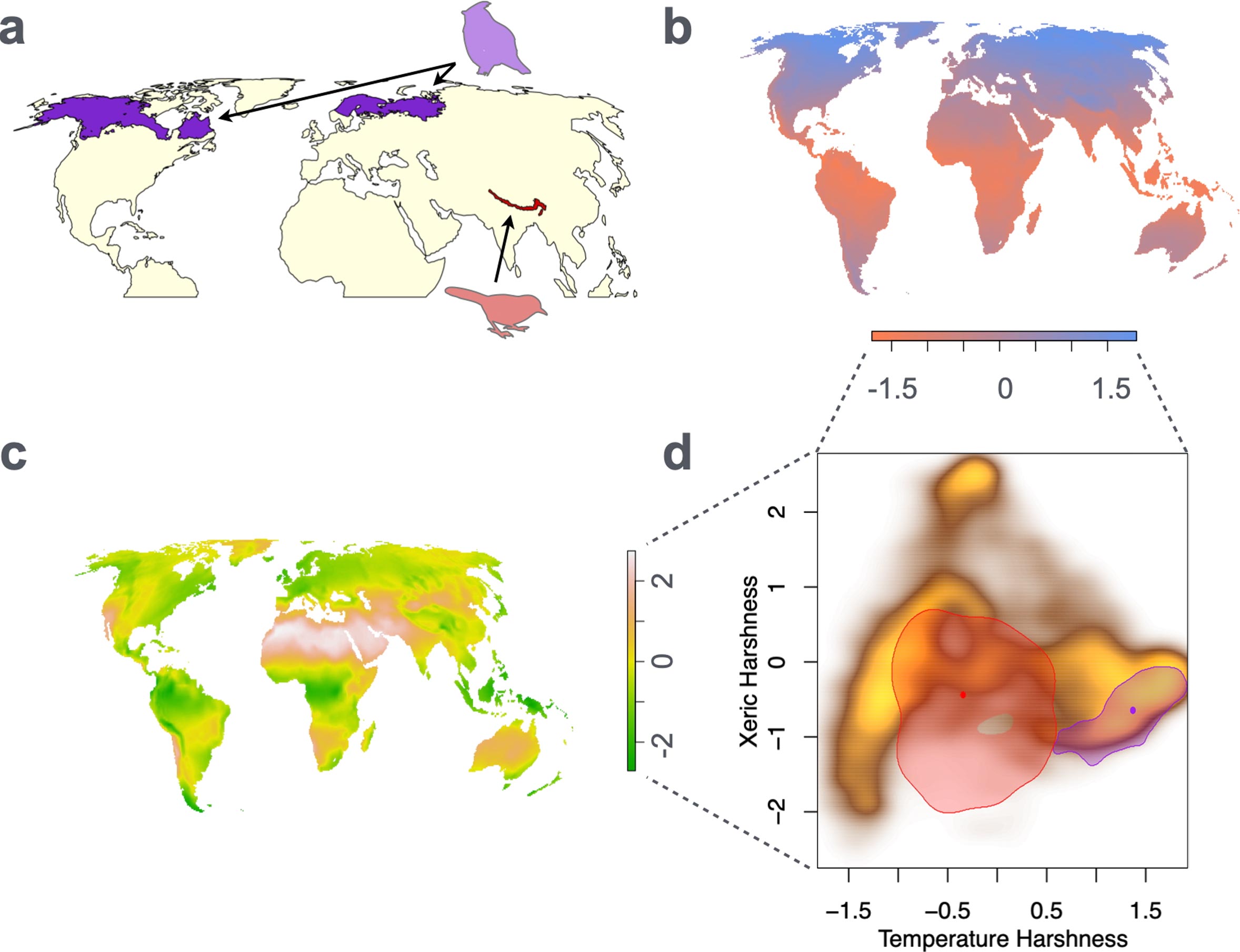
The researchers also found that species with larger brains (relative to their body size) tend to be adapted to narrow climate niches, which suggests they could also be more vulnerable to climate change than previously thought. A climate niche is the range of different climate conditions (think temperature, precipitation, and how predictably these two vary over time) that a species can thrive in.
“Larger brain sizes correlate with more flexible behavior, so big-brained birds are usually expected to be more adaptable,” Botero said. “However, it turns out that many big-brained birds are climate specialists—meaning that they have evolved to thrive in very particular climate types and may therefore also be more vulnerable to climate change than we expected.”
Leveraging Citizen Science for Global Data
Botero carried out the study with corresponding author and former UT postdoctoral researcher João Fabrício Mota Rodrigues.
For this study, Rodrigues and Botero used avian range maps estimated from hundreds of thousands of direct observations by citizen scientists reported through eBird. This successful partnership between birdwatchers and scientists is providing highly accurate representations of where different species occur in space and is enabling scientists to answer questions that were simply impossible to address before.
The research team also created a system for describing all the climate types found on Earth in terms of two factors: “temperature harshness,” a value that increases with colder, more variable, and less predictable temperatures—and “xeric harshness,” which increases with lower, more variable, and less predictable precipitation.
Mapping Earth’s Climate “Space”
Then they created a 2D “climate space” map that shows how much of Earth’s land surface corresponds to each possible combination of these two factors. Places that are less harsh in temperature and precipitation are near the center, while places that are harsher in one or both factors are farther out.
Finally, for each species, they mapped the range of climates that species tends to occupy onto the climate space map to see where and how large their climate niche is. Birds with a smaller and more extreme climate niche tend to be at higher risk from climate change.
Botero said this study highlights why the usual way of assessing risk for a species, which typically involves a checklist of individual factors, misses the complexity of underlying patterns and contradictions.
“We need to stop looking at individual risk factors in isolation, but evaluate how these complex factors combine,” Botero said. “Sometimes, it is the unexpected interactions that matter most.”
Reference: “The global determinants of climate niche breadth in birds” by João Fabrício Mota Rodrigues, and Carlos A. Botero, 17 April 2025, Nature Communications.
DOI: 10.1038/s41467-025-58815-1
This research was made possible by support from the National Science Foundation.
Never miss a breakthrough: Join the SciTechDaily newsletter.
Follow us on Google and Google News.